Higher Education in India at a crossroads: Leaders call for urgent curriculum overhaul
The experts were speaking at the ‘BW Businessworld Higher Education Summit - Moulding Higher Education in the AI Era - Improving Access and Quality’ in Bengaluru
 by
by
Published: May 19, 2025 3:51 PM | 11 min read
 Follow Us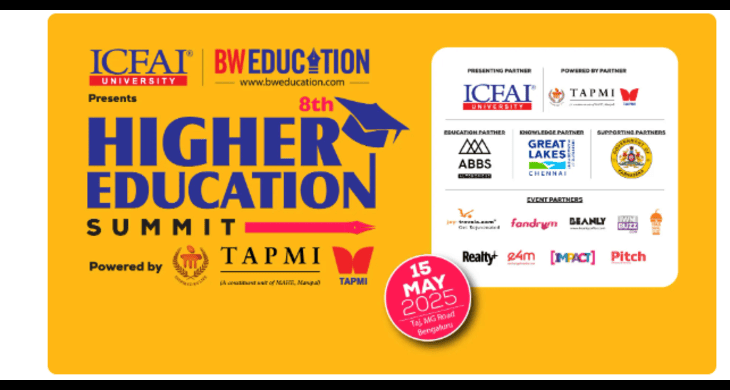

The period when knowledge taught becomes redundant has now shrunk from 15 months to five months. “The rapid obsolescence creates a fundamental challenge for curriculum development and teaching methodologies,” pointed out Dr Mrs Pankaj Mittal, Secretary General, Association of Indian Universities. She was delivering her key keynote address at the BW Businessworld Higher Education Summit - Moulding Higher Education in the AI Era - Improving Access and Quality’ in Bengaluru.
She highlighted several innovative features of the National Education Policy (NEP), especially the Academic Bank of Credits (ABC), and its immense potential. The system allows students to accumulate credits from different institutions and customise their degrees based on their learning journey.
However, despite the policy's potential, implementation remains a challenge, she pointed out.
Dr Mittal urged educators to view AI as an opportunity rather than a threat. "AI is totally changing the landscape of higher education. But it is for our students as well as teachers to learn how to use AI to their advantage, to their learning," she acknowledges.
Capacity Building Measures
In his keynote Address, Prof SR Niranjana, Vice Chairman, Karnataka State Council for Higher Education, emphasised that for India's aspiration to become a developed nation by 2047 — the centenary of its independence — education will be pivotal. “Economic growth, sustainable education, social progressiveness and e-governance are very important for Viksit Bharat,” he said.
He emphasised the need for internationalisation of education and skill development, highlighted initiatives being taken at the state level to enhance the quality of higher education, with particular emphasis on internationalisation.
Among the measures towards internationalisation are an MoU that Karnataka has signed with the British Council for language proficiency, as well as establishment of international cells in the public universities.
A key focus of Karnataka's reforms is embedding skills training within traditional degree programmes. Professor Niranjana informed that the state government is introducing the skill courses in nine universities.
Integration Of AI
The integration of AI in education has triggered both excitement and anxiety among educators. Prof (Dr) R Harish, Deputy Director, ICFAI Business School (IBS), Bengaluru, described some of the challenges that AI has brought about, especially the excessive reliance on AI among students. They seek all answers from AI. Therefore, the role of teachers must evolve too. Prof Harish suggested that rather than becoming obsolete, educators must become guides who help students navigate the AI landscape.
"What is important is for the faculty members as facilitators to guide the students. Don't look for solutions, look for the route,” he said.
Dr Mittal, Prof Niranjana and Dr Harish spoke at the BW Businessworld Higher Education Summit - Moulding Higher Education in the AI Era - Improving Access and Quality in Bengaluru
Transformations In Higher Education
As artificial intelligence and digital technology continue to reshape our world, a group of education leaders from top business schools came together to talk about what this means for higher education and for students preparing to step into the future workplace. They were sharing their thoughts on the theme ‘Reinventing Higher Education for a Hyper-digital and AI-driven World’ at the BW Education Summit.
Rishikesha D Krishnan, Director, IIM Bangalore, kicked off the conversation by pointing out that AI is becoming a big part of how work gets done. He stressed that while knowing your core subject is still important, students also need to learn how to work alongside AI tools from day one. But he also warned that education is more than just getting answers quickly. “Learning is about thinking critically and being creative,” he said. “AI can’t replace those uniquely human skills.”
Dr Manisha Singh, Dean - Academics and Academic Coordinator, ICFAI Business School, Bengaluru, shared the struggles of teachers trying to keep pace with rapidly changing tech. With so many demands on their time, from research to teaching to industry projects, faculty find it hard to constantly update their skills. She suggested that partnerships between schools and companies, along with more opportunities for teachers to take sabbaticals and learn new skills, could help bridge this gap.
Ajitesh Basani, Executive Director, Acharya Bangalore Business School, talked about how his school is experimenting with different ways to teach and support faculty. By focusing on each teacher’s strengths, whether in research or classroom work, they are trying to create an environment where both staff and students can thrive.
Dr Debasis Sanyal, Director, Great Lakes Institute of Management, Chennai, brought up an important point about fairness. “Millions of people in routine jobs need to learn new skills as AI changes the workplace,” he said. But not everyone has easy access to the internet or technology. He stressed that governments and institutions need to work together to make sure everyone can benefit from these new opportunities.
Dr Gururaj Kidiyoor, Dean - Academics, TA Pai Management Institute, Manipal, highlighted that teachers are key to helping students think creatively and critically — skills that AI cannot replicate. He said institutions need to rethink how they train and support their faculty so they can keep up with fast-changing tech.
The AI Dilemma For Students And Teachers
The integration of artificial intelligence (AI), big data, and disruptive technologies in higher education raises significant ethical dilemmas. These include concerns about data privacy, bias in AI-driven decision-making and the potential displacement of human teachers. During the panel discussion on ‘Navigating Ethical Dilemmas in the Age of AI, Big Data and Disruptive Technologies’, these aspects were discussed.
Prof R Janardhan, Pro Vice Chancellor, Dayanand Sagar University, made it clear that technology is there to benefit and gain and make somebody's life comfortable. “We need to take advantage to deliver faster and cheaper in this competitive world,” he said.
Dr Sagar Gulati, Director, Jain University, highlighted, “As educators we emphasise whether a project is completed through AI or human intelligence. We give the liberty to students to complete the project with the help of AI. However, if an outcome is created through generative AI tools and the students are able to explain it, the job is done.”
The landscape is changing and we should be open to the use of AI as long as the end outcome of the teaching learning process is attained, added Gulati.
Prof BD Kumbar, Vice Chancellor, Devangere University, highlighted the importance of training the faculty to identify the unethical use of AI. “It is the responsibility of the higher education institutions to help and train the students also about the right use of AI. Such types of dilemmas are common on the part of students and faculty.”
Teachers must be trained about the use of AI in the classroom including the research and innovation activities. The use of AI while grading can be disastrous to the students. We need to assess whether AI is improving our thinking capacity and not letting creativity diminished, Prof Kumbar added.
MBA Education Must Evolve For Digital, Uncertain World
Business schools need to fundamentally redesign MBA programmes to reflect rapid technological change, shifting job roles and global unpredictability, a panel of senior academics said on Thursday.
Speaking at a panel discussion ‘Rethinking MBA Education in the Era of Digital Transformation and Global Uncertainty’, experts pointed to the growing influence of artificial intelligence (AI), automation and economic volatility and called for stronger industry integration, flexible learning models and a renewed focus on ethics and leadership.
“We can no longer teach business the way we did a decade ago,” said Dr (Lt Col) Prasad SN, Director, SDMIMD. “Today’s MBA must be tech-savvy, ethically grounded and globally minded. The goal is not just management education but transformational leadership.”
Dr SK Prasad, Dean, Srinivas University, said MBA curricula must reflect a world where machines are taking on increasingly complex tasks. “AI and automation are redefining workplace roles,” he said. “We must prepare students to work with machines, not compete with them.”
Prof Tuhin S Banerjee, Deputy Director, MineRVa, RV Centre for Leadership and Executive Education, said that institutions should place greater emphasis on applied and interdisciplinary learning. “We are witnessing a paradigm shift from knowledge acquisition to capability building,” he said. “MBA programmes must simulate real-world problem-solving, crisis leadership and agility.”
Dr Narayani Ramachandran, Director, NMIMS Bangalore, said technology must be used to broaden access, not deepen existing inequalities. “Digital transformation should be a leveller, not a divider,” she said. “We are integrating remote learning tools, AI-driven assessments and personalised learning paths to improve both quality and access.”
Dr Sridevi, Director, IFIM College, argued that stronger collaboration with the private sector was vital. “Our partnerships with industry are not optional anymore; they’re core to the curriculum,” she said. “We are embedding live projects, startup incubation and cross-functional bootcamps to develop holistic business leaders.”
Revamping Engineering Education For Deep Tech Era
Preparing the next generation of engineers for a future shaped by deep tech and Industry 5.0 demands a fundamental rethink of academic curricula, infrastructure and industry collaboration. During the panel discussion on ‘Future-proofing Engineering Education: Aligning Academia with Industry 5.0 and Deep Tech Innovation’, experts from academia and industry shared their insights on how education must adapt to meet these challenges and opportunities.
Dr Annapurni Subramaniam, Director and Senior Professor, Indian Institute of Astrophysics, emphasised the transformative potential of deep tech and the role of fundamental science in driving innovation. “Deep tech evolves when there’s a need for precision, freedom and advanced manufacturing — needs often sparked by science,” she said. “Coming from an astrophysics background, I see first-hand how astronomy, though a pure science, is driven by engineering. Advancements like GPS, mobile phone cameras and space programmes become possible due to demands from astronomy that push technology into new frontiers.”
On the question of whether India currently possesses the academic infrastructure and industry-academia collaboration necessary to support such deep tech advancements, Prof KNS Acharya, Pro Vice Chancellor, GITAM University, offered a candid perspective drawn from his industry and academic experience. “In India, we rarely see industry professionals embedded directly in education. But that must change. When a robotics and AI company tells us they can’t find talent, we invite them to set up their R&D inside our campus. They now co-design and co-teach with us and run internships on site. This close collaboration bridges the gap, just like many institutions in the West already do.”
Addressing concerns about the future relevance of traditional engineering branches, Abhay Chebbi, Pro Chancellor, Alliance University, argued that core disciplines remain vital but must evolve. “It’s a misconception that core engineering branches lose relevance. Over time, education evolves from interdisciplinary to trans-disciplinary learning. Core fields like civil, mechanical, electrical and electronics integrate technology — for example, combining computer science and mechanical engineering leads to robotics, while biotech and electronics merge into biosensors and bioinformatics.”
Sanjay R Chitnis, Vice Chancellor, Reva University, discussed ways to spark and sustain student interest in these foundational disciplines. “Students are naturally curious — engineering is all around us and they are interested in how things work. But traditional theory-based exams and classroom teaching often diminish that interest. When exposed to hands-on activities like building drones or robots, their curiosity thrives.”
He stressed the importance of nurturing innovation and problem-solving. “Rather than stifling this curiosity, we foster it by providing the right support and facilities. Student project exhibitions show that this interest is self-driven—students willingly invest time and effort because they are genuinely passionate.”
When asked why breakthrough innovations similar to China’s DeepSeek model do not emerge from India’s institutions, Prof Subramaniam shared, “Innovation of this scale typically happens in industry, not just academic institutions or R&D labs. For example, India’s role in the 30 Meter Telescope project shows how deep-tech innovations need an ecosystem backed by industry, government and academia. Such projects require high investment, infrastructure, and long-term support.”
She added, “Students are eager to work on advanced projects and are willing to go the extra mile. What they need is an ecosystem that encourages ambition and provides opportunities to build cutting-edge technologies.”
Addressing concerns about the emotional intelligence and mental wellbeing of engineering students, Chitnis observed, “Competitive exams create a pressured environment with little time for sports, travel or family interaction. However, with the era of AI levelling the technical playing field, emotional intelligence becomes super important. Now is the time to give students the space to express themselves and nurture these skills, as they become crucial for their future.”
Read more news about Industry Briefing, Internet Advertising, Marketing, PR & Corporate Communication, Television Media
For more updates, be socially connected with us onInstagram, LinkedIn, Twitter, Facebook YouTube & Google News
