Accessible Video Entertainment: Dismantling Myths
Brij Kothari, Adjunct Professor, IIT-Delhi, School of Public Policy, writes on the implications of policies for accessible video entertainment on streaming platforms
 by
by
Published: Apr 7, 2026 10:12 AM | 6 min read
 Follow Us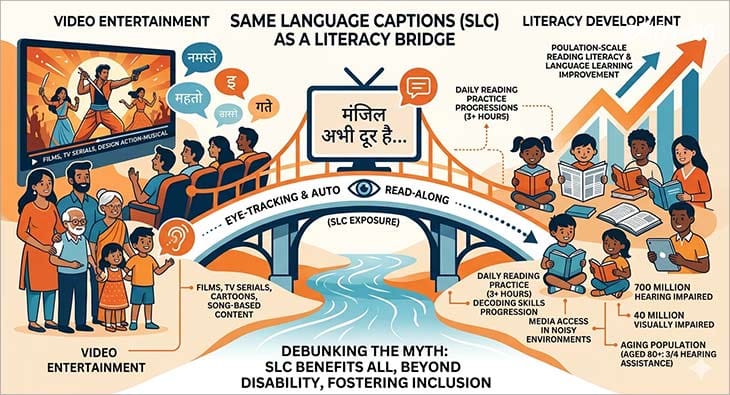

- In March 2023, India’s Central Board of Film Certification (CBFC) mandated that all films submitted for certification must include Same Language Captions (SLC) and Audio Description (AD) to enhance accessibility for the hearing and visually impaired, following a Delhi High Court ruling in the Akshat Baldwa vs. Yash Raj Films case.
- The Ministry of Information & Broadcasting (MIB) introduced the Cinematograph (Certification) Rules (2024), requiring all new films to be made accessible by March 2026, while ongoing court challenges are shaping accessibility policies for streaming platforms and television.
- Common myths surrounding accessibility features include misconceptions about their cost, relevance, and impact, with evidence showing that SLC and AD benefit not only individuals with disabilities but also the aging population and can enhance literacy among viewers.
- The article emphasizes the need for a shift from mere compliance with legal mandates to a commitment to social impact, highlighting the potential of SLC and AD to improve the viewing experience for a broader audience in India.
In March this year, India took a giant leap toward making video entertainment accessible for all. The Central Board of Film Certification (CBFC) mandated that all films submitted for certification must additionally submit Same Language Captions (SLC) for the hearing impaired and Audio Description (AD) files for the visually impaired.
This policy stems directly from a landmark ruling in the Akshat Baldwa vs. Yash Raj Films (2023) case where the Delhi High Court ordered YRF to make Pathaan, its super hit film, accessible. Pathaan is now available on Amazon Prime Video with SLC and AD. Moreover, upon the court’s direction, the Ministry of Information & Broadcasting (MIB) passed the Cinematograph (Certification) Rules (2024), a bold policy mandating that all new films must be born and made accessible from March 2026.
Meanwhile, policies for accessible video entertainment on streaming platforms (OTT) and TV too, continue to crystallize through court challenges that then result in policy formulation. Not surprisingly, this process over the last couple of years has spawned several myths.
Myth 1: Anyone who watches a film in a movie theatre will necessarily have to watch films with subtitles and/or hear the AD soundtrack.
CBFC has mandated the submission of accessibility feature files at the time of certification. This makes sure that accessibility features of the film can be enabled or disabled at any point during its supply, distribution, or viewing process. Architecting choice of accessibility into all content offers customization for individual needs downstream.
For instance, theatre owners can decide which shows to make accessible and with which mix of accessibility features. AD is now possible to deliver on mobile apps during any film screening. The tech to deliver subtitles in viewing glasses too exists in the US and UK. A low tech solution is simply to legally require a certain number of accessible shows (in every time band). Beyond theatres, most films have a long tail on OTTs, TV or YouTube where the accessibility features can be a welcome addition for all.
Myth 2: SLS and AD are costly to implement.
The typical cost of producing a commercial feature film in India is around INR 50 Crores. Creating quality SLC costs half a lakh, and with AD, the total is 2 lakhs or just 0.0004 percent of the production cost. With a combination of AI and human expertise, cost is no longer a barrier and will continue to fall. The hurdle for systemwide SLC and AD implementation in the entertainment industry is intent in the C-Suite and that will come with a deeper consideration of its societal and even business potential.
Myth 3: Accessibility is relevant only to a small number of persons with a disability.
Firstly, the numbers are not small. India has 90 million people with significant hearing loss and 40 million with moderate to severe visual impairment. Like everyone, they too want to enjoy films in theatres. Secondly, this myth overlooks the fact that, as individuals age, a sizable portion of the population is likely to experience hearing and vision loss. Above the age of 80 years, three out of four people require hearing assistance and one out of four has advanced visual impairment. There is a high probability that we will all make good use of accessible entertainment, even without a disability. The ethical and business case for accessibility is strong.
Myth 4: SLC and AD are only for the hearing impaired.
India innovated the mainstreaming of SLC in entertainment for population scale improvement in reading literacy and language learning. In a country where half the children in Class 5 cannot read a Class 2 level text, that results in 700 million weak readers who could potentially benefit from daily reading practice when SLC is an integral part of their daily staple of 3+ hours of serials, films, cartoons and song-based content.
A body of scientific evidence has found that weak-reading viewers (just like good readers) automatically try to read along to SLC. Over time, SLC exposure improves reading and language skills, incidentally. Countries like the US and UK, leaders in the use of captioning for hearing impairment for the last 50+ years, are closely following the SLC scale up in India and how it might impact reading literacy at population scale.
Myth 5: Illiterate viewers have no use for SLC.
Illiterate viewers in rural India do sometimes say that SLC is not directly useful for them but they still value it when they observe their children making an effort to read along. Weak readers almost immediately see and experience how SLC can benefit them directly. Especially youth and adult weak readers who have gone to school but still cannot read functionally and are often unwilling to admit it openly, value SLC on entertainment video consumed in the privacy of their homes. Literate viewers’ relationship with SLC is not around reading skills but rather for media access in noisy environments and language learning.
Myth 6: SLC is a "Magic Bullet" for non-readers.
The evidence is clear that while SLC is a powerful tool for literacy, it is not a "magic button" for those with zero literacy skills. Viewers need basic alphabet or character recognition to benefit from reading along. We eye tracked rural Rajasthan government school students in Classes 2-5 and observed that students with early decoding skills do not ignore SLC and increasingly try to read along as their skill progresses.
Myth 7: SLC distracts from the visual experience.
True, and yet SLC also adds value. Most viewers still turn SLC on depending on context (when traveling for example) and habit (whether they grew up or not with subtitles). A hearing viewer may not want SLC in a movie theatre but want it in their living room when streaming. A parent putting their baby to sleep may like the SLC turned on and the volume muted. As we grow older and experience hearing loss, we want SLC for access. Surveys in English speaking countries where English SLC is available on English content, found that over 80% of streamers turn them on at least once a month. They do because the benefit outweighs the distraction.
Myth 8: AI has completely "solved" the subtitling challenge.
While AI has brought down the cost of SLC creation significantly, there is a common misconception that automated speech-to-text is now perfect. People who tend to watch English video content do experience near universal SLC in English and acceptable quality auto-captions. That is far from the case for Indian language content. The accuracy of AI speech-to-text in Indian languages is still substantially behind what is possible in English.
The push for accessible media in India is no longer just a legal mandate; it is a profound opportunity to bridge the country’s literacy and inclusion gaps. By dismantling these myths, we can see that tools like SLC and AD offer a massive win-win for both the industry and the public. As we enter the age of all content "born accessible," the focus must shift from technical compliance to a genuine commitment to social impact. Embracing media accessibility doesn't just serve a specific community, it empowers a billion viewers, aids a growing aging population, and enriches the viewing experience for every citizen.
(The author Brij Kothari is an Adjunct Professor at IIT-Delhi’s School of Public Policy and Leads the Billion Readers (BIRD) initiative.)
Disclaimer: The views expressed here are solely those of the author and do not in any way represent the views of exchange4media.com.
Read more news about Industry Briefing, Internet Advertising, Marketing, PR & Corporate Communication, Television Media
For more updates, be socially connected with us onInstagram, LinkedIn, Twitter, Facebook YouTube & Google News