The end of the world as we know it?
Guest Column: Chintamani Rao, Strategic Marketing and Media Consultant, writes on his ‘mixed feelings’ about the recent developments in the ad industry
 by
by
Published: Mar 9, 2026 9:49 AM | 7 min read
 Follow Us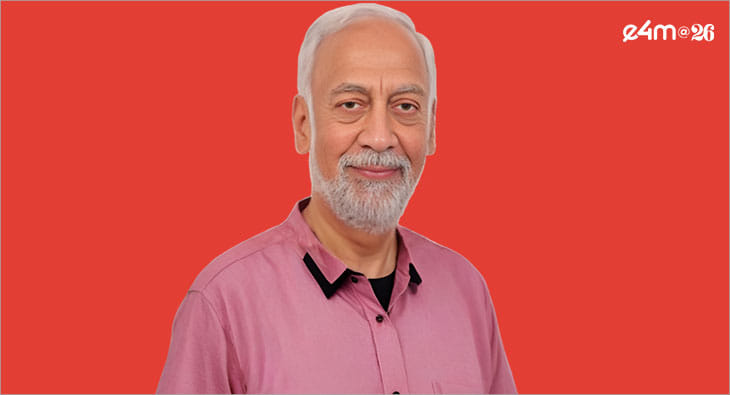

As I followed the news of the ongoing upheaval in the advertising industry, I wondered how these changes would benefit clients. I took it that they would in some way, and it was just that I wasn’t getting it. Then I saw Martin Sorrell’s interview with Annurag Batra, and found with mixed feelings that he doesn’t see either.
Why mixed feelings, one might ask. Well, on the one hand, relief: if Sir Martin was asking the same question, I was in good company. On the other hand, despair that the industry is driven by balance sheet custodians, not by brand custodians.
In the 50-plus years that I have been engaged with it, I have seen more change in the advertising industry than I have on the marketing side of the business: notably, the emergence of holding companies (now at the heart of the current upheaval); the diversification of communications offerings, adding specialist disciplines like PR, direct marketing and design; and the hiving off of the media function into specialist media agencies. Alongside, there was a great deal of learning: adoption of technology, first in media planning, then in production, and finally in creative; learning to use, and create for, new media; and learning to engage increasingly multi-tasking audiences. All those developments benefited clients, directly or indirectly.
What has changed in marketing, meanwhile, is that the function has lost its bearings. The preoccupation with, even paranoia about, digital media and technology has led to the ridiculous notion of performance marketing as distinct from brand marketing, and the CMO is an endangered species.
In the advertising business there were, along the way, mergers, acquisitions, and restructuring, but those were changes at the company or agency level, not across the board.
Now, apparently, clients’ needs are not high on the agenda. Presenting WPP’s three-year perspective, CEO Cindy Rose said, “Today we are unveiling a bold plan for a simpler, more integrated WPP. Our intention is to stabilise the business, return to organic growth, create capacity to invest in the future, and deliver attractive returns for our shareholders.” Not a mention of clients.
At the heart of the change is the drive “to deliver fully integrated, AI-enabled solutions” based on a “pioneering agentic marketing platform”, WPP Open.
The business will function through four core operating units: WPP Media, WPP Creative, WPP Production and WPP Enterprise Solutions.
Why WPP Media? How is it different from Group M? “This new era demands new thinking,” says the WPP website. “Brands need a strategic partner to help them navigate change and drive their business forward. That’s why Group M is now WPP Media.” Couldn’t Group M do that?
And what is WPP Creative? “Home to our iconic agency brands, amplifying human imagination while retaining distinct cultures, connected through unified leadership and WPP Open.” The iconic agency brands were already amplifying human imagination while retaining distinct cultures, we hope. The difference is WPP Open.
“They talk about integration,” said Sir Martin, “but if you plan and budget by discipline, you get interdiscipline rivalry. If [on the other hand] you say to a country head, I want you to pull together the disciplines, it'll be integrated at least on a country or regional basis.”
The idea of a fully integrated communications programme – or campaign, or solution, if you like – is far from new. (My own first experience of designing and running one was 40 years ago, at Ogilvy. And 20-odd years ago Integrated Communications was even in my job title!) The difference now is AI, and fear and uncertainty about what changes may be wrought by it.
What did happen was that as advertising agencies started adding communications disciplines, over time those disciplines grew into specialist divisions. Each had its own revenue, profit and client responsibilities, and was encouraged to go out and seek its own business and an independent existence. Interdiscipline rivalry was a natural consequence. No one in the system was responsible, or rewarded, for driving client business across disciplines, so no one did.
In 2018, Ogilvy made a bold move, doing away with all of its sub-brands – Ogilvy & Mather Advertising, Ogilvy One, Ogilvy Public Relations and others – and getting back to a single agency, a single brand, with a common client service model and P&L. This was a return to what those of a certain vintage have known as the full-service agency. To those who are familiar with its history and culture, Ogilvy was going back to David Ogilvy’s ‘One agency, indivisible’. Now its holding company is structuring itself around disciplines, to be able to offer “fully integrated” solutions!
Even as all this was going on, Omnicom acquired IPG and revealed the shape of the merged entity.
As both WPP and Omnicom move forward, their overarching agenda is clear: cost cutting. Both have announced cost-cutting targets; huge layoffs (4,000 in Omnicom); and mergers of agencies. So now WPP has Ogilvy, VML, and AKQA; and Omnicom has BBDO, McCann, and TBWA. Between them they have, in the last two years, killed at least six of the most respected agency brands in the world: JWT, Y&R and Grey, for WPP; and FCB, Lintas, and DDB, for Omnicom. (The Lintas name is retained only in India, as TBWA Lintas.) And, of course, IPG, the first holding company in the advertising industry and once the most powerful, has disappeared. It is amazing that in the merger of JWT, Y&R, Wunderman, and VML, the one name that survived was VML! Those names meant something, each stood for something. Each has been long respected as a brand custodian.
I was in Lintas when it was acquired by IPG, and in Ogilvy when it was acquired by WPP, in profit centre roles. Both drove financial management discipline. Both were clear that those companies were financial brands, and neither sought to direct our professional offering. (WPP did drive the separation of the media function, but that is another story.) We learnt and experienced that with financial discipline we had more resources to deploy in talent and technology.
Now the centre of gravity has shifted decisively from the client to the corporation. The language of the industry – once about brands, consumers, creativity and ideas – is now about platforms, operating units, integration frameworks and shareholder returns. Technology, particularly AI, is presented as the organising principle of the future business. But technology, however powerful, is only a tool. It does not define the purpose of the enterprise.
Clients, meanwhile, still have the same fundamental need they always have had: to build enduring brands. That requires imagination, judgement, and an understanding of people and culture: capabilities that no platform can substitute for. AI may make processes faster, targeting sharper, and production cheaper, but it cannot replace the strategic and creative thinking that makes communication effective in the first place.
If the current upheaval helps agencies deploy technology better, eliminate waste, and collaborate more effectively, clients will indeed benefit. But if the primary outcome is consolidation, cost cutting and the erosion of distinctive agency cultures, then something valuable will have been lost. Those agency brands that are now disappearing were not merely names; they represented accumulated ways of thinking about brands, creativity, and client service.
Perhaps this is simply another turn in the long cycle of the industry. Advertising has reinvented itself several times in the past half-century, usually in response to new media, new technology or new economic realities. Each time it has eventually rediscovered the same basic truth: that the business exists not to optimise structures or platforms, but to help clients grow.
Disclaimer: The views expressed here are solely those of the author and do not in any way represent the views of exchange4media.com.
Read more news about Internet Advertising India, Marketing News, PR and Corporate Communication News, Digital Media News, Television Media News
For more updates, be socially connected with us onInstagram, LinkedIn, Twitter, Facebook YouTube & Google News