Bharat’s everyday quirks become marketing lens in new Rediffusion-Bharat Lab report
The report, ‘It Happens In Bharat Only’, looks at distinctly Indian consumer behaviours and explores what brands and marketers can learn from them
 by
by
Published: Sep 22, 2026 9:32 AM | 3 min read
 Follow Us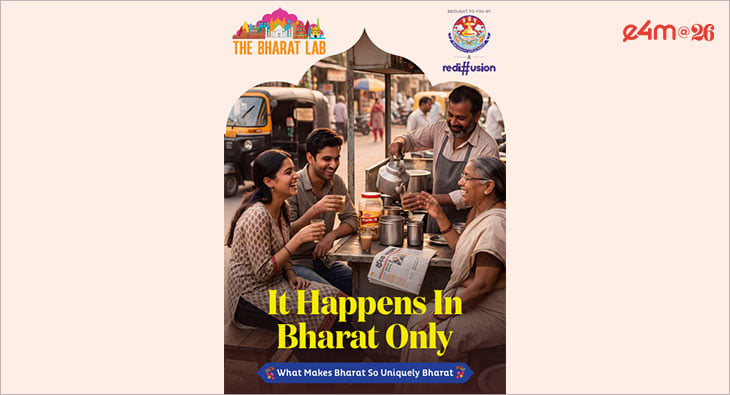

- Bharat Lab, in collaboration with Rediffusion, has published a report titled ‘It Happens In Bharat Only,’ which explores the unique consumer behaviors and social patterns in India through observational research and conversations across various regions.
- The report emphasizes the relational nature of Indian consumer behavior, highlighting the influence of family, social networks, and community on decision-making, as well as the legacy of scarcity that shapes practices like bargaining and resource optimization.
- It identifies specific consumer behavior patterns termed “Bharat Specials,” such as the ‘Muhurat Tax’ related to auspicious purchasing times, and discusses the impact of informal social networks and cultural rituals on brand interactions and purchasing decisions.
- The report also documents everyday cultural practices, advocating for brands to understand these behaviors as integral to Indian identity rather than anomalies to be corrected, aiming to provide insights into how consumers relate to products and each other.
Bharat Lab, in association with Rediffusion, has released a new report titled ‘It Happens In Bharat Only: What Makes Bharat So Uniquely Bharat’, examining the everyday behaviours, rituals and social patterns that shape consumer behaviour in India.
The report takes an observational approach, drawing on “hundreds of chats and conversations” across different parts of India. Rather than focusing on economic or demographic indicators, it looks at what it describes as the behavioural side of Bharat — from family-led decision-making and bargaining to religious customs, scarcity-driven jugaad and community influence.
A central theme of the report is the idea that Indian behaviour is often relational rather than purely individual. Family, social networks and community can influence everyday decisions, with the report arguing that consumers often view themselves as extensions of their families rather than as isolated individuals.
Read more: The Muhurat Tax - By Dr Sandeep Goyal
The report also links India’s culture of jugaad and optimisation to a historical experience of scarcity. Examples cited include bargaining, preserving household products with plastic covers and finding ways to make limited resources stretch further. It describes this behaviour as a legacy of scarcity that continues even as consumption and incomes evolve.
For marketers, the report identifies a series of consumer behaviour patterns it calls “Bharat Specials”. These include the ‘Jamai Premium’, ‘Shagun Pricing Effect’, ‘Muhurat Tax’, ‘Kitty Party Economy’, ‘Bhai Discount’ and ‘Tiffin Box Test’, among others. The report uses these concepts to illustrate how relationships, cultural rituals and social validation can influence purchasing and brand interactions.
The ‘Muhurat Tax’, for instance, refers to purchasing patterns around auspicious dates and festivals. The report cites its own observations that 40% of annual auto sales occur during the 22 days around Dussehra-Dhanteras and 30% of gold sales take place over three days, using these examples to argue that brands need to account for cultural calendars when planning inventory and marketing.
Another theme is the influence of informal social networks. The report describes the traditional kitty party as an early form of peer-to-peer influence, sampling and social proof, and argues that these networks have increasingly extended to platforms such as WhatsApp.
The ‘Tiffin Box Test’ looks at how products can be judged not only by the consumer who buys them but also by family members and colleagues who encounter them. The report uses this to argue that brands targeting Indian consumers need to understand the wider social context around consumption.
Other sections explore the ‘Badaam Effect’, or how visible acts of effort can signal care and build trust; the ‘Sharma Ji Ka Beta Effect’, which frames social comparison as a source of influence; and the ‘First Salary Syndrome’, where products bought with an individual's first salary can acquire lasting emotional significance.
Beyond consumer behaviour, the report documents a range of everyday cultural practices, including the Indian head wobble, the nimbu-mirchi charm, dahi-cheeni before important occasions, plastic-covered household items, repurposed biscuit tins and the ritual of dipping biscuits into tea. It also explores food-related practices such as eating with one's hands, folding banana leaves after a meal and adding chaat masala to fresh fruit.
The report concludes that these behaviours should not necessarily be viewed as quirks to be corrected, but as cultural patterns that offer brands a window into how Indian consumers relate to products, communities and each other. It positions the exercise as an attempt to “frame Bharat” rather than “fix Bharat”.
Read more news about Internet Advertising India, Marketing News, PR and Corporate Communication News, Digital Media News, Television Media News
For more updates, be socially connected with us onInstagram, LinkedIn, Twitter, Facebook YouTube & Google News