After Piyush Pandey: Where does Indian advertising go from here?
With the passing of Piyush Pandey, Indian advertising has lost its most instinctive voice. As dashboards and data take on a growing role, how will agencies continue to blend insight with instinct?
 by
by
Published: Oct 30, 2025 9:21 AM | 7 min read
 Follow Us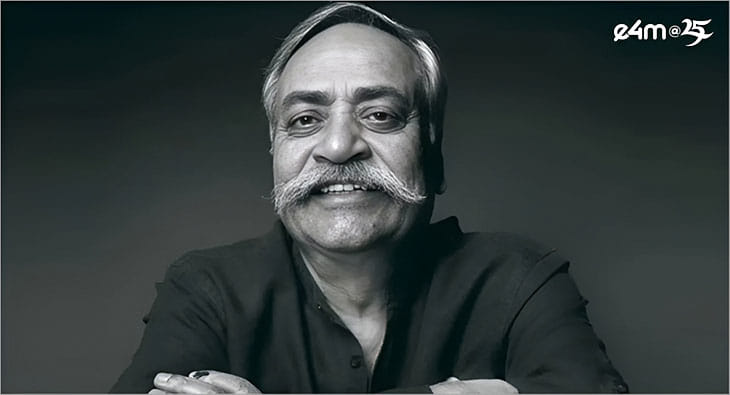

After Piyush Pandey's demise on October 24, Indian advertising didn't just lose a legend; it lost its piece of heart. The man who made us believe that a drop of Fevicol could bond more than surfaces, that a simple 'Thanda Matlab Coca-Cola' could capture an entire generation's mood, that Cadbury could make us see celebration in the everyday, was gone. He leaves behind a legacy of advertising that valued human connection as much as numbers and metrics.
Pandey's work wasn't just memorable. It was felt. The Surf Excel 'Daag Achhe Hain' campaign didn't just sell detergent; it sold the idea that childhood innocence was worth protecting. The Asian Paints 'Har Ghar Kuch Kehta Hai' films weren't about paint; they were about the stories that lived within our walls. And who could forget the Vodafone ZooZoos, those quirky white alien-like creatures that made telecom advertising actually entertaining?
These weren't campaigns born from focus groups and heat maps. They were born from gut, from heart, from an understanding of what made people tick that no algorithm could replicate. But here's the uncomfortable truth: the advertising world Pandey leaves behind looks nothing like the one he thrived in.
Today's agency floors hum with a different energy. Dashboards glow on multiple screens. Real-time metrics flash updates every hour. Performance marketers sit in rooms once reserved for art directors. And somewhere in all this noise, the quiet voice of instinct struggles to be heard.
Read On: Iconic ads by Piyush Pandey: The adman who rewrote India’s advertising story
The Tyranny of the Data Sheet
Avinash Pandey, Secretary General of IBDF (Indian Broadcasting and Digital Foundation), doesn't mince words about what's happened to the industry. "To be fair to agencies, the agency can work what the client allows them to do, unfortunately, for most of the clients, what I have seen today, the tyranny of data science has completely destroyed the creative work which is required for brand building, and brand building can only happen through emotional connect," he says. "We are taught in the science that you never remember what you were told or shown, but you will always remember what you were made to feel, and that's what Piyush's creativity was all about."
"In today's world, Prasoon Joshi and other creative artists are doing a great job, but the problem is the too much of next day sale, this month's target, quarterly numbers has overtaken the creativity completely out of the advertising and it has gone to the science of just the data and algorithm and that's the saddest thing to happen for the industry," Avinash adds. "In the long run, this will lower the consumption in our economy."
It's a paradox worth sitting with. In chasing immediate, measurable results, are brands actually eroding the very thing that drives long-term loyalty? Emotional connection. The kind Piyush Pandey built his entire career on.
The Machine That Needs Oiling
Sumanto Chattopadhyay, former Executive Creative Director at Ogilvy, has been watching this shift from the inside. His take offers a sliver of hope, even as it confirms the struggle. "I think the best agencies still come up with ideas using gut instinct and use data to confirm its robustness," he says. "But one does see a lot of dreary advertising out there that looks as if it's been cranked out by a machine that desperately needs oiling."
This formulaic quality is often recognizable. Ads may check boxes such as diversity, aspirational imagery, and trending audio, yet still lack the emotional resonance that makes audiences pause, engage, or connect deeply with the message.
Chattopadhyay recalls a conversation with Pandey himself. "I remember Piyush talking a year or so ago about this somewhat unhappy state of affairs in advertising – but he also concluded that this was probably a phase the industry was going through and that creativity would take its rightful place in the sun again."
Even until the end, Pandey believed. That's what made him who he was. The eternal optimist who thought the pendulum would swing back. That eventually, brands would tire of mediocrity and remember why they fell in love with great advertising in the first place.
Read On: 'His passing is not just the loss of a legend, but the loss of a guiding light'
When Instinct Meets Intelligence
But perhaps the answer isn't choosing between data and gut. Perhaps it's about knowing when to let each lead. Kalpesh Patankar, Group Chief Creative Officer at VML India, puts it perfectly. "Some of the best creatives I've met have all been shoot-from-the-gut kind of people. And that's what makes them special. Data can inform you; it can't make the decision for you. That's something you must do, all by yourself, with all the information you have by listening to your gut."
In a world increasingly dominated by Artificial Intelligence, Patankar argues that instinctive intelligence becomes even more valuable. "We live in an age where we cannot ignore the metrics. We use them to our advantage, where they strengthen our case, help inform our decisions, and even measure our progress," he explains. "But sometimes, when there are no metrics, or if every metric stands in opposition to your gut, then you throw caution to the wind and go with your gut. Because that's what creativity is about. It's an act of freedom, it's an act of rebellion, and very often it's acting out against conformity."
Think about the campaigns that actually break through today. The Cred AI-generated ads with their absurdist humour and nostalgia plays. Swiggy's 'Voice of Hunger' campaign that turned food delivery into comedy gold. These didn't come from playing it safe. They came from someone, somewhere in an agency, saying, "I know this sounds crazy, but what if?"
The Heart Still Beats
Patankar's words cut to the core of what Pandey represented. "Honest, hand-to-heart creativity, the kind of advertising that really speaks to people and touches their hearts, needs to be all heart. There can be no other way. And the proof is all around us – in the difference between the banners you don't even notice when you're reading a website and the ad you shared on your family WhatsApp group, or the difference between the ad you skipped, and the one you rushed into the cinema early to avoid missing. Real advertising for real people still takes real heart."
That distinction, between advertising you ignore and advertising you share, that's everything. And it's a distinction Pandey understood better than most. His Pepsi campaigns with regional flavour, the Google India 'Reunion' ad that made grown men cry, the Titan campaigns that made watches feel like keepsakes of time itself; these weren't just ads. They were cultural moments.
The question now is whether the industry can maintain that spirit. Can a new generation of creatives, accustomed to analytics and attribution models, still balance data with instinct? And can clients, focused on quarterly performance, provide agencies with the space to build brands over the long term?
Read On: Piyush was rare. They don’t make people like him anymore: Avinash Pandey
What Comes Next?
The truth is, Indian advertising is at a crossroads. The tools have changed. The pressures have intensified. But the fundamental truth of what makes great advertising hasn't changed at all. People still respond to stories that move them. They still remember ads that make them feel something. They still share work that speaks to their lived experience.
Piyush Pandey proved this over and over again for nearly four decades. He showed that you could be commercially successful and emotionally resonant. That you could win awards and win hearts. That data could inform the strategy, but the soul of the idea had to come from somewhere deeper.
As the industry mourns his loss and reflects on his legacy, a fitting tribute would be to meet his unspoken challenge: to show that creativity guided by human insight remains vital, that instinct still plays a role in an age of algorithms, and that advertising can continue to connect with people, even after Piyush Pandey.
Read more news about Internet Advertising India, Marketing News, PR and Corporate Communication News, Digital Media News, Television Media News
For more updates, be socially connected with us onInstagram, LinkedIn, Twitter, Facebook YouTube & Google News