RT India’s presence here is both timely as well as appropriate: Runjhun Sharma
At e4m NewsNext 2025, Runjhun Sharma, Head of News, RT India, said preparations for launching a full broadcast operation from India had been underway for about a year
 by
by
Published: Dec 23, 2025 1:37 PM | 5 min read
 Follow Us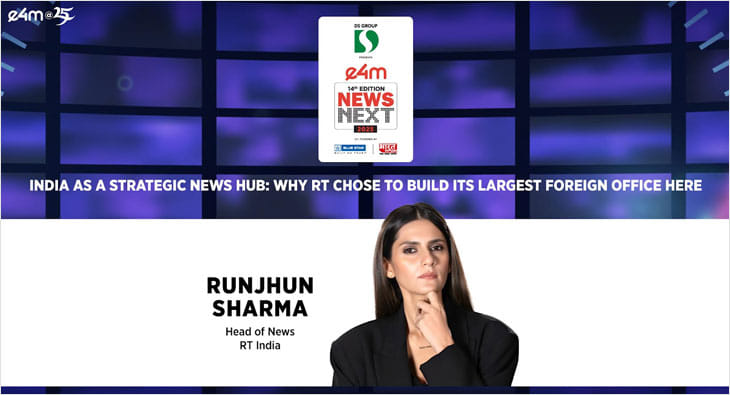

RT’s decision to establish its largest foreign newsroom in India was discussed by Runjhun Sharma, Head of News, RT India, during a keynote session at e4m NewsNext 2025, where she spoke about the reasons behind the move and the editorial approach the organisation plans to follow in the country.
Explaining the decision, Sharma said, “RT India’s presence here is both timely as well as appropriate,” and referred to India’s significance as the world’s largest democracy. She also spoke about the scale of the country and said that India’s population size brings both challenges and complexity.
Sharma said preparations for launching a full broadcast operation from India had been underway for about a year. She said RT had already had a presence in India as well as in the Global South before the decision was taken to launch a full-scale operation. Recalling early discussions, she said that when she was told by Moscow about plans to run a full broadcast operation from India, she questioned whether the timeline was realistic, noting that the team on the ground at the time consisted of only a handful of people.
She said the launch of RT India took place at a time when the network was facing restrictions and bans in several Western countries, including the United States and parts of Europe. Referring to remarks by the Kremlin’s spokesperson, Sharma said that operating in India mattered to the organisation. She added that while being the most populous country presents challenges, it also requires a foreign newsroom that can match India’s scale, complexity and nuance.
Speaking about why India was chosen for RT’s largest foreign office, Sharma said that India and the wider South Asian region have, for a long time, seen a dominant presence of Western media. She said this coverage has often approached India in a biased and patronising manner. Drawing from her own experience, Sharma said she has worked with both Western and Russian publications and has seen a difference in how editorial decisions are made.
According to Sharma, Russia looks at India as an equal, and this perspective influences how RT approaches stories from the country. She said editorial decisions at RT India are taken locally and are not dictated by Moscow. “This is not a decision that Moscow will take; they leave that decision to us,” Sharma said.
She added that this approach exists because RT does not believe that journalists from outside a country should dictate how that country should be covered. Sharma said Russia understands that India has its own complexities and nuances and that these cannot be fully understood by someone sitting outside the country.
On RT’s broader editorial approach, Sharma said the organisation does not judge countries or attempt to lecture them through its journalism. She cited examples from the Global South, including Africa, where she said RT reports developments without telling countries how their laws or systems should be changed. According to her, while opinions may exist, it is not the role of an international media organisation to instruct countries on governance or legislation.
Sharma said RT India will cover geopolitics as well as developments within India. She said stories are approached without being painted in a particular way, adding that perception plays a significant role in global media. According to her, the lens used to tell a story often defines how it is understood.
Addressing whether RT’s presence in India could reduce dependence on Western news agencies, Sharma said that this was the hope. She said that during early editorial discussions, she realised that journalists often needed to unlearn approaches shaped by long exposure to Western media framing.
She cited coverage of H-1B visa policies as an example, explaining that such stories are often framed around immediate negative impact. Sharma said editorial discussions at RT India explored whether such developments could also be viewed from a longer-term perspective, including implications for domestic talent and innovation.
Reflecting on global perceptions of India, Sharma said outdated stereotypes continue to persist. She said that even when India achieves milestones in areas such as space or technology, international coverage often highlights poverty and social challenges alongside those achievements.
On audience behaviour, Sharma said there has been increased interest in geopolitical and international news among Indian viewers in recent years. She linked this to India’s changing position in a world that is becoming more multipolar. According to her, news also needs to reflect this shift.
Sharma said RT India does not intend to compete with Indian news channels on speed or breaking news, describing this as a conscious editorial choice. “We’re not the fastest, and we don’t intend to be,” she said.
On coexistence with Indian news channels, Sharma said RT India does not plan to engage in confrontational debates or partisan political programming. She said the channel will focus on geopolitics, the economy and policy. At the same time, she expressed admiration for India’s network of reporters and stringers, describing them as important to how local media functions.
Concluding her remarks, Sharma said RT India aims to offer an alternative global news perspective. She also spoke about the people-to-people relationship between India and Russia, recalling cultural connections from the Soviet era and saying RT India hopes to contribute to strengthening that broader engagement.
Read more news about Television Media, Digital Media, Advertising India, Marketing News, PR and Corporate Communication News
For more updates, be socially connected with us onInstagram, LinkedIn, Twitter, Facebook YouTube & Google News