News broadcast needs to reinvent, innovate: Sudhir Chaudhary to Kailashnath Adhikari
Sudhir Chaudhary was speaking on a Governance Now podcast with Kailashnath Adhikari, Managing Director, Sri Adhikari Brothers
 by
by
Published: Apr 14, 2025 6:28 PM | 4 min read
 Follow Us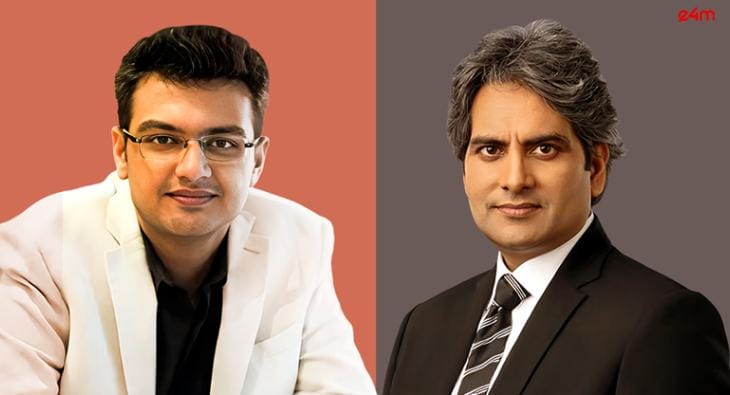

Popular news anchor and journalist Sudhir Chaudhary has said that the news broadcast industry has not reinvented itself in the last 20 years, which is why news consumption has gradually shifted to other platforms. Unlike social media influencers with millions of followers, there are no stars in the news industry.
While basic storytelling remains the same, viewers have shifted to emerging social media platforms.
“Least innovation has taken place in the news broadcast industry. With every new technology coming in, existing formats have to reinvent themselves. Today, the consumer has a plethora of available options. News is available on WhatsApp, Instagram, Snapchat, TV, print, and social media. You have the choice to watch news in long format, short format—Reels—and you have to show the same story in different formats, durations, and parts on different platforms. This has opened the market and given more choice to viewers, who benefit the most.”
He was speaking on a Governance Now podcast with Kailashnath Adhikari, Managing Director, Sri Adhikari Brothers.
Chaudhary said that out of the nearly 400 news channels that exist today, 10–15 major ones follow the same breaking news formats—red tickers, similar headlines, studios and tables where news anchors look the same, debate on the same subjects, and invite mostly the same panelists.
Experts in newsrooms study TRPs and ratings and suggest content creation based on popularity. “Ninety-nine percent of the industry functions in this reactive manner. The industry has lost its way. Instead of repeating the same formula, you have the choice to create good content. Ratings, TRPs, and money are by-products—and good content will automatically generate good ratings. This is the principle I followed in my own shows,” he said.
Responding to a question on how he uses his research methodology to pick and explain issues simply to his viewers, Chaudhary said his news reports touched the lives of common people and were initially ridiculed by rival channels, who worked on set formulas of political news with cabinet meetings, party alliances, etc. Later, his concept of news analysis came to be adopted by many channels, though only for ratings and not organically.
“Unless the news anchor feels his story, it will not resonate with viewers and will look mechanical. A reporter must look at small stories in newspapers to enhance their potential for the common man,” he said.
On the question of how he views the shift of news consumption to digital platforms, he explained: “In the era of radio and print came TV, which was followed by digital—and both print and radio continued to survive. Today we have radio, TV, print, internet, and now AI. With every new technology coming, existing formats have to reinvent themselves. Similarly, earlier films had a duration of three hours; now they are 1.5 hours. Earlier, Test cricket lasted five days; now you have T20. Cricket, stadiums, bats, balls, runs, players, wickets, viewers—everything is the same. Cricket has reinvented itself.”
Speaking on how social media has impacted the ecosystem, the media personality, who has 7.9 million followers on social media platform X, said: “Earlier people said they watched me on TV, but now they say they follow me. This is a big change, and these are all different forms of technology. With social media influencers creating new and different content in long and short form, people are coming in large numbers from YouTube, Reels, and other platforms—whereas many in mainstream media for years do not have as many followers. However, the challenge in the coming days will be to maintain speed and accuracy. You cannot compromise accuracy for speed.”
On being asked how a news person can identify fake news in an era of fast news and increasing sources, Chaudhary explained that news channels rely on multiple sources, while content creators on social media have even more.
“However, it needs to be understood that big agencies spend a lot on credible news gathering, and large newsrooms have multi-layered mechanisms for filtering news. If the news is not credible, it will be caught at some checkpoint. In contrast, a YouTuber, who is a one-man show, hasn’t spent money on news gathering or filtering, and many times can show inaccurate news.”
He emphasized the importance of decoding numbers in storytelling and said that news creation is serious business—it requires discipline, and content creators must continuously upgrade their skills.
In his next innings, Chaudhary—who is rumoured to be joining the national broadcaster—said he now needs the freedom to create content instead of chasing TRPs or numbers, and he seeks the support of social media content creators to promote his own work.
Read more news about Television Media, Digital Media, Advertising India, Marketing News, PR and Corporate Communication News
For more updates, be socially connected with us onInstagram, LinkedIn, Twitter, Facebook YouTube & Google News