BBC may shut channels, radio stations as it targets £500m in savings
Matt Brittin said on BBC One's "Sunday with Laura Kuenssberg" that no program or channel can be guaranteed to continue forever
 by
by
Published: Sep 26, 2026 10:17 AM | 3 min read
 Follow Us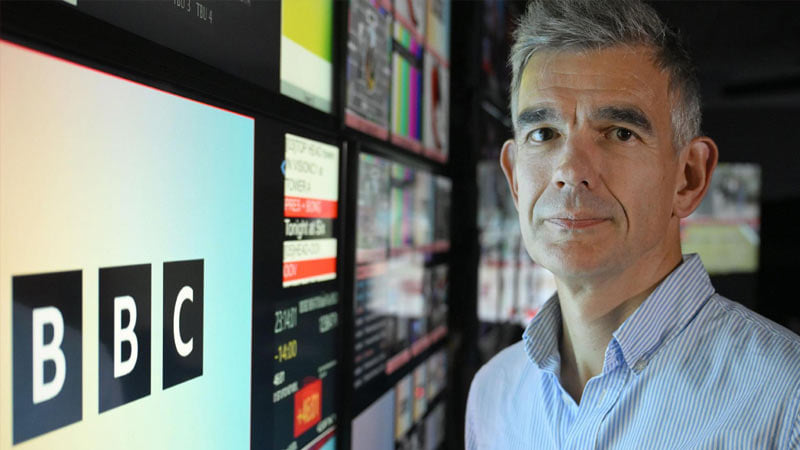

- BBC Director General Matt Brittin announced potential closures of some channels and radio stations due to financial challenges and changing audience consumption habits, with a goal to save approximately £500 million and reinvest in on-demand services.
- Brittin emphasized the need for the BBC to adapt to evolving viewer preferences, noting that traditional broadcasting models may no longer be sustainable as more audiences shift to on-demand platforms.
- The BBC has already implemented job and program cuts, including popular shows, and further reductions are anticipated as part of the organization's restructuring efforts.
- Addressing the role of AI, Brittin expressed openness to its use in programming while stressing that human creativity should not be replaced, and he highlighted concerns over the concentration of information control among a few major tech companies.
BBC Director General Matt Brittin has said that due to the BBC's financial situation and the changing way people consume content, some channels and radio stations may be closed. The saved resources will be invested in on-demand services.
The BBC is trying to make savings of around 500 million pounds. Matt Brittin said on BBC One's "Sunday with Laura Kuenssberg" that no program or channel can be guaranteed to continue forever. He said the economic situation is challenging, and that is why some decisions are being considered earlier than expected.
Matt Brittin said audience behavior is also changing rapidly. If more people are watching content on-demand, the BBC will have to consider the cost and utility of its different services.
'We are still stuck in the old model'
Brittin said that while making savings, their main focus is on minimizing the impact on viewers. He cited the example of a channel's broadcast program being watched by approximately 100,000 people on TV, while the same program might be watched by 500,000 people on iPlayer. So, the question is when is the right time to make that service fully on-demand.
He said his responsibility also includes ensuring license fee payers get the most value for their money. According to Brittin, the BBC needs to adopt different methods to reach its audience. He said that people have evolved in the way they consume content, while the BBC is still stuck with the old model.
Over the past few months, the BBC has announced the closure of several jobs and programs, including "Blankety Blank," "Celebrity Mastermind," "Live at the Apollo," and "Football Focus." More cuts are expected in the future.
Matt Brittin took over as Director General of the BBC in May. Prior to this, he spent nearly a decade as President of Google for Europe, the Middle East and Africa.
Brittin also spoke about AI
When Laura Kuenssberg asked him if he would allow AI to create and present a program, Brittin said he would, subject to certain rules and limitations. He said the BBC wants to experiment with the technology and understand what AI can and cannot do. However, he added that he believes in human creativity.
Brittin said that no BBC job should be completely replaced by AI. He said that AI can help in many areas, such as better use of license fee funds, decision-making, and creative work, but it is not a substitute for humans.
The danger of information falling into the hands of six big tech companies
Brittin also spoke about the danger of a few big tech companies having too much control over information in the future.
He said that AI is advancing rapidly, and a situation could arise where six companies could control access to people's information and the creation of new and misinformation. He added that none of these six companies are based in Europe or the UK.
Brittin said that in such a situation the role of BBC becomes important, because more than half a billion people consider BBC a trustworthy institution.
Regarding trust in big tech companies, he said that many platforms exist and he wouldn't automatically trust any one platform. He said it's important to constantly monitor how these platforms operate and ensure BBC content is reaching the right destinations.
He said the BBC and its apps and services should be "alternative to algorithms." He said content elsewhere is often influenced by commercial interests.
Read more news about Television Media, Digital Media, Advertising India, Marketing News, PR and Corporate Communication News
For more updates, be socially connected with us onInstagram, LinkedIn, Twitter, Facebook YouTube & Google News