Who is the customer? Gen Alpha marketing blurs the line between child and parent
ASCI says intent, not audience, should define responsible advertising to children, while brands rely on disclosure and their own limits
 by
Published: Nov 25, 2026 9:29 AM | 6 min read
 Follow Us


- The Advertising Standards Council of India (ASCI) is examining how advertisements affect Gen Alpha (ages 7-15), emphasizing that intent and nature of communication should guide regulation rather than just the target audience.
- ASCI's study indicates that children aged 10-12 often struggle to recognize commercial intent in integrated content, highlighting the need for clearer advertising disclosures to protect this vulnerable age group.
- Brands are acknowledging their responsibility, committing to transparent disclosures in creator partnerships and ensuring age-appropriate content that does not exploit children's trust or create undue pressure.
- ASCI advocates for advertising literacy among both children and parents, recognizing that while technical safeguards exist, they may not effectively prevent children from encountering misleading advertisements.
A child watching a creator's video does not always know when the person on screen is selling something. A parent watching television with that child may not realise the ad on screen is working on the child beside them. Both problems now sit at the centre of how India's advertising self-regulator thinks about Gen Alpha.
ASCI's study of this cohort's ad and content consumption suggests that regulating by asking who an advertisement is addressed to fits poorly with how children meet brands. Brands selling to this audience, were asked how they handle the same questions. Their answers show where responsibility is being claimed and where it is still left open.
Read On: 86% Indian parents say Gen Alpha kids influence family purchases: Study
Intent matters more than audience
The regulatory question is whether advertising aimed at children should be treated differently from advertising that uses children to move parents. ASCI's answer is that the line is the wrong one to draw. "The distinction should be based on the nature and intent of the communication, rather than simply who the advertisement is addressed to," said Manisha Kapoor, CEO & Secretary General, ASCI.
The reasoning comes from how Indian families consume media. Children are rarely in a separate viewing universe. "In India, there is significant co-viewing of linear and digital content within the family. So, children are exposed to ads that may not be addressed to them directly," said Kapoor.
That makes the stated target audience a weak guide to who is affected. For ads that do address children, ASCI points to Chapter 3 of its Code. "Advertisements addressed to children should not contain anything, in illustration or otherwise, that might result in their physical, mental or moral harm, or which exploits their vulnerability," said Kapoor.
The age gradient
The What the Sigma, an ethnographic study by the Advertising Standards Council of India (ASCI) Academy and Futurebrands Consulting that examines how Indian children (Gen Alpha, ages 7–15) interact with digital media and recognize advertising puts numbers on the vulnerability. Children aged 7 to 9 tend to identify advertising through obvious cues. Those aged 10 to 12 may not always recognise commercial intent when promotions are integrated into content. By 13 to 15, they are better able to identify it even when it is not overt.
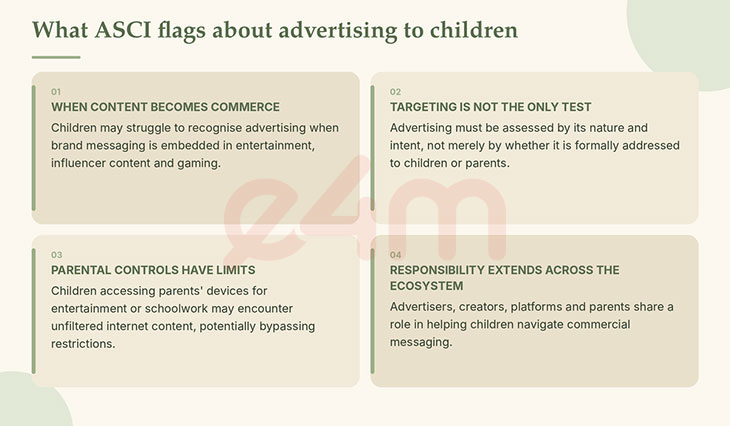
The middle group matters most. It is old enough to be targeted directly and young enough to miss the sell, and it is also where creators, gaming and entertainment-led formats do their work. Kapoor said the blurring is the problem. "As the 'What the Sigma' report notes, children often do not distinguish between advertising and entertainment when commercial messaging is seamlessly integrated into content," said Kapoor.
Read On: Inside the new playbook for Gen Alpha marketing
For advertisers, that shifts the test from what a campaign says to how a child is likely to experience it. "Advertisers must therefore consider whether their communication is creating undue influence with them or their parents, exploiting children's trust or encouraging preferences without making the commercial intent clear," said Kapoor.
What the brands commit to
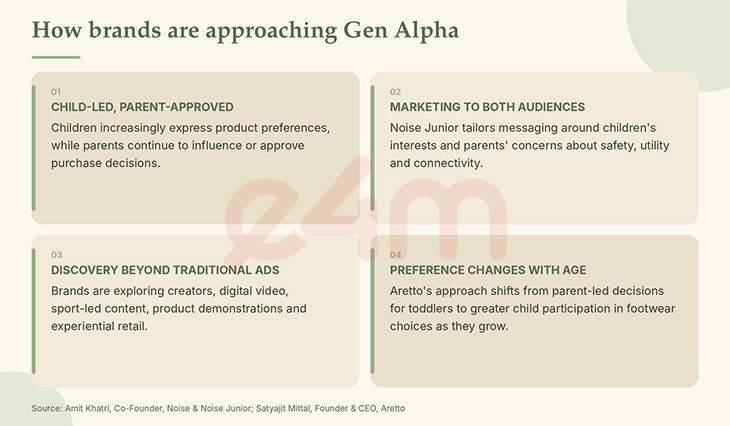
Brands accept the premise, at least in principle. Disclosure is the first line of defence for each. "Any creator partnership or sponsored collaboration should have clear and visible disclosures so that audiences can easily recognise commercial associations," said Amit Khatri, Co-Founder at Noise & Noise Junior.
Aretto frames it as a matter of platform-neutral honesty. "We believe all commercial associations should be clearly disclosed, whether the communication comes through an influencer, a creator or any other platform," said Satyajit Mittal, Founder & CEO, Aretto. It adds a content rule as well. "Our content should be age-appropriate and should never make exaggerated claims about the product," said Mittal.
Noise Junior draws a line on emotional pressure, the area ASCI flags when it speaks of exploiting trust. "Brand messaging should not create pressure on children to own a product to feel popular or accepted, or encourage them to influence their parents through unrealistic promises," said Khatri.
Noise Junior also treats product design as a safeguard, which speaks to Kapoor's concern about unfiltered access.
When the child is the decision-maker
The responsibility question sharpens as children gain a say. Noise Junior pitches different features to different people. "For children, we focus on independence, curiosity, play and engaging experiences. For parents, the conversation centres on safety, connectivity and parental controls," said Khatri.
Aretto goes further with its oldest range, built for tweens. "Our research showed that this generation wants to be spoken to as equals, and our communication for this range is built on that principle," said Mittal. The parent's role there is to sign off. "Here, the child chooses and the parent approves," said Mittal.
Read On: ASCI study explores children’s engagement with content and advertising
That is a notable position set against ASCI's age findings, since tweens sit in the 10 to 12 band where recognising commercial intent is less certain. Aretto also treats the child's choice as the measure of success. "With Leaps Pro (one of Aretto’s products), independent preference has become directly measurable, because the child's choice is now visible in the purchase itself," said Mittal.
Noise Junior is more cautious about crediting any single influence. "We also recognise that purchases are influenced by multiple touchpoints, including recommendations, product reviews, retail experiences and family conversations," said Khatri.
Who checks the promises?
ASCI's position leaves little room for the argument that a campaign is only a parent's concern because a parent signs the cheque. If intent is the test, a brand that designs a product for a child to choose carries some responsibility for how that child reads the message. The regulator is not pushing for category-specific restrictions in food, technology or entertainment, arguing that a principle-based approach suits a fast-changing ecosystem and that its Code already covers the areas of concern. It is also realistic about technical safeguards, since a child using a parent's phone can easily bypass them. Its bet is on literacy.
"While parental controls play an important role, the need for advertising literacy for children and parents remains a key gap," said Kapoor. That gap is where the risk sits. The commitments from brands are clear in their wording, yet they are promises the brands make to themselves, with no one checking. Children aged 10 to 12 may already be missing the sell, and the formats built to hide it are only getting better.
So what happens when the ad no longer looks like one, and the only thing standing between a child and the pitch is a promise?
Read more news about Marketing News, Advertising News, PR and Corporate Communication News, Digital News, People Movement News
For more updates, be socially connected with us onInstagram, LinkedIn, Twitter, Facebook, YouTube & Google News