How India's changing festive shopping habits are giving brands new stories to tell
Industry heads say that the detail that matters for creative teams is what went into those baskets since there’s so much more to the traditions and nuances of the festival
 by
Published: Nov 25, 2026 9:30 AM | 10 min read
 Follow Us


- A recent report from Instamart reveals a shift in Diwali shopping trends, with consumers purchasing a mix of traditional items and practical goods, such as air purifiers and hoodies, alongside festive decorations and gifts.
- GoKwik's data indicates that while daily orders during the festive season increased modestly, the average order value rose significantly, suggesting shoppers are opting for fewer but more expensive items.
- The report highlights a disconnect between traditional advertising portrayals of Diwali and the actual shopping behaviors of consumers, particularly in smaller towns, where price sensitivity and practical needs dominate.
- Experts suggest that future advertising should reflect the realities of modern Indian households, focusing on affordability and practicality rather than idealized representations of festive celebrations.
Ask any Creative Director to sketch a Diwali film and the frame arrives on cue: a sprawling joint family, a home dressed in marigold and fairy lights, gifts changing hands in soft light. Ask Indian shoppers what actually went into their carts this festive season and a very different list emerges. Air purifiers were bought alongside diyas, hoodies alongside steel tableware and a one-gram gold coin shared an order with a kids’ lunch box. The distance between those two pictures is where the festive brief is being tested, and where agencies need to show whether they are keeping pace.
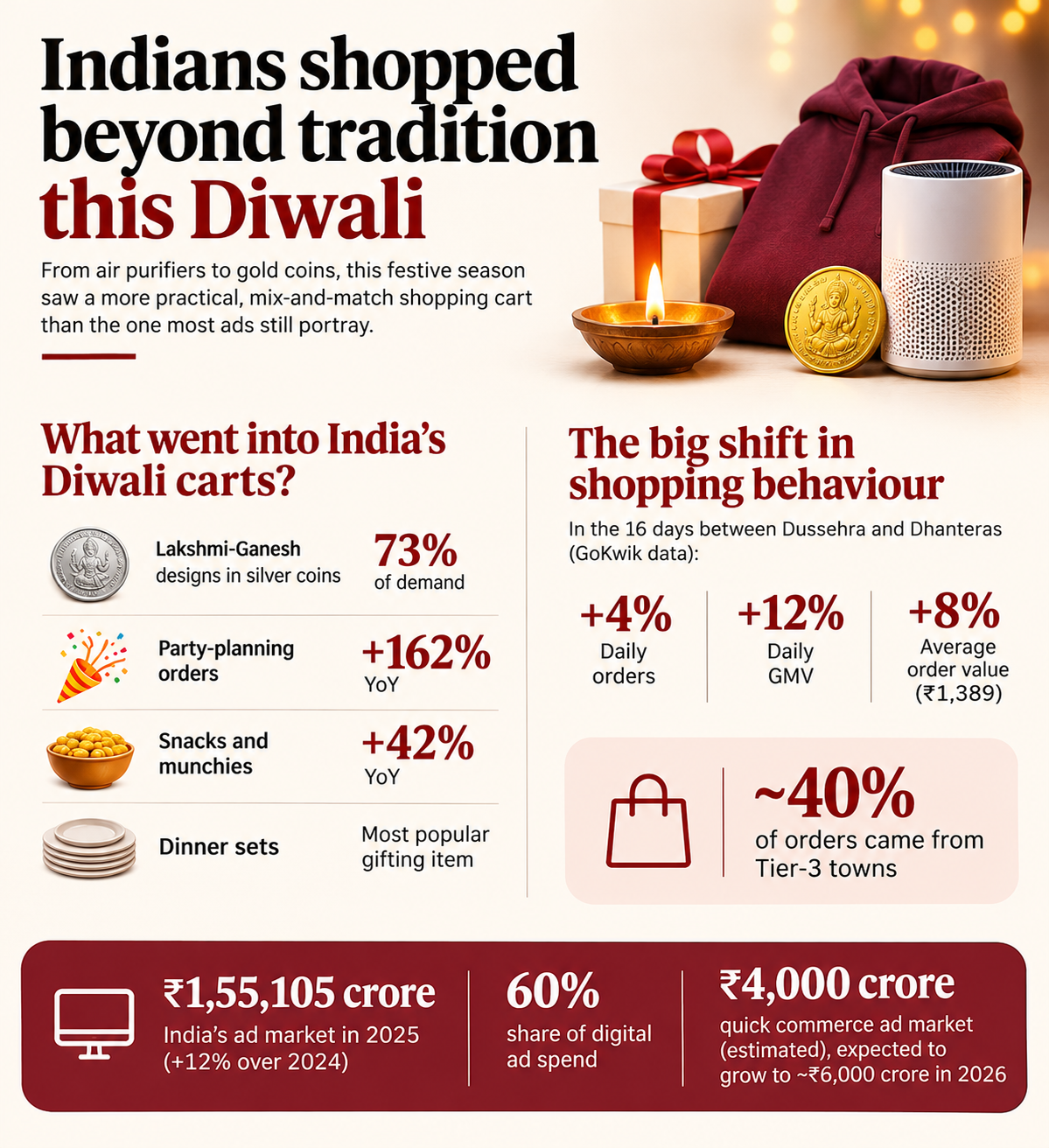
Instamart, the quick commerce arm of Swiggy, put numbers to that mix in its post-Diwali shopping report released on 10 November. The Diwali the ad film knows well was there, with Lakshmi-Ganesh designs taking 73% of silver coin demand, but party-planning orders also grew 162% year on year, snacks and munchies rose 42%, assorted dry-fruit packs more than doubled and dinner sets emerged as the most popular gifting item. Even the biggest baskets were not all gold. A Noida user spent ₹25,313 on an air purifier and a cordless vacuum cleaner, while a Gurugram user paired a 1g Laxmi gold coin with a kids’ lunch box.
The checkout data tells the same story from another vantage point. GoKwik, an e-commerce enablement platform that works with D2C and online brands such as Mamaearth, Man Matters, Libas, Plix and Shoppers Stop, tracked the 16 days between Dussehra and Dhanteras across its network. Daily orders rose just 4% over a normal September fortnight, but daily GMV climbed 12%, with the average order value up 8% to ₹1,389, which GoKwik reads as shoppers buying fewer things but pricier ones. Water purifier sales jumped 10.6x, air purifiers grew 4.3x, sweatshirts and hoodies nearly quadrupled and chocolate gift boxes sold over five times their usual units, all in the same fortnight as diyas, steel tableware and maang tikkas.
Chirag Taneja, Co-Founder and CEO of GoKwik, sees the pattern as a shift in what the festival is for. “The clearest story from our network this Diwali is that India shopped for its home,” he says. The detail that matters for creative teams is what went into those baskets, because the festive shopping list stopped being a purely festive one. Taneja puts the mix neatly. “Tradition and practicality sat on one shopping list: new utensils for Dhanteras, cleaner air for smog season, a warm layer for the evenings.” Add chocolate gift boxes as the small indulgence and what emerges is a far more layered consumer than the picture-perfect festive household most films still sketch.
One festival, many calendars
The same data punctures a few comfortable assumptions about how India shops for Diwali. Up to 3 PM on Dhanteras, orders on GoKwik’s network were 8% below a normal day, because online shoppers had finished buying a week earlier so that parcels would arrive in time. Demand peaked on the weekend of 31 October and 1 November, with 1 November the biggest day of the run-up, which means festive campaigns and the inventory behind them need to land 7-10 days before the festival itself. Coupon usage dipped from 51.5% of orders to 49.8%, so festive buying did not simply run on discounts, and 42% of established brands on the network sold less during the run-up than in early September, with health and wellness slipping from 12% to 9.4% of sales as shoppers put routine self-care on hold. The winners, in Taneja’s reading, were the brands that rode existing intent. “The brands that grew were the ones selling what people had already planned to buy,” he says.
Geography adds another layer. Gujarat grew 29% in the run-up as Diwali ran into the Gujarati New Year and Bihar and Jharkhand grew 26% with Chhath close behind, while West Bengal stayed flat because Durga Puja had already peaked and Kerala dipped because Onam is its big shopping moment. Instamart’s list of top festive cities, which featured Raipur, Madurai, Guwahati, Thrissur and Kollam, points in the same direction, away from a metro-only reading of festive demand. For anyone planning a tentpole, Taneja’s verdict is blunt. “A single national campaign launched on one date will be early for some markets and late for others,” he says.
Smaller towns are central to this picture. Tier-3 towns accounted for roughly four in ten orders in most categories on GoKwik’s network last festive season and more than half in hardware and auto, and these shoppers are sharply price-aware. In fashion, the most common order value was ₹699 and one in four orders ended in 99. That has a direct creative implication, which Taneja spells out. “Creative that leads with a clear price point and a reason to buy now travels further here than a broad brand film.”
The delivery risk in these markets is just as real. Cash-on-delivery orders from Tier-3 towns came back undelivered more often than the national average in every category GoKwik tracks, and the riskiest were small baskets of one or two items. A campaign there has to carry its delivery promise through a clear delivery date at checkout, a nudge to prepay and a WhatsApp confirmation before dispatch, which is why Taneja treats the ad as only half the job. “The ad earns the click. What happens after checkout decides whether the brand actually gets paid,” he says.
The household ads rarely show
All of which raises an uncomfortable question about who the festive film is made for. The adex numbers suggest money is already following the shopper to the point of purchase. The Pitch Madison Advertising Report 2026 pegs India’s ad market at ₹1,55,105 crore in 2025 under an expanded definition, up 12% over 2024, with digital accounting for 60% of the total. Quick commerce advertising is estimated at around ₹4,000 crore and is forecast to grow roughly 50% to about ₹6,000 crore in 2026. Media budgets, in other words, are moving to formats where the ad sits a tap away from the cart, while a lot of the creative continues to live in the glossy metropolitan living room.
Shweta Sangtani, Co-Founder and CEO of Sangya Project, a sexual wellness brand that grew out of an adult sex education page on Instagram, frames the disconnect sharply. “If ads are supposed to reflect society, why does Indian advertising keep showing us the same imaginary one?” she asks. She argues that the middle class of 300 - 350 million people who drive the country’s real demand is mostly invisible in advertising, even as India is said to be adding 100 million affluent consumers by 2027. The lives of that middle class, she says, look nothing like what ads portray. “These ads show affluent lifestyles while the economic data proves the middle class is actually buying less (smaller packs) and paying more,” she says.
The baskets from Instamart and GoKwik point to a household that plans, prioritises and trades off, which is precisely the calculation Sangtani says ads skip. The gap, she adds, is as much about representation as about money, with caste and disability, by her account, showing up in less than 1% of advertisements. The consequence is a feeling of distance rather than a mere statistical omission. “When people can’t see themselves on screen, they don’t feel spoken to,” she says.
She traces the drift to a shift over decades. Back in the 90s, middle-class advertising spoke the language of value (affordable, effective and no-frills), of which the Nirma jingle every household knew is her example. “Advertising moved from selling value to selling a vibe,” she says. Even today’s more progressive work on gender roles, modern relationships and changing family structures tends to bypass the money question, and the daily grind of financial calculations stays invisible. “They address what families think and feel, but rarely how much families can afford,” she says.
Beyond the giant party
The festive film is not standing still, and the Diwali 2026 slate shows brands feeling for new entry points. Zomato’s in-house film with Saif Ali Khan lampoons hampers of towels, bedsheets, soaps and crockery and argues for bringing mithai back into the gift box. Asian Paints’ ‘Taiyyari Shuru, Tyohaar Shuru’, created by Ogilvy, finds its story in the weeks of preparation rather than the day itself, while 921 Basmati Rice, a GRM Foods brand, asks ‘Aaj Diwali Hai Kya?’ to locate festivity in an ordinary meal. These are meaningful shifts in entry point and tonality, but few of the films tracked this season put price, affordability or the arithmetic of the festive budget at the centre of the story. The gap between film and cart shows up even in the hamper joke, since the crockery Zomato’s film pokes fun at is still selling, with Instamart listing dinner sets as its most popular gifting item.
Lakshmipathy Bhat, a brand communications advisor and former vice president at FCB Ulka, sees a different kind of drift. He points to the West, from the Christmas films of big UK retailers to Apple’s ‘Misunderstood’ from 2013 and Chevrolet’s 2023 effort, as a tradition built on positivity. “One common theme in the West (with exceptions, of course): feel-good, positive stories anchored on ‘goodness’, sharing and acts of kindness,” he says.
Indian agencies have made such films too, Bhat concedes. “In India, such positive, ‘feel-good’ Diwali ads have been made,” he says. His worry is about what followed, with some agencies now treating that route as too cliched and chasing difference for its own sake. He has no quarrel with quirk as such. “Yes, ads can bring a smile through quirky, offbeat themes too,” he allows.
The trouble, in his view, is where the shortcut leads when difference becomes the goal. “The easy way out seems to be to equate Diwali = giant party & revelry. But there’s so much more to the traditions and nuances of the festival. Only a handful of brands seem to base their festival ads on such,” he says. Bhat is not asking for a return to the cliché. The nuance he wants is already visible in the cart and on the calendar, in a Gujarat where Diwali runs into the New Year, a Bihar where Chhath follows hard on its heels and a Tier-3 shopper counting rupees down to the ₹699 price point. Those are specific, local and unmistakably Indian stories, and few of them have made it into the festive film.
That is where the opportunity sits for agencies and brands alike. A gold coin, an air purifier, a hoodie and a box of chocolates landed in the same Diwali basket, and a brief that the shopper wants to meet cannot begin and end in the living room set. Sangtani believes the way in is acknowledgement rather than aspiration. “People appreciate acknowledgement, the connection that says: ‘We see the life you’re managing,’ rather than, ‘Here’s the life you should want,’” she says. The evidence for what that life looks like is available in real time to anyone willing to look. “Checkout is the most honest signal a brand has. It shows what people actually paid for, at what price, from which pincode, and how they paid,” says Taneja.
Read alongside the work, that signal suggests the next Diwali brief may need to begin with the shopping list rather than the family portrait.
Read more news about Festive Season, Marketing, PR and Corporate Communication, Internet Advertising, People Movement
For more updates, be socially connected with us onInstagram, LinkedIn, Twitter, Facebook, YouTube & Google News