Perils of forced marketing strategies
Guest Column: Pradeep Menon. M, Co-founder, Head - Branding & Strategy, of Blackswan (India) Ideations, shares insights on recent campaigns that played with brand identities
 by
by
Published: Feb 10, 2025 1:32 PM | 7 min read
 Follow Us

- Small and medium brands should avoid altering their brand identity unless undertaking a complete revamp, as this can confuse consumers and dilute brand recognition.
- Clarity in advertising is essential; campaigns that prioritize attention-grabbing tactics over clear messaging can backfire, leading to wasted resources and potential brand damage.
- The recent marketing campaigns by Puma and Jain University serve as cautionary examples, demonstrating that extravagant and confusing promotional strategies can provoke backlash and diminish consumer trust.
- Brands should focus on genuine communication and understanding customer needs rather than merely seeking to capture attention, as missteps can have significant financial repercussions for smaller enterprises.
What small & medium brands SHOULD NOT learn from PVMA & Jain University campaigns
- Do not tamper with your brand identity unless it is for a total revamp
- Do not test the patience of your audience by losing clarity in your campaign
Catching the eyeballs
Every marketer in today’s business world is vying for the eyeballs of the consumer in any way they can. At times they go overboard forgetting the basics of advertising. Advertising is used to communicate clearly about something the brand stands for to the audience. It is as simple as that. Whenever you forget that premise of clarity, advertising becomes forced. Forced Marketing ideas just to catch eyeballs may backfire or get valuable money lost in the process.
The PVMA campaign – Overdoing in the name of creative ideas
Puma is a well-known brand and their logo is almost etched in every consumer’s mind who is interested in sports. Recently they signed PV Sindhu, one of the sports icons of India, as their brand ambassador. Even a press meet with her would have done the necessary word of mouth but the marketing team went brain storming to do something ‘out of the ordinary.’ And the idea they came up with is something that an established brand would think a hundred times before execution – Tampering with their own logo and that too on their storefront boards. The move went viral on internet for sure and people came to know about the brand ambassador.
It really would have cost a lot to do such a campaign and what does it bring back to the brand. Just a tweaked name on the store board and that too which even turns out to be a word which have no proper pronunciation to read it. It does not make sense while reading it. It looked almost like all the hotels down south naming their restaurants fake names with variants of ‘Saravanabhavan’ and ‘Arya Nivas’ expecting the customers to flock in seeing those name boards. And what is the ROI on such a huge investment? The MD of Puma India said in an interview that “Quantifying its tangible impact is challenging, but it has undoubtedly strengthened our brand position.” He also ‘proudly’ takes responsibility of the idea as he claims this great idea was born & brought up at their internal marketing team discussions. Maybe if they consulted it with their branding agency, they would have given a third eye viewpoint.
Here lies the lesson for small or medium brands. It involves huge cost to rebrand your stores and especially if it is temporary better not go for it just to catch eyeballs.
Now will this ‘bold’ campaign bring in more business. People will know that PUMA is giving a lot more focus on badminton accessories but the same could be achieved just by creating a sub section in the store with Sindhu’s involvement in announcing it and maybe a sub brand of badminton sports goods in the name of the great star, PV Sindhu. In several interviews the stakeholders at PUMA have said that they are not sure what they would achieve with such a campaign but they were sure that people would take notice. A big brand like PUMA may have the financial muscle power to do spend on such extravaganza which is doubtful to create an impact on the consumer’s mind, but small or medium brands may lose its entire money and their brand identity if they follow such campaigns.
Brand is bigger than the brand ambassador
As someone who is in the advertising industry for more than 25 years, I am pretty sure about one thing – Brand should be bigger than the brand amabassador. Whenever brands have tried to overdo the brand amabassador thing, those brands have suffered at some point. Most marketing heads fall into the notion that it is their brand amabassadors that brings in the business. Brand ambassadors just catch the attention of the consumer, the business grows only if the brand promises something to the consumer and the consumer is satisfied that they get what is promised. There are several examples of instances where brand ambassador overshadows the marketing decisions of the brand and the brand suffers at the end of it.
The Jain University Kochi ‘summit of the future’ campaign – Overdoing in the name of innovative marketing ideas
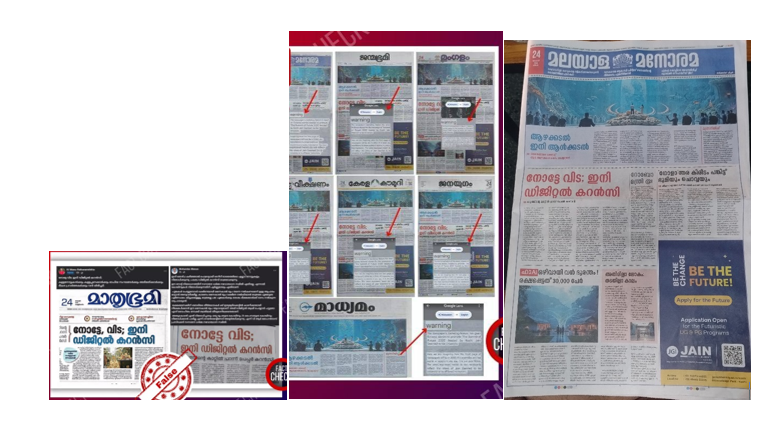
Jain University, Kochi is a new entrant in the highly competitive Kerala education market. Kerala is known for its high literacy rates and high rate of students seeking higher education. Jain University already was doing aggressive marketing & advertising ideas even before their campus started functioning and was making a huge impact as a preferred destination for higher education. Then they decided to conduct an ambitious event of a large scale named ‘The summit of the Future 2025’. Being an event of such a large scale that specialists in different fields from all over the world would participate in this event, they thought of creating something out of the ordinary. And what the idea they come up with is to turn the front page of every newspaper in the state into their advertising platform. The idea is to create frontpages with imaginary news items which may appear in 2050. A huge backlash followed from all the readers both against the advertisement and more towards the newspapers. Internet suddenly exploded with readers getting annoyed to read imaginary news. Most of them thought them to be the news of the present day as even the date was shown as same 24th but the year was 2050. The small column of warning went drowned among the news items and in this today’s world people have no time to read anything in full. Readers believed that all the news headlines were true as on the present date and especially one of the news headlines which said ‘all paper currencies to be banned, only digital currencies can be used’ made the readers panic and some of them even shared this as a genuine new information. Later when the readers came to know it was a marketing stunt, they felt fooled by both the newspaper and the advertisement. The very next day Jain University had to issue an apology on the same front page where they did their huge marketing idea. Still did not see the newspaper issue an apology for fooling their readers.
Here is the lesson for small or medium brands. Never ever lose your money on campaigns just to catch eye balls or making it the talk of the town. Advertising is about clarity. The consumers are not to be confused or fooled but to be treated with genuineness if your brand must be in the top of the mind of your consumer. Just catching eyeballs is not enough but the way you catch those eyeballs is what makes the difference.
Conclusion
Everyone has ideas in every field. While implementing new marketing tactics and innovative advertising methods a small or medium enterprise may not be able to sustain their existence if something goes wrong. The mantra for innovative ideas should always be based on the thought that instead of thinking always about what I have to say it should be about what and how my customer would want it to hear. The sense and sensibility of the customer decides how your innovative idea will be communicated. Big brands with plenty of funds to spend may be able to try out and lose but others do not have that luxury.
Disclaimer: The views expressed here are solely those of the author and do not in any way represent the views of exchange4media.com.
Source of the images: ETV Bharat
Read more news about Marketing News, Advertising News, PR and Corporate Communication News, Digital News, People Movement News
For more updates, be socially connected with us onInstagram, LinkedIn, Twitter, Facebook, YouTube & Google News