Human creativity will continue to stand apart in the age of AI: Prasoon Joshi
At the India AI Impact Summit, Prasoon Joshi, Chairperson of CBFC, spoke about how creativity has taken different forms over the years and why defining it has become crucial
 by
by
Published: Feb 17, 2026 11:24 AM | 3 min read
 Follow Us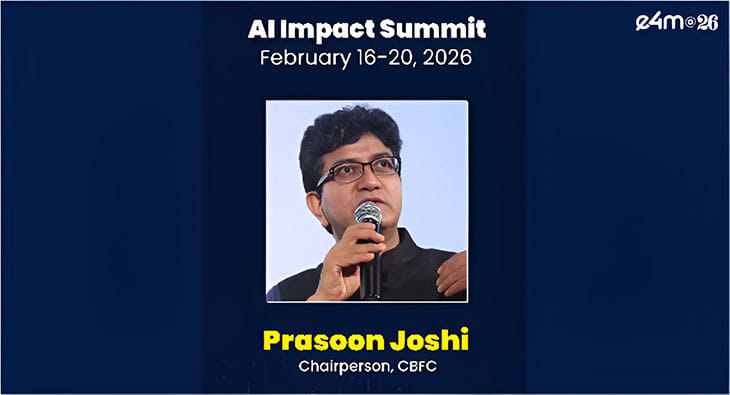

Prasoon Joshi, Chairperson of the Central Board of Film Certification (CBFC), said human creativity will continue to stand apart in the age of artificial intelligence because it comes from what is still unexpressed, a space he believes machines cannot reach.
Speaking at a panel discussion at Le Meridien during the India AI Impact Summit, Joshi anchored his argument with a line that summed up his view of creativity and the future of human expression: “Ab sabse sundar geet abhi tak likha nahi gaya hai aur sabse sundar khwaab ab tak dekha nahi gaya.”
Joshi said creativity is often narrowly defined as something that must be entirely “done by you” to qualify as original. He argued that even the act of choosing from multiple options carries a creative imprint, though it may not always be recognised as creativity in classical terms.
He described human creativity as rooted in what is yet to be expressed, calling it the defining human advantage in an era where AI can generate outputs at scale. Referring to the idea of “avyakta”, Joshi said humans are shaped by what has not yet been said, heard, or imagined, and this unexpressed potential is what makes human beings unique.
Drawing an analogy from quantum physics, he said that as one goes deeper into matter, the final field one reaches is again the unexpressed, which he linked to the idea of limitless human potential. In contrast, he said AI is powered by data that can be reconfigured to produce impressive ideas and expressions, but it remains rooted in what has already been said.
In another segment of the discussion, Joshi spoke about how creativity has taken different forms across human history, and why defining creativity in the present moment has become crucial. He said creativity in prehistoric times looked like stone tools, in the Renaissance it became individual expression, and in the industrial era it evolved into innovation and invention through machines.
He argued that creativity cannot be restricted only to poetry, music, painting or storytelling, since even cave art was a creative act in its own time. According to him, creativity is contextual and shaped by the era it emerges from.
On AI, Joshi also challenged the term “artificial”, saying AI is built on real data and real human experience that is being converted into computational combinations and experimentation. He referred to the idea of “white coding”, describing it as a more expressive form of coding driven by how one speaks and feels, unlike prompting which he described as technical.
Joshi said AI will increasingly offer creators a range of choices and options, but emphasised that the creative process itself is often non-linear, where creators may not always know exactly where they are headed, only the broad direction they want to explore.
Read more news about Marketing News, Advertising News, PR and Corporate Communication News, Digital News, People Movement News
For more updates, be socially connected with us onInstagram, LinkedIn, Twitter, Facebook, YouTube & Google News