How fitness, fashion and credibility are shaping Gen Z’s lifestyle choices
At the e4m Health & Wellness Marketing Conference 2025, creators and clinicians explored how Gen Z is redefining wellness into a lifestyle movement
 by
by
Published: Jul 28, 2025 10:41 AM | 9 min read
 Follow Us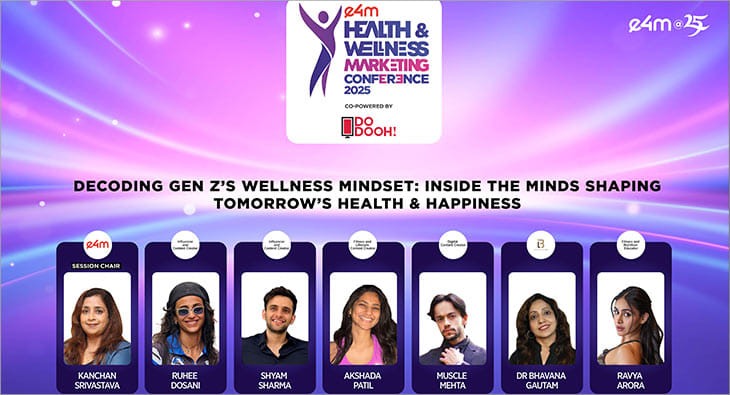

At the e4m Health & Wellness Marketing Conference 2025, the panel titled "Decoding Gen Z’s Wellness Mindset: Inside the Minds Shaping Tomorrow’s Health & Happiness" brought together a diverse mix of voices redefining health for the next generation.
Chaired by Kanchan Srivastava, Senior Editor & Group Editorial Evangelist, exchange4media Group, the discussion featured Ruhee Dosani, Influencer and Content Creator; Shyam Sharma, Influencer and Content Creator; Akshada Patil, Fitness and Lifestyle Content Creator; Muscle Mehta, Digital Content Creator; Dr Bhavana Gautam, Founder of Embracelife; and Ravya Arora, Fitness and Nutrition Educator.
Ruhee Dosani, widely recognised for her humour-led dance content, reflected on her recent shift towards fitness storytelling. “I wasn’t sharing this important part of my life, which is fitness,” she said. “This year, I decided to go all in and talk about it. People on social media are so caught up in everything that they forget themselves. I wanted to help them reconnect.”
She added that humour remains her emotional anchor. “Humour is my coping mechanism. If I’m going through something, I want to laugh it out rather than cry or meditate.” She highlighted how powerful it feels when followers message her, saying they relate but are scared to express themselves. “Even if a hundred people connect, laugh, or learn from our content, that’s a big win,” she said.
For Shyam Sharma, known more for his comic sketches, the fitness journey began personally but soon resonated with his audience. “Trust is a huge word,” he said, adding that he never expected to build that kind of credibility simply by posting workout updates. “My Instagram stories have become an attendance sheet. If I skip a post, people ask why I didn’t go to the gym.”
Now a year into his transformation, he emphasised that his approach has never been to instruct, but to share. “I’m not certified like others here. I’m just a guy experimenting on himself and putting it out there,” he said. “What worked for me might work for you, and if it helps even one person, that’s enough.” The response, he added, has been overwhelmingly positive.
For Akshada Patil, a spontaneous decision to run a marathon turned into a full-blown movement. “I made a silly move by putting a marathon on my bucket list without even knowing the distance,” she laughed. But what struck her was the lack of runners her age. “That’s when I started the hashtag ‘run with overlydaa’. For the first two months, no one used it. I deleted it. But then people slowly began engaging.”
From DMs to real-world meet-ups, her running community grew. “We’ve had around 300 people show up for our community runs. It’s motivating when people wake up at 7 a.m. to join you.” She credits the authenticity of her content for the connection. “I’m not chasing podium finishes. I share the truth, even when I don’t feel like running. That honesty is what people relate to.”
Their run club, which meets bi-weekly, continues to grow. “It’s about showing that normal people, with normal struggles, can still show up.”
Adding to what Patil said, Mehta took the conversation deeper into the idea of balance. “The name Muscle Mehta resonated with me because I started out skinny and just wanted to build muscle,” he explained. “But over time, I realised health is not just about muscle. It’s spiritual, emotional, mental and everything in between.”
He defined holistic health as the overall wellness of a human being. “You can’t be missing any one element. Spirituality has helped me stay focused and stable. Earlier, it was all about muscle. Now, it’s about living a long and healthy life.”
Mehta stressed that the goal isn’t just visible results but longevity in an increasingly toxic environment. “We live in a world full of junk food and pollution. Holistic health is no longer optional. It’s essential.”
The second half of the panel delved deeper into how Gen Z approaches therapy, nutrition, cultural context, and the role of authenticity in content creation. A generation that embraces mental health, self-awareness, and fun, Gen Z is reshaping wellness narratives, one post at a time.
Dr Bhavana Gautam brought a clinical lens to the evolving wellness landscape and shared a telling anecdote. “I walked into a coffee shop recently and overheard a young person telling their friend, ‘You’re not ghosting them, you’re drawing boundaries,’” she recalled with a laugh. “That, to me, sums up Gen Z.”
She described the generation as self-aware and empathetic. “They have this beautiful nuance of recognising that life has to be a little more about ‘me’ than about pleasing others. And if I’m doing well, I want my peers to do well too.” Dr Gautam shared that while 50% of Gen Z in 2025 report anxiety or depression, one in three is likely to recommend therapy or support to someone else. A shift her generation never imagined.
“They are open-minded, honest, and quick to act,” she said. “With older clients, the first step is breaking down the belief that the problem lies in the environment. But Gen Z walks in saying, ‘The problem is in me, and I want to fix it.’”
Fitness and nutrition educator Ravya Arora picked up from there and spoke about educating Gen Z without overwhelming them. “Gen Z questions everything, and that’s amazing,” she said. “We’ve gone from talking about just calories to discussing mental health’s role in physical fitness.”
She explained that while she ensures her content is rooted in science, it’s the storytelling that makes it engaging. “If I start throwing out PubMed (a free search engine that provides access to the MEDLINE database of life sciences and biomedical literature) references, my audience is gone in three seconds,” she said. “So I curate narratives and create fun around fitness. If it doesn’t feel fun, no one sticks to it.”
This sense of relatability and joy is what makes content connect, added Dosani. “If I’m just listing workout instructions in a boring tone, it doesn’t work. I won’t connect to it, why would anyone else?”
She shared an example of a recent video she posted. “I’m into MMA, so I put up a kickboxing video, but the first shot was of me getting a shin massage with a steel rod. It was painful! But people loved it.”
To add to the fun, she uses meme audio, Bollywood references, or culturally resonant sound bites. “If I post a boxing video, I might add an audio of ‘Boxer Bhai.’ It’s not just about knowledge anymore. You have to be original and entertaining. That’s what keeps engagement up.”
Authenticity came up again when the panel discussed balancing realness with performance metrics. For Sharma, who has been a comedy content creator for over seven years, the shift to fitness content wasn’t just a genre change; it was a new form of connection. “People have followed me for years. They know me. So when I started talking about my fitness journey, they understood where I was coming from.”
Being honest, he said, is non-negotiable. “You can’t fool the audience. You can’t just post what they want to see. You have to be true to who you are. That’s what works.”
As the panel came to a close, the spotlight shifted to the intersection of fitness, fashion and digital credibility in shaping Gen Z’s wellness mindset. With voices from both creators and clinicians, the discussion highlighted how deeply embedded health is becoming in the everyday culture of young India.
Patil captured the trend in a single observation: “These days, people want to show up in matching outfits and that’s the motivation,” she said. “Earlier, fitness meant wearing dull clothes and probably working out alone. But now, fitness, lifestyle, and fashion are all linked, and people are coming together to do activities. It’s one of the best changes we’re seeing.”
She pointed out how Gen Z has turned fitness into a social experience. “If you invite a friend to join you for pickleball, it’s not just about the sport anymore. It becomes this cute activity: you go out, grab a coffee, and fitness is included.”
Mehta agreed, noting that social media reels are acting as entry points into fitness. “It’s a spark. Someone watches a reel and thinks, ‘I can do this too.’ Then they try it, see results, and stay. That spark becomes a flame,” he said.
But with growing interest comes the challenge of separating fact from fiction. Dr. Gautam underlined the responsibility professionals have in curating the right messages. “For Gen Z, social media is native. They were born into it. Before they visit a clinic, they’re going to Google it,” she said.
That, she pointed out, can be both empowering and dangerous. “The same platform that informs you can also mislead you. It can give you FOMO, body image issues, or unverified advice. That’s where professionals like us come in. We have to be educators, filters, and translators.”
Her approach is rooted in relevance. “I look at reels not to follow trends, but so I know what clients are referencing. My job is to help them turn a single piece of advice into a lifestyle transformation, not just temporary weight loss or quick fixes.”
Arora wrapped up the panel by highlighting key wellness shifts within her community. “Women are lifting more than ever. Twenty years ago, gym gender splits looked very different. Now, gyms are full of strong women who aren’t afraid to lift. It makes me proud.”
She also noted the growing link between mental health and physical fitness. “People are talking more about eating disorders, their relationship with food, and how they feel about their bodies. These are important conversations, and I’m just happy to be part of a generation that’s so curious.”
With curiosity, connection, and cultural relevance at its core, Gen Z is transforming wellness into something deeply personal and widely influential.
Read more news about Marketing News, Advertising News, PR and Corporate Communication News, Digital News, People Movement News
For more updates, be socially connected with us onInstagram, LinkedIn, Twitter, Facebook, YouTube & Google News
