From billboards to algorithms
Guest Column: Shantomoy Ray, Founder & Director of K-Factor Communications, writes about how brand awareness has evolved from traditional billboards to algorithmic precision
 by
by
Published: Aug 4, 2025 12:27 PM | 7 min read
 Follow Us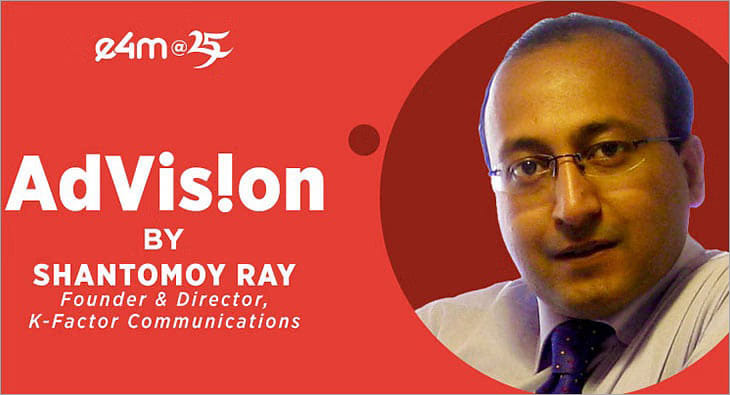

Imagine a world where every advertisement you encounter feels personally crafted for your exact needs, appearing at precisely the moment you require that product or service. This scenario, once relegated to science fiction, now represents the cutting edge of modern brand awareness. Yet this sophisticated reality emerged from humble beginnings: painted signs on barn walls, newspaper classified advertisements and simple word-of-mouth recommendations. The transformation from these rudimentary methods to today's algorithmic precision represents one of commerce's most fascinating evolutionary tales, driven not by technology alone but by an increasingly nuanced understanding of human psychology, consumer behaviour and the delicate balance between relevance and intrusion.
The early twentieth century marked the golden age of traditional advertising, where brand awareness operated on principles of mass communication and shared cultural experiences. Television advertisements during prime time slots commanded enormous audiences, creating collective moments where millions of people simultaneously encountered the same branded messages. Radio jingles became embedded in collective memory, their catchy melodies serving as audio triggers that instantly recalled specific products or services. Print advertisements in newspapers and magazines offered detailed product information alongside aspirational imagery, whilst outdoor advertising transformed urban landscapes into canvases for brand messaging. This era represented a democratic approach to brand awareness, where the same message reached factory workers and executives alike, creating common reference points across diverse social groups.
During this era, successful brand awareness campaigns relied on a carefully calibrated balance between repetition and memorability. The principle appeared straightforward: frequent exposure across multiple touchpoints would embed brand messages into consumer consciousness. However, the execution required considerable skill and intuition. Advertising agencies developed sophisticated media buying strategies, understanding that purchasing advertising space during popular television programmes required more than simple audience numbers. They needed to consider viewer engagement levels, programme content alignment with brand values and the competitive landscape within advertising breaks. Similarly, securing premium positions in widely circulated publications and negotiating prominent billboard locations along busy motorways demanded strategic thinking about sight lines, traffic patterns and demographic concentrations.
The introduction of cable television and the proliferation of specialist magazines began to fragment these mass audiences, creating the first significant shift towards more targeted brand awareness strategies. Advertisers could now reach specific demographic groups through channels dedicated to particular interests, whether sports, cooking, home improvement or children's programming. This segmentation allowed for more tailored messaging whilst still operating within the traditional broadcast model of one-to-many communication.
The digital revolution fundamentally disrupted this established paradigm whilst simultaneously revealing its limitations and strengths. Early websites functioned as digital brochures, providing static information about products and services, but they quickly evolved into dynamic platforms capable of engaging visitors through multimedia content, interactive features and personalised experiences. This transition highlighted a crucial insight: consumers welcomed more control over their brand interactions, preferring to seek information when needed rather than receiving it through scheduled broadcasts. Email marketing emerged as a cost-effective method for maintaining ongoing communication with interested consumers, but its success depended entirely on permission and relevance. Unlike traditional advertising, which could command attention through strategic placement, digital communication required genuine value proposition to avoid immediate deletion or unsubscription.
Search engines transformed how consumers discovered brands, shifting power from advertisers who could purchase premium placement to websites that could optimise their content for relevant search queries. This development introduced the concept of earned attention, where brands needed to provide valuable, relevant content to attract organic visibility. The rise of search engine marketing created new opportunities for targeted brand awareness, allowing businesses to display advertisements precisely when potential customers were actively seeking related products or services.
Social media platforms revolutionised brand awareness by introducing genuine two-way communication between brands and consumers. Unlike traditional advertising, which was inherently one-directional, social media enabled brands to engage in conversations, respond to feedback and build communities around shared interests or values. This shift required brands to develop more authentic, human voices and to demonstrate transparency in their operations and communications. User-generated content became a powerful tool for brand awareness, as satisfied customers shared their experiences with their personal networks, creating organic endorsements that often carried more credibility than traditional advertising messages.
The proliferation of social media platforms also introduced the challenge of maintaining consistent brand awareness across multiple channels, each with its own unique audience demographics, content formats and communication styles. Professional networking platforms attracted business-focused audiences, whilst visual-centric platforms appealed to younger demographics interested in lifestyle and entertainment content. Video-sharing platforms enabled brands to create longer-form content that could tell more complete stories and demonstrate products in action.
Mobile technology accelerated these trends whilst introducing location-based targeting capabilities that were previously impossible. Smartphones enabled brands to reach consumers at precisely the right moment and location, whether they were walking past a retail store, attending a relevant event or searching for nearby services. Push notifications allowed for immediate communication, though they required careful balance to avoid becoming intrusive or annoying to users.
The emergence of artificial intelligence and machine learning algorithms has ushered in the current era of hyper-personalised brand awareness strategies. These systems can analyse vast amounts of data about individual consumer behaviour, preferences and purchase history to predict which products or services are most likely to interest specific users at particular moments. Recommendation engines now suggest products based on previous purchases, browsing history and the behaviour of similar consumers, creating highly targeted brand exposure that feels more like helpful suggestion than traditional advertising.
Programmatic advertising platforms use real-time bidding systems to purchase advertising space automatically, evaluating thousands of variables within milliseconds to determine the optimal price for reaching specific individuals with particular characteristics. These systems can adjust targeting parameters continuously based on performance data, optimising campaigns for maximum effectiveness whilst minimising waste.
Artificial intelligence has also enabled more sophisticated content personalisation, where the same brand message can be automatically adapted for different audience segments, adjusting imagery, copy and calls to action based on demographic data, past behaviour and predicted preferences. Dynamic creative optimisation ensures that each consumer sees the version of an advertisement most likely to resonate with their individual interests and motivations.
The integration of customer relationship management systems with digital advertising platforms has created closed-loop attribution, allowing brands to track individual customer journeys from initial brand awareness through to purchase and beyond. This capability enables much more precise measurement of brand awareness effectiveness and return on investment, moving beyond simple metrics like impressions and clicks to focus on actual business outcomes.
Looking towards the future, emerging technologies promise even more sophisticated brand awareness capabilities. Voice-activated devices are creating new opportunities for audio-based brand interactions, whilst augmented reality experiences allow consumers to visualise products in their own environments before making purchase decisions. The increasing importance of privacy and data protection is simultaneously driving innovation in privacy-preserving advertising technologies that can deliver personalised experiences without compromising individual privacy rights.
The trajectory from mass-market billboards to algorithmic precision reveals a profound paradox: as technology has enabled unprecedented personalisation, the fundamental challenge remains unchanged. Whether etching messages onto stone tablets or deploying machine learning algorithms, brands must still answer the same essential question: how do you capture attention without alienating, inform without overwhelming and persuade without manipulating? The tools have evolved dramatically, but the underlying human psychology they seek to influence remains remarkably consistent. Today's most successful brand awareness strategies recognise this continuity, leveraging technological sophistication not to replace human insight but to amplify it. They understand that behind every data point lies a person with genuine needs, emotions and decision-making processes that no algorithm can fully replicate. The future belongs not to brands that can deploy the most advanced technology, but to those that can harmonise technological capability with authentic human understanding, creating awareness that feels less like marketing and more like meaningful conversation.
Disclaimer: The views expressed here are solely those of the author and do not in any way represent the views of exchange4media.com.
Read more news about Marketing News, Advertising News, PR and Corporate Communication News, Digital News, People Movement News
For more updates, be socially connected with us onInstagram, LinkedIn, Twitter, Facebook, YouTube & Google News