e4m programmatic summit: The Trade Desk calls open internet next big frontier for brands
At the e4m Real-Time Programmatic Advertising Conference, Dhruv Dhawan and Yenny Wong deliberated on India’s growing digital opportunities and much more
 by
by
Published: Sep 22, 2025 1:50 PM | 4 min read
 Follow Us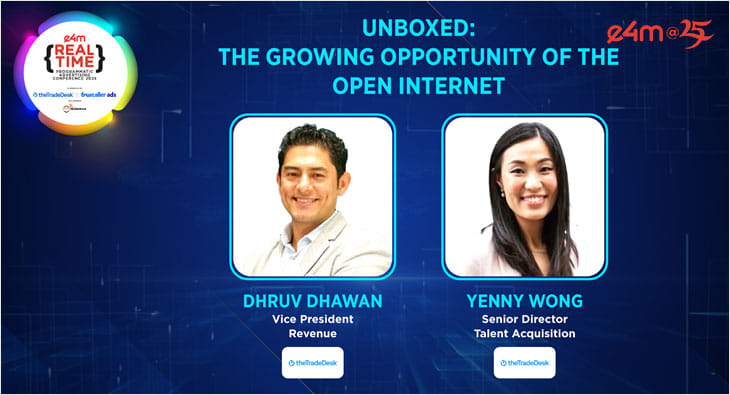

At the e4m Real-Time Programmatic Advertising Conference, The Trade Desk took center stage with a session titled “UNBOXED: The Growing Opportunity of the Open Internet”, led by Dhruv Dhawan, Vice President – Revenue, India, and Yenny Wong, Senior Director, Talent Acquisition, Asia-Pacific. The conversation set the tone for how digital advertising is evolving in India and why the open internet is becoming the most critical arena for marketers.
Opening the discussion, Dhawan highlighted how the advertising industry has transformed from rudimentary outdoor measurement exercises to today’s highly data-driven ecosystem. With nearly 900 million Indians online, attention is no longer concentrated in a handful of platforms but dispersed across music, streaming, connected TV, retail media, gaming, and online press. According to research cited by The Trade Desk, 74% of consumer time in India is now spent outside walled gardens such as Google, Meta, and Amazon. For advertisers, this creates both opportunity and complexity: the challenge lies in reaching fragmented audiences at the right moment, in the right context, while maintaining measurable efficiency.
Dhawan illustrated how the consumer journey has become an intricate web of touchpoints, spanning Spotify during a morning workout, digital out-of-home displays, OTT content, search and discovery platforms, and connected TV in the evening. In this landscape, brands need smarter ways to identify, target, and measure consumers across multiple environments. “The open internet is rewriting the rules,” Dhawan said, stressing that marketers cannot ignore the expanding share of consumer attention outside traditional walled gardens.
He went on to emphasize The Trade Desk’s unique positioning as the world’s largest independent media-buying platform, serving the interests of advertisers rather than owning inventory. Independence, transparency, and cutting-edge technology were flagged as the company’s competitive advantages. In India, The Trade Desk is strengthening partnerships with retail players like Zepto, Swiggy, and BigBasket, enabling precise audience targeting and retargeting across devices and channels. Dhawan noted that such collaborations allow advertisers to connect a television impression with a mobile action, maximizing attribution and efficiency. “If outcomes cannot be measured, advertising has little meaning,” he remarked, underscoring the importance of data-driven insights and attribution models.
The company’s Mumbai office, opened recently, is seen as a sign of commitment to scaling operations in India. Dhawan described The Trade Desk’s mission as not just serving ads but fundamentally “making digital advertising better,” and reaffirmed the company’s belief in the future of the open internet.
Transitioning the conversation, Wong brought the spotlight to the people behind the platform. “Nothing is more important than the teams that bring our vision to life,” she said. The Trade Desk processes about 11 million queries per second and generates 120 terabytes of data daily, a scale that demands deep technical expertise and a culture of collaboration. Wong explained that building and nurturing talent is at the core of The Trade Desk’s growth strategy, and India is seen as a key talent hub within Asia-Pacific.
She also emphasized the company’s strong culture, anchored in values like openness, agility, and empathy. Through mentoring, skill development, and career mobility, The Trade Desk is fostering an environment where employees can grow rapidly while contributing to innovations in programmatic advertising. Wong cited the example of Meeta Gupta, who joined the firm four years ago and now leads customer success in Delhi, as a story of how the company invests in its people.
Employees themselves echoed this sentiment in short testimonials, describing The Trade Desk as a place to learn, experiment with large-scale data, and grow careers in a collaborative and dynamic environment. Wong noted that only 2% of the company’s global mission has been achieved, with Asia-Pacific emerging as the fastest-growing region and India poised to play a central role in this expansion.
The session closed with a reminder that the open internet is no longer a niche but it is where audiences spend most of their time, and where brands must be present if they want to stay relevant. By combining independent technology, strong publisher and retail partnerships, and a culture built on people, The Trade Desk positioned itself as a key enabler for marketers navigating the complexities of modern advertising.
As Dhawan summed up, “We stand for the brand and the buyer. Our goal is to empower advertisers with transparency, precision, and outcomes. The future of the open internet depends on it.”
Read more news about Marketing News, Advertising News, PR and Corporate Communication News, Digital News, People Movement News
For more updates, be socially connected with us onInstagram, LinkedIn, Twitter, Facebook, YouTube & Google News