Don’t be a cookie cutter, stay true to your brand value: Shankar Prasad, Plum Goodness
While speaking at the Real Time Programmatic Advertising Conference, Shankar Prasad, Founder of Plum Goodness, explains why 'obsession' with the consumer is important for brands today
 by
by
Published: Sep 19, 2024 2:09 PM | 5 min read
 Follow Us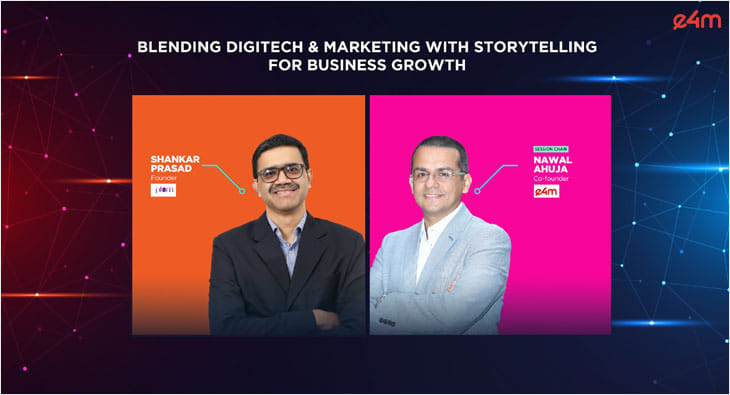

Shankar Prasad, Founder of Plum Goodness, engaged in a fireside chat with Nawal Ahuja, Co-founder of exchange4media Group, on the topic "Blending Digitech & Marketing with Storytelling for Business Growth." Prasad, who worked close to 8 years with Hindustan Unilever, shared how his stint with the FMCG giant shaped his outlook towards marketing and what makes HUL such an institution.
Prasad said, "I joined HUL 27 years ago, and the first thing I was told was ‘Sleep well at night because we do all the right things,’ which shows how serious HUL was about ethics. There was a strong sense of doing the right thing and not crossing lines regarding compliance or boundaries of the law. The obsession with the consumer is very important to us. At HUL, they taught me that the customer is a ‘She’ 25 years ago, and that concept stuck with me. Plum was also founded with a ‘She’ in mind. Of course, there are male customers now, but the image of the consumer in our minds is still a ‘She.’ This consumer-centric mindset is vital.”
He continued, “Digitally, we are all learning, but these fundamentals don’t change. HUL, despite being a behemoth, is adapting and evolving at a phenomenal pace.”
Ahuja then asked Prasad about the beauty and wellness space, which has seen explosive growth in recent years. He mentioned how investors often talk about two kinds of baskets—white space and disruption—and asked Prasad for his outlook on the industry’s future: will it remain fragmented, or will we see consolidation?
Prasad responded, saying that he could only speak for the beauty and personal care industry, as D2C covers a wide range of sectors. “Beauty and personal care, by nature, has a long and fat tail of brands. Even abroad, it’s not a two or three-player market; it’s a multiplayer market. It’s important to avoid having a static view of the world in terms of market shares or investments, especially when marketing is changing, and consumer access to information and preferences are evolving.”
He further added, “Brands that evolve with changing consumer preferences while staying true to their core values will succeed. Every day, we’re faced with choices, but we must always be guided by where the consumer is and what the brand stands for. It’s a thin line to walk in order to stay relevant. Many great brands fail to evolve and end up in drastic situations just a few years later, that’s how fickle the market has become. This gives room for new brands to emerge, but only those that evolve and adapt while staying true to themselves will thrive.”
Ahuja then commented on the innovation happening in the space, referencing Plum’s Kajal and sharpener story, which Prasad had shared in various forums, including the India Enclave. Prasad explained how they had to address customer concerns regarding the Kajal pencil’s PVC-free barrel, which was difficult to sharpen. "We went to ground zero and fixed it, again emphasizing the importance of consumer satisfaction."
Prasad continued, “Consumer context is crucial when it comes to product design and innovation. Listening to feedback makes all the difference. HUL ingrained that in me through market visits and meeting customers, especially in small markets and villages, to understand exactly what the consumer is looking for.”
Ahuja then inquired about the increasing impact of technology on marketing and asked where Prasad saw the biggest opportunities for a category like beauty and personal care. Prasad responded, “I must admit, I come from a non-marketing and traditional world view, so seeing how tech is evolving into programmatic and AI is interesting, yet challenging from a business perspective. If you break marketing tasks down into four areas—strategy, planning, production, deployment, and engagement—you’ll see the biggest opportunity lies in strategy and planning. The amount of data available is overwhelming. Every day, we encounter new data sets, such as dark store availability and search patterns in quick commerce, which didn’t exist six months ago. This opens up torrents of data that have implications for advertising decisions.”
He went on, “Strategy and planning can be fine-tuned according to your spending, making it almost ‘uber-optimal.’ The challenge is keeping up because things are changing so fast. By the time you think you’ve mastered something, something new comes along. Where I’ve found the most joy is in production. Recently, a team member made a fully AI-generated video for our 10th anniversary. The kind of animation we achieved wouldn’t have been possible in-house. AI is changing the way content is produced, which is a relief when we don’t have enough designers. At least 30% of routine work can be done through AI, but for the remaining 70%, you still need creative humans to ensure the quality is right. Engagement is also evolving with chatbots and CRMs becoming more intelligent in how we communicate with consumers.”
Ahuja then raised the issue of over-dependence on technology, asking if there’s a risk of losing the human touch. Prasad agreed, saying, “In our space, there’s a risk of brands becoming predictable and mechanical. The data-driven approach can make things feel too cookie-cutter, but humans make decisions with their hearts, especially in categories like fashion, lifestyle, and beauty. Customers connect with a brand because it fulfills a need in their lives. As marketers, it’s important to understand why a customer vibes with a brand and to stay true to that. Her needs may evolve, but the brand must remain authentic in delivering what she loves. No algorithm can replicate that human connection.”
Prasad concluded by reflecting on how social media, despite being an algorithmic platform, still allows people to see through to the heart of a brand, and that authenticity continues to resonate with consumers.
Read more news about Marketing News, Advertising News, PR and Corporate Communication News, Digital News, People Movement News
For more updates, be socially connected with us onInstagram, LinkedIn, Twitter, Facebook, YouTube & Google News
