Brand building has no time to wait: Kartik Sharma, OMG India
Kartik Sharma, CEO of Omnicom Media Group (OMG) India, spoke on 'The Changing Face of Sales: Platforms, People & Possibilities' at e4M Revenue Leaders Conference 2025
 by
by
Published: Jul 31, 2025 9:29 AM | 5 min read
 Follow Us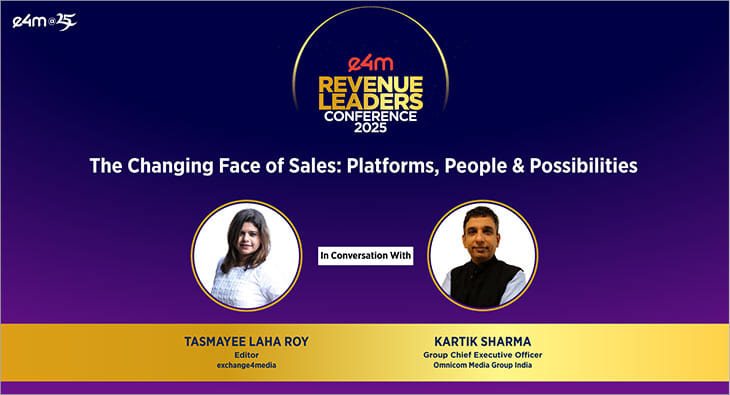

Kartik Sharma, CEO of Omnicom Media Group (OMG) India, struck a blunt yet pragmatic tone as he spoke on The Changing Face of Sales: Platforms, People & Possibilities at e4M Revenue Leaders Conference 2025. The core of his address? In today’s hyper-pressured environment, even long-term brand building has to prove short-term returns.
"Brand building used to be long-term. But shareholders now won't give you years. It's come down to quarters,” Sharma said. “You’ll be lucky if you're getting two or three quarters.”
To drive home the urgency brands are under, he cited a striking statistic: 10 of the Nifty 50 companies—India's top 50 publicly traded firms—have seen CEO changes in the last five years. That’s 20% churn among the country’s best-run corporations. “It’s not even like the five-year government we vote for,” he quipped, adding that stakeholders today are no longer willing to wait even a decade to see results.
The agency’s new client: The CFO
Sharma also detailed how the definition of ‘client’ itself has evolved for agencies. Where media planners once spoke only with CMOs, they now spend as much time in boardrooms.
“I now end up spending a lot of time with CEOs. In some cases, board members. In some cases, the CFO. The client definition itself has changed.”
This has also reshaped the pitch process. Agencies are no longer expected to just present creative ideas or media plans—they're expected to decode the P&L.
“Today, I end up reading a lot more annual reports. And why should a media agency do that? Because there's data there—A to S ratio, free cash flow—things which show what is really happening in the company,” Sharma explained.
No more vanity metrics
Sharma emphasized that agencies must shift from selling "vanity metrics" like reach or engagement to proving business outcomes.
“I’ve got a lot of reach. I got a lot of engagement. And I have got a lot of stickiness. It’s good but not sufficient,” he said. “The ability to connect the input to business impact is becoming primary. Agencies which can do that, win. Others go by the way.”
He likened today’s marketer to a doctor whose prescription has to directly fix a patient’s problem. “That level of high skill is what is expected now out of agencies.”
Why media sellers need to think like strategists
In the world of increasingly cluttered media platforms, Sharma said that media sellers can no longer rely on relationships or standard decks to push inventory.
“Good old relationship will at best guarantee you a meeting. Beyond that, it is a lot of hard work,” he said. “You need to understand the full funnel of what the client is doing. Integration is the most abused word in marketing, but you have to really mean it.”
He urged media sellers to study a brand’s category and even their financials before approaching an agency: “If it’s a listed company, read the annual report. If not, go mystery shop. Talk to real consumers. Ground reality is very different from boardroom reality.”
Precision vs scale? Don’t sacrifice one for the other
On the perennial dilemma between precise targeting and mass reach, Sharma explained that while precision is valuable, over-reliance on it—especially just because digital allows it—can hurt probability-based outcomes.
“If I divide this room in half and exclude one group, my chance of selling goes down. So don’t make it too narrow just because you can,” he said. “Scale is always needed if you want to grow. Even for a ₹1 crore car, factories have to run.”
AI budgets are real, and the gap is widening
Citing jaw-dropping numbers, Sharma reminded the audience just how much big tech is investing in AI: Google at $100 billion, Meta at $50-60 billion, Amazon at $70-80 billion.
“Now fight them,” he challenged. “Hope will not win you business. Doing something really meaningful will.”
On pricing: Effectiveness over efficiency
Sharma addressed the industry’s growing obsession with low pricing during pitches, calling it a flawed proxy for value.
“Pricing is an efficiency metric. What the client actually wants is effectiveness,” he said. “If a client has ₹100 crore and I show that the right plan only needs ₹70 crore, I’ve saved them ₹30 crore—not by discounts, but by planning.”
He blamed the rise of procurement-led decisions for reducing complex business challenges to lowest-cost wins. “Some are sophisticated, most are not. They look at media the same way they look at buying auto parts.”
The rise of cross-skilled generalists
According to Sharma, the industry has over-specialised to its own detriment. With clients now seeking integrated solutions, the pendulum is swinging back toward generalists who can understand the business holistically.
“Clients don’t want so many agencies. They want one person who can tell the story,” he said. “Skills are far more limited today. Broad understanding of brands, marketing and business is going to be key.”
OMG, for instance, mandates continuous certification for its teams—whether it's skill-based learning or complex leadership training. The company runs global programs in partnership with Harvard to build real-life problem-solving capabilities.
Final mantra: There’s no shortcut to trust
Sharma wrapped up with a simple but powerful piece of advice for emerging media platforms looking to win agency trust:
“Invest in yourself. Read FE case studies. Talk to consumers. Talk to Gen Z. Read annual reports. Understand the business. Nothing replaces hard work. A one-day program will not solve your problems.”
As he put it, “If quick fixes were possible, everybody would’ve done it. They’re all smart people here. It takes a lot of work.”
Read more news about Marketing News, Advertising News, PR and Corporate Communication News, Digital News, People Movement News
For more updates, be socially connected with us onInstagram, LinkedIn, Twitter, Facebook, YouTube & Google News