Is it a TV serial? Is it a trailer? Nope, its AI storytelling twisting the marketing plot
With AI-powered storytelling gaining momentum, influencer marketing is moving beyond top-of-the-funnel awareness to driving full-funnel impact — from brand discovery to purchase and retention
 by
by
Published: Jun 6, 2025 9:02 AM | 5 min read
 Follow Us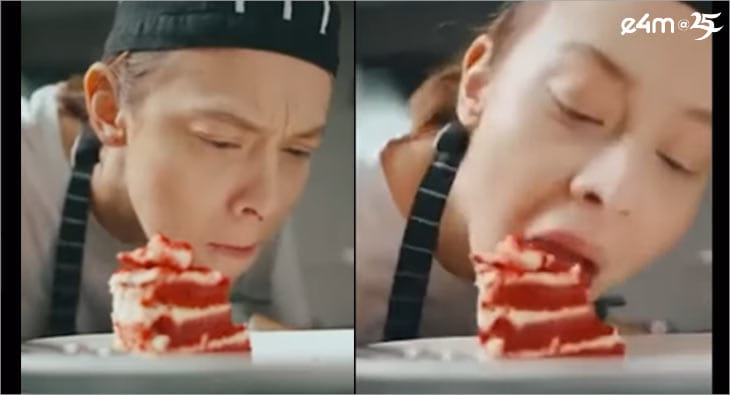

South Indian food chains are cutting through the ad noise on social media — not with big budgets or celebrity faces, but with AI-generated soap opera-style reels. Waltair Kitchen, a restaurant, recently shared a reel that looked straight out of an old-school TV serial.
At first, it didn’t even register as an ad. There was no product placement, no obvious branding — just AI storytelling. Viewers got hooked, drawn into the melodrama, expecting a twist or a heartfelt ending — only to be surprised by a sudden biryani reveal.
Oddly enough, it worked. At the time of writing, the reel had crossed 100K shares, 47,900 likes, and nearly 2K comments — blurring the line between fiction and advertising. The reels have reactions ranging from “Marketing team killing it” to playful speculation like “What happened to the man’s girlfriend?” and “Where’s the ring?”.
View this post on Instagram
Despite the seemingly incoherent plot, the narrative stuck — and more importantly, it worked. The restaurant claimed to have a visible increase in footfall, driven by the reel’s high recall value and intrigue-led storytelling.
This isn’t an isolated case of such ads, many D2C brands are now using the same formula to grab attention, especially as the average consumer’s attention span on a single screen has dropped to just 47 seconds, down from 2.5 minutes in 2004.
Soft Integration, High Recall
Shweta Kaushal, Founder Director at CreatorCult, acknowledged the growing trend. “These kinds of stories pop up where there are realistic pictures and you can make out it's an AI-led picture. It's not as creative as a real ad video. But having said that, storytelling is actually working for brands.”
She explained that this shift in content is giving rise to two distinct approaches: direct messaging typical of D2C brands, and soft integrations, where storytelling drives subtle product placements. “They don't want a very pushy kind of content that I directly introduced the brand. So there, storytelling does work.”
However, she noted that shorter formats are still key. “Instagram's algorithm or Meta's algorithm still pushes the 20-second reel a lot. So, if you have a lot of storytelling in it, your engagement will go there.” For longer storytelling, YouTube remains relevant, with Kaushal calling it “the LIC of the digital world” — a platform where content keeps getting traction years after it goes live.
AI Meets the Funnel
Sagar Pushp, Co-Founder and CEO of ClanConnect, outlined the deeper transformation underway in influencer marketing. “Influencer marketing is quickly shifting from a top-of-the-funnel tool to a full funnel approach playing a pivotal role in consideration, conversion, and retention,” he said.
Pushp attributed this change to smarter creator collaborations and AI-enabled insights. “Predictive analytics can now tell a brand what to expect in outcomes and allows for real time optimizations reducing risk.”
He emphasized the role of platform-specific content — whether it's short videos or live sessions — in making campaigns more targeted and contextual. “This shift represents a significant development in the influencer marketing industry and needs not only to measure and drive performance, but to connect, provide value and build lasting relationships.”
The Blurring Line Between Fiction and Influence
The rise of AI-generated storytelling is further amplified by tools like Google’s Veo 3, a new video generation model that can create hyper-realistic videos from text prompts. Already, platforms like Instagram and X are seeing fictional product demos and spoof news reports that feel indistinguishable from reality. As AI content becomes increasingly lifelike, the boundary between creative fiction and marketing is dissolving.
For brands, this presents both an opportunity and a challenge — the ability to hook audiences with surreal narratives while maintaining transparency and trust.
How creators are bridging the gap
Praanesh Bhuvaneswar, Co-Founder and CEO of Qoruz, explained how creators have moved from being an afterthought to becoming integral to media planning. “In categories like personal care and D2C, creators sit alongside TV and display in media planning meetings.”
This approach now involves a structured framework. “You now have frameworks that map the right content to the right audience, predict likely outcomes, and benchmark success,” said Bhuvaneswar.
Qoruz, he shared, uses AI to match content to business outcomes. “We analyze things like audience overlap, historical performance, and even engagement velocity to figure out who’s likely to drive clicks, who’s better for installs, and who’s just a better cultural fit for your brand.”
And content doesn’t end with a post. “High-performing teams today are treating influencer content as ad assets, remixing and repurposing videos into mid-funnel creatives, running them in A/B tests, and plugging them back into their performance engine.”
“Honestly, the funnel isn’t what it used to be. It’s no longer this neat, linear path from awareness to conversion. What we’re seeing today is a fluid, creator-led loop where people discover, consider, and even purchase all within a single piece of content,” he said.
AI Cuts Through the Noise
“One of the biggest challenges in influencer marketing has always been making sense of all the noise, millions of posts, creators, campaigns happening every day,” said Bhuvaneswar. “That’s where our AI comes in.”
He cited practical use cases: “A brand can see how they’re performing against competitors, what kind of creators their competitors are working with, which campaigns performed best, where they’re falling behind. On the flip side, with Trends & Insights, you can look at what’s worked in the past, say, during Diwali or IPL and use that data to plan smarter, faster, and more relevant creator collaborations."
That’s where using AI comes in handy, according to brand experts.
Read more news about Digital Media, Internet Advertising, Marketing News, Television Media, Radio Media
For more updates, be socially connected with us onInstagram, LinkedIn, Twitter, Facebook, YouTube & Google News