D2C Brand Innovation: Investor insights for scalable and sustainable growth
At the HiveMinds Ecommerce Conclave 2025, one of the most insightful discussions revolved around the theme of D2C Brand Innovation
 by
by
Published: Mar 27, 2025 4:43 PM | 5 min read
 Follow Us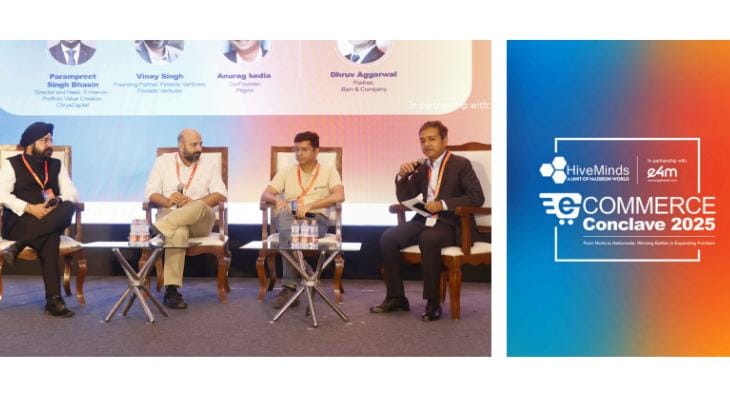

At the HiveMinds Ecommerce Conclave 2025, one of the most insightful discussions revolved around the theme of D2C Brand Innovation, where industry leaders shared their expertise on building scalable and sustainable brands in India. The event brought together notable dignitaries and thought leaders, such as Sam Balsara, Chairman & MD of Madison Media, who delivered the welcome address, and Noopur Chaturvedi, CEO of NPCI Bharat BillPay Ltd., who provided a thought-provoking keynote on the future of digital payments and the growing role of commerce in India’s economy.
The event also boasted of a large gathering of investors and entrepreneurs. The panel discussion on the topic, For a country like India, is Innovation enough to build Mega D2C Stories , Parampreet Singh Bhasin, Director and Head, Enhancin - Portfolio Value Creation,ChrysCapital and Vinay Singh,Founding Partner, Fireside Ventures debated the reasons behind success and failure of D2C brands with Anurag Kedia, Co-Founder, Pilgrim. The session was chaired by Dhruv Aggarwal, Partner, Bain & Company.
Innovation: The Key to Insurgent Brand Success
The panel highlighted that innovation is at the heart of successful insurgent brands looking to carve their niche in a competitive market. Parampreet Singh Bhasin from ChrysCapital aptly stated, “Innovation is the key for insurgent brands to make their mark.” Drawing on examples like Atomberg’s disruption in the fan industry and Mamaearth’s successful launch of a clean mosquito repellent for babies, the discussion illustrated how product innovation can effectively address market gaps and offer a unique value proposition.
Panelists also emphasized how D2C brands in India are increasingly focusing on consumer insights and data to guide their product development. With new-age technologies enabling brands to engage with audiences differently, innovation has evolved beyond product creation—it's now about understanding consumer needs and delivering tailored, meaningful solutions. This focus on consumer-centric innovation is exactly what investors seek when evaluating D2C brands for funding.
Building Brand Loyalty: An Audience-Centric Approach
Anurag Kedia from Pilgrim discussed the critical importance of transitioning from a distribution-focused model to an audience-focused brand-building approach. As Kedia shared, “In the 0-1 journey, media is the last step. A customer will discover your brand in any medium now—every content that reaches the consumer is brand building for me.”
For early-stage D2C brands, Kedia emphasized the significance of leveraging owned media touchpoints—social media, packaging, websites, and email marketing—to build connections with consumers. While this process requires substantial time and effort, it is a cost-effective way to build strong brand foundations. Investors are particularly interested in brands that are able to maximize these early-stage, low-cost strategies to foster long-term brand loyalty.
The panelists agreed that building brand loyalty today goes beyond just performance marketing. D2C brands must create a multi-step consumer journey, ensuring that every interaction—from packaging to social media—is consistent and meaningful. This approach is critical for brands looking to develop trust and cultivate lasting relationships with their audience.
Data and AI: Fueling Growth and Scalability
A key highlight from the session was the growing role of data and AI in scaling D2C brands. Investors like Vinay Singh from Fireside Ventures noted, “The biggest asset for a brand today is its audience, not its distribution.” The panel discussed how leveraging data and AI not only helps brands understand their audience better but also allows them to optimize their marketing and media strategies for sustained growth.
D2C brands today must utilize data-driven insights to ensure they are engaging with the right audience in the most effective ways. Investors are looking for brands that can use these insights to drive conversions, optimize customer acquisition, and maintain a strong and consistent brand presence across various platforms.
Navigating the Challenges of Scaling and Delegation
Scaling a D2C brand presents unique challenges, and the panel addressed key considerations when it comes to building the right team and structuring the business for growth. Anurag Kedia stressed that a successful founding team must possess a mix of essential skills: “There are three capabilities that are critical in the founding team: product/domain understanding, brand-building, and digital growth hacking.”
Investors prioritize these core capabilities when evaluating startups. They want to see a well-rounded team with the expertise needed to scale the brand effectively. Additionally, Kedia discussed the importance of cash flow management, an often-overlooked but critical skill for managing business growth.
As the business scales, delegation becomes increasingly important. The panelists agreed that successful D2C brands must build teams that can adapt and evolve as the brand grows. Kedia explained, “Hiring bottom-up is the way to build a team—let it scale to the top as the brand and capability grow.”
Capital Efficiency: A Key Factor for Investment
The conversation also touched on the importance of capital efficiency when building a D2C brand. Parampreet Singh Bhasin pointed out that capital efficiency is a critical factor for investors when evaluating D2C businesses. “At different stages, capital efficiency acts as a minimum threshold for us when looking to invest in a D2C brand,” he said. For investors, it’s not just about having a strong product-market fit; it’s about the brand’s ability to grow sustainably while managing costs effectively.
The Future of D2C: Innovation, Consumer-Centricity, and Strategic Scaling
The D2C Brand Innovation panel provided a comprehensive look at the strategies and best practices helping brands succeed in the competitive digital marketplace. As panelists highlighted, the key to scaling a successful D2C brand in India lies in continuously innovating, understanding consumer insights, and building strong, audience-centric brand connections.
For investors, the future of D2C lies in supporting brands that prioritize a consumer-first approach, leverage data and AI for scalability, and demonstrate the agility to adapt to changing market conditions. The HiveMinds Ecommerce Conclave 2025 served as a vital platform for brands to gain the insights they need to position themselves for success in the rapidly evolving ecommerce landscape.
Read more news about Digital Media, Internet Advertising, Marketing News, Television Media, Radio Media
For more updates, be socially connected with us onInstagram, LinkedIn, Twitter, Facebook, YouTube & Google News