Omnicom–IPG: Why India's leadership announcement will be the most anticipated
A market defined by unmatched scale, breakneck growth and leadership heavyweights, India now stands at the epicentre of the merger narrative
 by
by
Published: Dec 1, 2025 8:46 AM | 6 min read
 Follow Us

When the world’s largest advertising holding company Omnicom announces its consolidated leadership, and possibly the operating blueprint as well, on December 1 after absorbing IPG group, most global observers will be scanning the top deck in New York, London, or Singapore. But insiders know the real suspense lies elsewhere—in India. The subcontinent’s leadership chart, more than any other market, will signal who controls the next phase of growth in the combined Omnicom–IPG universe. This is not merely an HR announcement. It is the geopolitical frontier of the merger.
India is the world’s largest consumer market at present. The country’s advertising spend, currently estimated at around ₹1.07 lakh crore and accounting for roughly 0.4% of GDP, is expected to rise to nearly 0.5% by 2029, according to Bain & Company’s Advertising in the Digital Age: In India and Around the World report. Regionally, North America continues to hold nearly half of global advertising spend, growing steadily at 9–11% per annum through 2029. The Asia-Pacific region, however, is set to outpace it, driven by high-growth markets such as India, which is projected to grow at a 10–15% CAGR. This surge is underpinned by rising media consumption, platform innovations, and expanding internet penetration across both metro and non-metro markets.
India’s GDP growth surged to 8.2% in Q2 FY26, driven by strong manufacturing, services and investment, reflecting robust economic momentum despite global challenges, as per the government data. At the same time, India’s broader internet economy is expected to reach $1 trillion by 2030.
With quick-commerce platforms, retail media networks, and AI-powered targeting reshaping the digital landscape, the next five years will be pivotal for marketers. Advertisers who embrace mobile-first strategies, regional storytelling, and attention-led measurement frameworks will be best positioned to capitalize on this growth.
The report underscores that India is rapidly becoming one of the most dynamic advertising ecosystems globally. Omnicom, armed with fresh talent and new capabilities post-merger, is keen to tap into India’s potential early and aggressively.
Ashish Bhasin, senior industry leader and the founder of The Bhasin Consulting Group and Former CEO Asia Pacific at Dentsu, says, “India is one of the most important markets for Omnicom post its acquisition of IPG for several reasons. It is among the fastest-growing economies, poised to become the third largest in the world after the US and China in the next two years. Moreover, India is a net exporter of exceptional talent—we’ve consistently seen Indian leaders occupy pivotal global roles.”
“It will be interesting to see how the combined entity picks its executives and veterans to steer the India market”, quips Bhasin.
Also read: Omnicom seals IPG acquisition; leadership structure to be unveiled on Dec 1
Omnicom–IPG consolidation puts FCB & DDB in the spotlight
Global No. 1 & Indian No. 2: How Omnicom–IPG merger redraws the power map
Why India Is the Most Politically Sensitive Market
Across creative, media, and digital territories, India’s advertising landscape has been shaped by leaders who don’t merely run agencies—they shape narratives.
In the US and Europe, power resides in systems; in India, power resides in people. The Omnicom–IPG merger brings together two leadership cultures that, while professionally cordial, are structurally distinct—one driven by platform logic, the other energized by iconic talent brands, quips a senior ad executive.
According to a senior industry executive, “Omnicom and IPG together bring more than a dozen marquee agency brands—each with its own legacy, leadership style, and internal hierarchies. Bringing them under one strategic umbrella without diluting their identities or igniting turf wars will require more than a structural reorganisation; it demands cultural assimilation at a scale the industry has never witnessed.”
Whether the combined leadership can reconcile competing philosophies, redistribute influence, and maintain momentum without alienating entrenched power centres is the question everyone in the market is now asking.
What will make these announcements more remarkable is that Omnicom will encounter its toughest contest in India from the UK-based WPP, which currently commands close to 35% of the country’s advertising spends. The eventual leadership construct, insiders say, will hinge on who is best equipped to take on the rival at a time when the UK-based holding giant is perceived to be navigating one of its most challenging global phases.
India is no longer a peripheral geography in global media networks; it is the gravity centre where creative scale, digital experimentation, retail media, and vernacular content intersect with a consumption economy on steroids. For Omnicom and IPG, both of whom have fortified India through powerful agency brands and strong-willed leaders, the biggest challenge isn’t synergy—it’s centre of gravity.
Ramesh Narayan, veteran adman and Director Strategy, Asian Federation of Advertising Associations (AFAA) shares, “Both Omnicom and IPG have performed strongly in India, led by exemplary leadership teams. Combine that with India’s exceptional economic prospects, and it’s clear Omnicom will be planning its future with India firmly at the centre.”
Also Read: EU gives unconditional approval to Omnicom–IPG merger
Omnicom–IPG merger would hold ‘moderate market positions’ in Europe: EU Commission
IPG employees on the edge as countdown to Omnicom acquisition intensifies
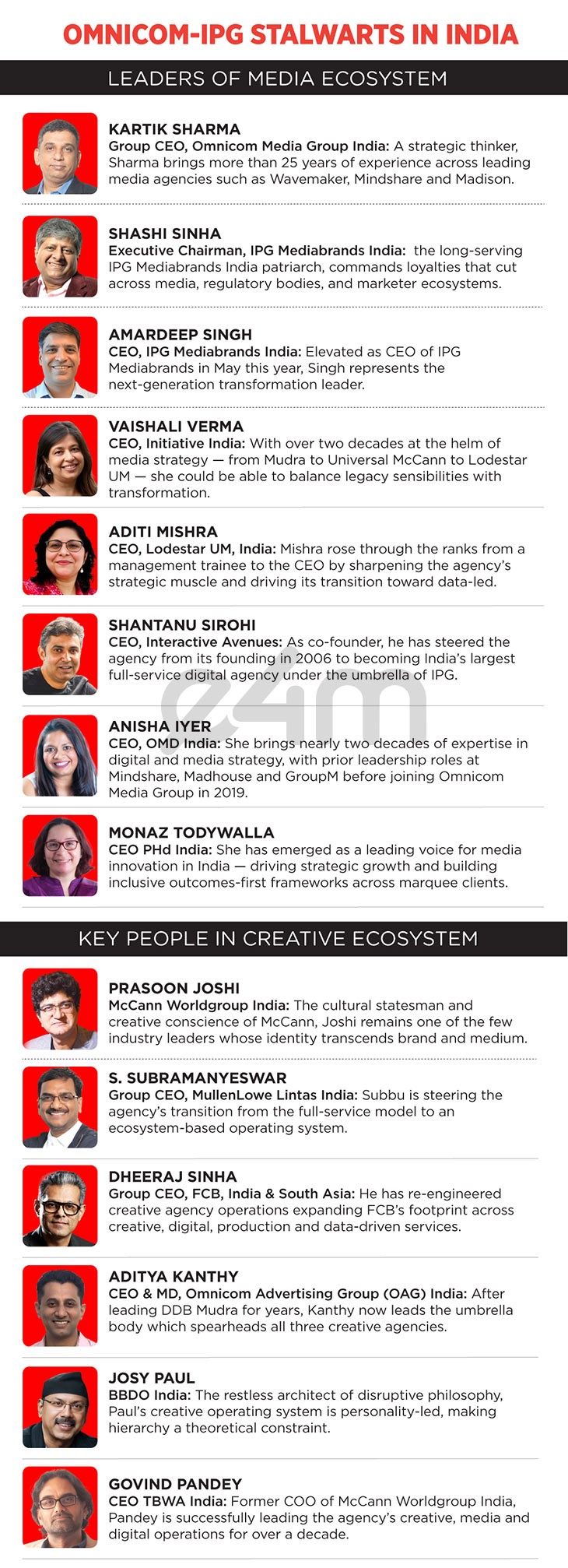
The power Matrix
The IPG group in India has four main agency brands under its fold- Mediabrands (led by Shashi Sinha, Amardeep Singh), Initiative (led by Vaishali Verma), Lodestar UM (led by Aditi Mishra) and Interactive Avenues (led by Shantanu Sirohi).
Omnicom Media Group (OMG), which is led by Kartik Sharma, has three agencies under its fold–OMD (led by Anisha Iyer), PHD (led by Moanz Todywalla), and Heart & Science (led by Rochelle Chhaya).
As far as the Creative ecosystem is concerned, Omnicom operates three major creative agencies in India-- DDB Mudra Group, TBWA India and BBDO India. The holding company has already moved toward consolidation globally, integrating its creative agencies under Omnicom Advertising Group (OAG), led in India by Aditya Kanthy.
The IPG group also had three agencies–McCann Worldgroup India, FCB Group India, Mullen Lowe Lintas Group. IPG agencies continue to operate under their respective global structures.
Each of these leaders has authority. Each commands a constituency. And none is easily repositioned without consequences. Though insiders believe dual governance will not last long once integration accelerates.
However, no one knows yet—Who will become the commercial custodian of India’s unified growth story? Will creative and media continue to operate as separate moral universes, or converge under capability heads? Will India operate under a single P&L, and if so, whose name—legacy or new—will sit atop it? And how will the personalities that have defined the Indian advertising landscape for decades coexist within a system that demands shared accountability?
A senior industry strategist summed it up succinctly: “In the US, leadership is power. In India, leadership is identity. If India doesn’t get the architecture right, you don’t get the market.”
Industry is in the wait and watch mode till Tuesday.
Read more news about Internet Advertising India, Marketing News, PR and Corporate Communication News, Digital Media News, Television Media News
For more updates, be socially connected with us onInstagram, LinkedIn, Twitter, Facebook YouTube & Google News