The best and the good of FIFA World Cup 2026 ads
From Nike's genre-defying 'RIP the Script' to Coors' one-trick chant, here's how the biggest FIFA World Cup 2026 campaigns stack up
 by
by
Published: Jun 6, 2026 9:43 AM | 9 min read
 Follow Us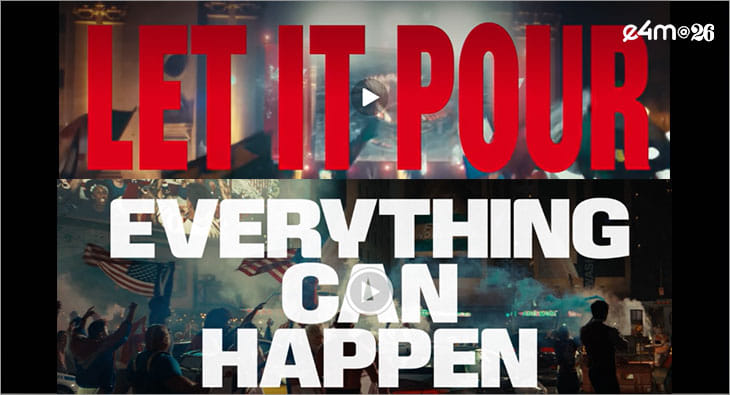

- The FIFA World Cup generates significant advertising activity, with brands aiming to create campaigns that resonate culturally and emotionally, particularly for the 2026 edition co-hosted by the U.S., Canada, and Mexico.
- Nike's "RIP the Script" leads the rankings for its ambitious storytelling and cultural relevance, featuring prominent athletes and celebrities, while Adidas' "Backyard Legends" emphasizes nostalgia and the grassroots origins of football.
- Coca-Cola's "Uncanned Emotions" focuses on fan experiences rather than the sport itself, effectively connecting the brand to the emotional moments surrounding the World Cup.
- Other notable campaigns include Pepsi's "Football Nation," which celebrates global football culture, and Budweiser's "Let It Pour," which creatively links beer to the anticipation of the tournament, while some campaigns, like Coors Light's "The Coooors Call," struggle with originality and depth.
Every four years, the FIFA World Cup turns the advertising industry into a parallel tournament of its own. Brands queue up, briefs balloon, and the global stage demands that creative work do more than sell. It must feel like the sport itself.
The 2026 edition, co-hosted across the United States, Canada, and Mexico, has drawn an unusually strong creative field. Global ad spend around major sporting events has consistently outpaced broader market growth; GroupM's 2025 Global Ad Spend Forecast pegged sports-driven advertising as one of the fastest-growing segments, with event-linked campaigns delivering measurably higher brand recall and purchase intent than non-event work.
Against that backdrop, here is how the biggest campaigns of the cycle rank, best to good.
The gold standard
Nike's "RIP the Script" arrives not as an advertisement but as a statement of cultural intent, and it earns its position at the top of this ranking almost without argument. Created by Wieden+Kennedy, the six-minute film sets football free from the controlled machinery of film production, letting Cristiano Ronaldo, Kylian Mbappé, Erling Haaland, Vini Jr., Ronaldinho, and Zlatan Ibrahimović write their own rules as the set collapses around the director's careful plans. The casting of cultural cameos, like Kim Kardashian, LeBron James, Travis Scott, LISA from BLACKPINK, and Ted Lasso, is not stunt work; it is a deliberate argument that football no longer belongs only to football. It belongs to culture. What lifts "RIP the Script" above the field is its formal ambition. Six minutes is a gamble that most marketing committees would kill before the first internal review. That Nike not only greenlit it but built an entire "Universe of Nike Football" around it signals the kind of brand confidence that advertising rarely gets to express. The film celebrates instinct, joy, and creative irreverence: qualities that have always defined the best football and the best advertising.
If Nike represents football as culture, Adidas' "Backyard Legends" represents football as memory, and the emotional gap between the two is narrower than it first appears. Where Nike looks outward toward celebrity and spectacle, Adidas turns inward, toward the cracked concrete, the improvised goalposts, and the endless afternoons before anyone was watching. The campaign's star-studded cast is deployed with restraint, placed not in stadiums but in the spaces where the sport is first loved rather than performed. Adidas has spent decades building the argument that greatness begins before recognition, and "Backyard Legends" is the clearest articulation of that belief the brand has produced in years. The nostalgia is real, not manufactured. That distinction matters enormously in a creative field where sentiment is frequently mistaken for sincerity.
The smart money
Coca-Cola's "Uncanned Emotions" makes a choice that most World Cup campaigns are too nervous to make: it removes the football almost entirely. Created by WPP OpenX and led by Ogilvy, the film is built around fans rather than players, and around commentary rather than action. The deployment of broadcasters Peter Drury and Luis Omar Tapia, whose voices have narrated some of the sport's most electric moments, is a masterstroke of emotional shorthand. Their presence alone unlocks memory for any serious football watcher, and the campaign understands that Coca-Cola's relevance to the World Cup is not about the pitch; it is about what happens in the living room, the bar, and the street when something extraordinary occurs. The extension into physical fan experiences (the FIFA Trophy Tour, Panini collectibles) shows a brand that has thought beyond the thirty-second film. Coca-Cola's World Cup work has often been underrated because it does not announce itself loudly. This campaign earns its place in the sharp second tier precisely because of that discipline.
Pepsi's "Football Nation" is the most explicitly global campaign in this field, and it uses that ambition to its advantage. The conceit (a fictional nation where football is the common language) gives the brand a framework flexible enough to contain David Beckham, Mohamed Salah, Vinícius Júnior, Cole Palmer, Alexia Putellas, Lauren James, and Leah Williamson without the film feeling like a roster announcement. That is a genuine creative achievement. Where Pepsi campaigns have sometimes suffered from trying to be everything at once, "Football Nation" finds a unifying idea strong enough to carry the weight of its talent. The inclusion of women's football figures alongside the men, like Putellas, James, and Williamson, is not a decorative addition, which reflects where football culture has actually moved, and the campaign is stronger for taking that seriously.
Fox Sports' "Miracle" is the most specifically American campaign in the cycle, and it works precisely because it is not embarrassed by that. The premise of a fan's daydream in which the United States wins the World Cup on home soil is set to Elvis Presley's ‘The Impossible Dream’, a choice that sits somewhere between grandiose and knowing. The reveal that the entire sequence is wishful thinking, rather than deflating the film, makes it more honest. Tom Brady, Zlatan Ibrahimović, and Olympic hockey legend Mike Eruzione in the same frame should not work as well as it does. It does. Fox Sports is not selling matches here. It is selling permission to believe in something unlikely, which is, when you strip it back, what sports broadcasting has always sold.
The effective middle
Budweiser's "Let It Pour" understands beer advertising's fundamental constraint: the product must become the emotion, or it becomes furniture. Created by Grey Global Group and deploying Erling Haaland and Jürgen Klopp across more than forty countries, the campaign uses the image of a slow beer pour as a metaphor for the building anticipation of a tournament. It is a neat idea, cleanly executed, and the tonal blend of humour and dreamlike spectacle keeps the film from tipping into the solemn register that beer brands sometimes mistake for gravitas. "Let It Pour" will not be remembered as a landmark campaign, but it will do the work it was built to do: it will make people associate the tournament with the brand. In a forty-plus-market rollout, that is not a small thing.
Michelob ULTRA's "The Superior Match" takes the hotel lobby as its arena and turns it into an impromptu football pitch involving Lionel Messi, Christian Pulisic, Alex Morgan, Ronaldo Nazário, and Guillermo Ochoa, while Billy Bob Thornton waits patiently for his beer. The bellhop-as-protagonist device is well-worn territory, but the film executes it with enough energy and enough genuine talent on screen to carry the conceit. What holds "The Superior Match" back from the upper tier is the sense that its energy is borrowed from the cast rather than from an original idea. The talent does the work that the concept should do. Still, as World Cup advertising goes, borrowed energy is better than no energy.
Lay's "Most Epic Watch Party" is doing exactly what the "No Lay's, No Game" platform has always done: positioning the brand not inside the stadium but inside the living room, the sofa, the shared experience of watching together. David Beckham, Thierry Henry, Lionel Messi, and Alexia Putellas, alongside Steve Carell with unsuspecting real fans, is a formula, but it is a well-tested one. The campaign understands that Lay's is not a football brand in the Nike or Adidas sense, it is a company that wants to be present in the moment when football happens, not on the pitch. That clarity of purpose keeps the campaign coherent even when the execution does not push particularly hard.
Style over substance
Stella Artois' "Celebration" is the most straightforwardly entertaining film in the lower half of this ranking. David Beckham in a packed bar, slow-motion chaos erupting around a goal, a Stella Artois held intact while everything else spills. It is a simple joke told well. GUT's direction gives the film a visual quality that elevates it above standard beer advertising, and the "A Taste Worth More" positioning lands cleanly. The problem is that there is not much more to say about it. The campaign is competent, handsome, and entirely disposable. It will not change how anyone thinks about the brand, but it will not embarrass it either, which, for a premium beer advertising around a major tournament, is a defensible goal.
LEGO's "Everyone Wants a Piece" has the most novel formal approach in the cycle. Turning Cristiano Ronaldo, Lionel Messi, Kylian Mbappé, and Vinícius Júnior into collectible minifigures is an idea strong enough to carry the campaign even when the execution stays fairly safe. The brand is doing something no other advertiser in this field can do: it is literally making the players into objects of play. That is a genuinely different relationship with football fandom than any other brand here is proposing. What stops LEGO from ranking higher is that the campaign ultimately plays to its most obvious audience (younger fans, families) rather than reaching for the kind of cultural breadth that the Nike or Adidas work achieves. Safe is not a criticism when the brief is probably to sell sets. It is just a ceiling.
Visa's "Tap In" is the campaign in this field that most clearly knows what it needs to do and does it without excess. Jason Sudeikis, leading a cast that includes Lamine Yamal, Erling Haaland, Christian Pulisic, and Jorge Campos through a humorous articulation of seamless payments, is brand advertising working at its most functional. The double meaning of ‘tap-in’, the simplest football goal and the easiest payment, is a clean insight. The campaign extends sensibly into promotions, digital activations, and fan experiences across the three host nations. Nothing here will win a Grand Prix. Everything here will help Visa's business around the tournament, which is what Visa's marketing department presumably asked for.
Coors Light's "The Coooors Call" sits at the bottom of this ranking not because it fails on its own terms but because its terms are so narrow. The idea of replacing the "Gooooal" chant with "Coooors” is a single joke built into a campaign that spans television, digital, social, retail, and stadium activations. The joke is fine. It is even charming the first time. By the third or fourth execution, it has become a function of media budget rather than creative thinking. There is a school of advertising thought that says a simple, repeatable idea is a virtue, and that school is not wrong. But simple and repeatable only hold when the underlying idea has room to breathe. "The Coooors Call" does not. It is a tagline in search of a campaign.
Read more news about Internet Advertising India, Marketing News, PR and Corporate Communication News, Digital Media News, Television Media News
For more updates, be socially connected with us onInstagram, LinkedIn, Twitter, Facebook YouTube & Google News