15 barges, no clearances, no audience data: Mumbai's floating OOH test
As Mumbai moves to monetise its waterfront through 15 floating hoardings, questions over advertiser interest and green clearances have remained a concern, say industry players
 by
Published: Nov 26, 2026 9:43 AM | 7 min read
 Follow Us
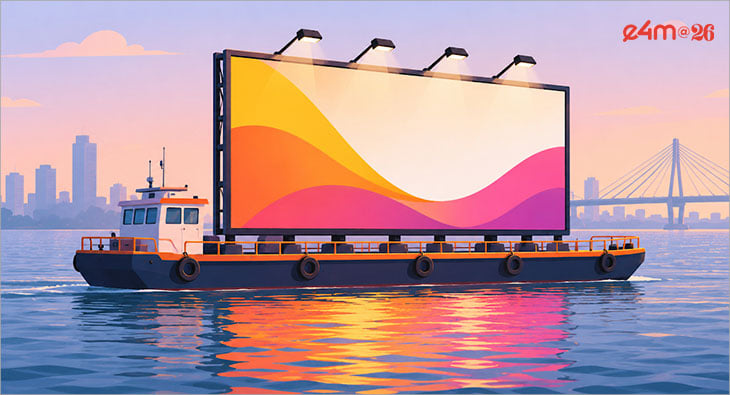

- Bids for Mumbai's first state-licensed fleet of floating billboards closed on November 27, amid mixed reactions from the out-of-home (OOH) advertising industry, ranging from skepticism to cautious optimism.
- The Maharashtra Maritime Board (MMB) aims to monetize waterfront areas, but the tender process has faced criticism from environmentalists and political figures, leading to confusion over the number of proposed floating billboards, which has fluctuated between 4 and 20.
- Industry experts express concerns about regulatory issues and environmental impacts, with some suggesting that brands are hesitant to engage until clearer guidelines and permissions are established.
- The commercial viability of floating billboards remains uncertain, as advertisers seek measurable audience data and face seasonal limitations, indicating that the format may not achieve widespread acceptance without addressing these challenges.
On 27 November, bids closed for what could become Mumbai's first state-licensed fleet of floating billboards. When e4m reached out to OOH players, the responses ranged from silence to off-the-record doubt to carefully worded optimism.
The Maharashtra Maritime Board (MMB) wants to monetise its waterfront, jetties and bridges. The industry is asking whether the sea is ready to be sold, and who would be the first to buy it.
A tender that keeps changing shape
The MMB's September round covered 19 location-specific tenders across Mumbai, Navi Mumbai and the wider Mumbai Metropolitan Region (MMR), extending to Mandwa Terminal. It mixed floating advertising barges with conventional illuminated hoardings and drew immediate criticism from environmentalists, citizens' groups and political leaders, including Aaditya Thackeray, who urged Chief Minister Devendra Fadnavis to scrap the plan.
Fisheries and Ports Development Minister Nitesh Rane then clarified that only four floating hoardings were planned in Mumbai's waters, two of them existing structures near the Sea Link. On 13 and 14 November, the MMB floated tenders for 15 illuminated floating hoardings at 10 locations across the MMR. Only four are on Mumbai's coastline. The other 11 sit on creek crossings and terminals elsewhere in the region.
The shifting numbers have not gone unnoticed in the trade. "The public numbers have swung from 20, to four, to 15 across the region in under a month," said Yuvrraj Agarwaal, Chief Strategy Officer, Laqshya Media Group.
The figures are not strictly contradictory, because each counts something different: the wider waterfront programme, Mumbai-only floating structures and the MMR-wide round. For a medium that is asking brands to trust it, though, the lack of a single stable number is a problem in itself.
When silence is the answer
Several OOH players were approached for this story. One company declined to comment, citing the subject's links to government regulations and government bodies. Another reply was brief. "This is still under a bit of controversy due to regulations and public sentiments. I would like to avoid giving any comments on this one."
In a trade where media owners depend on government bodies for sites and permissions, silence is a position. It suggests the risk of being quoted on a contested public project currently outweighs the benefit of being seen to back it.
Another OOH player spoke on condition of anonymity and was less guarded about the problem. "There are a lot of issues with this because several environmental bodies are involved. There have been orders from the Supreme Court and the High Court," the executive said.
The same source went on to describe the density concern. "Now, if you fill the remaining sea with hoardings and lights, you are affecting wildlife, the sea, fishermen and everything else."
Nobody has asked the brands yet
The question put to the industry was whether advertisers are holding back. Agarwaal rejects the premise. "Brands are not holding back. They have not been asked yet."
His reasoning is that the first buyers in this process are not brands. "At this stage the buyers are not advertisers but licensees: the agencies bidding to design, build, finance and run the barges for up to ten years," he said. The tenders follow a Design, Build, Finance, Operate and Maintain model with a concession period of up to 10 years. Agarwaal added that only four of the 15 barges sit on Mumbai's sea face.
The anonymous OOH player, however, said that on the bidding side, "As far as the bidding is concerned, nobody has applied for it." The two accounts can both be true while the deadline has not passed. Agarwaal notes that the September round had its deadlines extended to 27 October, and that some of the Board's land hoarding tenders are now on a second call.
The anonymous source was blunter about timing. "I don't think anything is going to happen in the next six months."
Clearance after contract, and a regulatory grey zone
The deepest worry is about sequence. Under the tender, winning agencies get six months from the licence to secure statutory permissions. Designs must be vetted by IIT Bombay or an MMB-approved body, and annual safety certification and public liability insurance are mandatory.
For brands, that order of events creates a planning problem. "A brand cannot plan a launch around a site that may never be cleared," said Agarwaal.
Agarwaal argues the rulebook itself has gaps. He pointed to a 2023 RTI query on whether floating billboards already operating off Juhu and the Sea Link had coastal clearance. He said the coastal authority replied that it had no information on record of any, while the operator's position was that self-propelled vessels did not need one.
"That is a grey zone, not a framework."
His proposed fix is a reversal of the current order. "Clear the site first, then sell it."
Fahim Batliwala, Chairman, Managing Director and Promoter, SIMCA Advertising Limited, approaches the same issue from the advertiser side. "Environmental responsibility and brand safety are increasingly integral to advertising decisions, irrespective of the medium," he said.
Agarwaal gives that a geographic edge. The highest-priced packages in the tender are at Vashi Bridge and Airoli Road Bridge, with the Thane Creek Flamingo Sanctuary between them. Thane Creek has been a Ramsar wetland since 2022. "A brand that lights up that stretch at night risks becoming the logo in every flamingo story of the season."
The business case remains afloat
Even if clearances come through, the format faces a commercial question: can a barge deliver what advertisers buy OOH for?
Agarwaal says the answer is not yet. There is no audience data of the kind a metro provides, and he applies a test to any screen: "A screen you can plan, buy, verify and measure: that is DOOH." In his view, a barge today meets the first two and fails the last two.
Seasonality adds another limit. Batliwala flagged it directly. "Seasonality is an important factor in this format, particularly in markets like Mumbai, where floating billboard operations may remain suspended for approximately three to four months during the monsoon."
Batliwala frames the slow start as normal for a new format. "Rather than interpreting the initial response as limited appetite, we should view it as a natural phase in the evolution of a new advertising medium."
Agarwaal's reading of the same moment is different. "No CMO wants to be the first logo on the water while the city is still arguing about the water."
What the bids will and won't tell us
Both Batliwala and Agarwaal stop short of predicting a scalable format. "It would be premature to assess the scalability of floating hoardings at this stage," said Batliwala. Agarwaal is more direct about where it goes. "Floating billboards will not become a format. They will become a handful of addresses."
Whatever the 27 November deadline brings, it will measure interest from licensees, not advertisers. Agarwaal's summary of the brand position is a caution, not a rejection. "Brands are not rejecting the sea. They are waiting for the paperwork, the data and the city to catch up."
The floating hoarding debate is less about whether brands want the sea than about who decided to sell it first. The tender went out before the clearances, the audience numbers and the public argument were settled, and the industry's reactions reflect that order of events. One player stays silent, another doubts the process and a third wants the sequence reversed. If the first barges arrive with permissions in hand and measurable audiences, the format may earn a place. If they arrive ahead of both, the city's reaction could decide the outcome for the whole medium.
Read more news about Out of Home, Internet Advertising, Marketing, Digital Media, TV Media
For more updates, be socially connected with us onInstagram, LinkedIn, Twitter, Facebook, YouTube & Google News