FTA market sees shake up as big networks clock up ad revenue
Sources say the big networks, who returned to the FTA space this year, are expected to eat into the revenue share of existing networks as they are estimated to make Rs 800 cr this year in ad revenue
 by
by
Published: Sep 25, 2025 8:49 AM | 7 min read
 Follow Us

India’s Free-to-Air (FTA) television space, long dominated by independent players such as Dangal, Shemaroo and others, is undergoing a major shake-up. With big networks like JioStar, Zee Entertainment and Sony Pictures Networks India (SPNI) aggressively re-entering the ecosystem, the competitive balance is shifting fast.
According to sources, big networks, who returned to the FTA space this year, are expected to eat into the revenue share of existing networks, as they are expected to make Rs 800 crore this year in ad revenue. While JioStar is expected to make Rs 350 crore, Zee Entertainment is expected to make Rs 60-70 crore and Sony Pictures Networks India (SPNI) is expected to make around Rs 120-150 crore this year.
The timing of their return is significant. In April 2025, Star Utsav re-entered DD Free Dish, while Zee Anmol, Sony Pal, and Colors Rishtey secured slots in the 85th MPEG-2 e-auction for the April 2025–March 2026 cycle. This marked another phase in the broadcasters’ shifting approach to the free-to-air ecosystem, where exits and re-entries have been dictated by regulatory changes and commercial triggers.
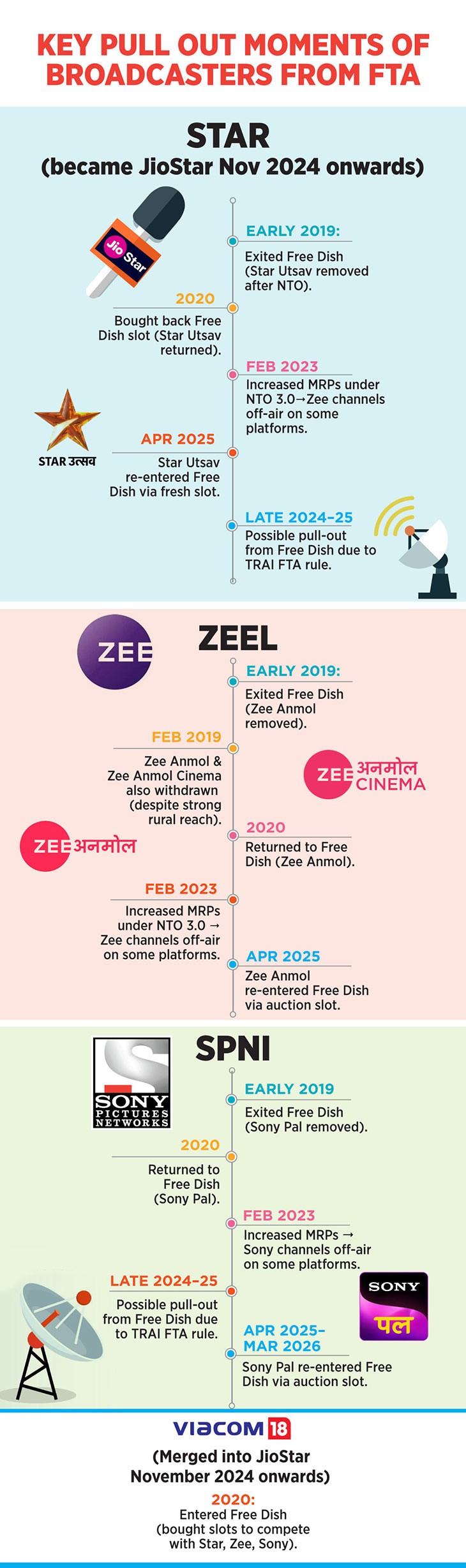
Broadcasters had earlier pulled out in 2019 after TRAI’s New Tariff Order barred channels from being both FTA and paid. Popular offerings like Star Utsav, Zee Anmol, Sony Pal, and Colors Rishtey were withdrawn despite their massive rural following. Later disruptions came in February 2023 under NTO 3.0, when a hike in MRPs by 10–15% and disputes with distributors led to temporary blackouts. By late 2024, yet another TRAI regulation required any channel available free on DD Free Dish to remain free on all addressable platforms, prompting plans for fresh withdrawals. Despite this, the big four networks returned to FTA in April 2025, signalling renewed intent to tap into the segment’s reach.
Among the existing players in FTA, Shemaroo’s revenue for the financial year ending March 31, 2025 stood at Rs 693.5 crore, down from Rs 712 crore during the previous fiscal. According to reliable sources, annual revenue of Dangal TV (owned by Enterr10 TV Network) stood at Rs 500 crore.
Also read: Free Dish boosts channel ratings
Also read: Will big networks rushing back to DD FreeDish impact Pay TV universe?
Expanding market size
Industry estimates suggest the FTA ad market, pegged at Rs 4,000 crore last year, could expand to nearly Rs 5,500 crore this year. Much of this growth is being driven by the re-entry of large broadcast networks and the launch of multiple new channels. According to buzz in industry circles, big broadcasters alone are expected to contribute between ₹600 crore and ₹900 crore, with estimates placing their share at close to ₹800 crore.
An industry insider noted that the impact on existing FTA players will vary as “channels with consistent performance and a strong viewer connect may continue to hold ground, while others could face pressure as large networks leverage their extensive content libraries to attract both audiences and advertisers.”
Also read: Why is DD Free Dish facing calls for reforms?
Also read: Regional inclusion gets a boost on DD Free Dish
Broadcaster perspectives
Sharing their perspective, a JioStar spokesperson underlined the enduring role of FTA in India’s media ecosystem, saying, “FTA channels continue to play a very important role in India’s television ecosystem, especially when it comes to reaching audiences in the Hindi heartland. They remain one of the largest and most effective platforms for advertisers, given that these viewers are highly loyal to television and engage deeply with the content. From an ad sales perspective, FTA offers unmatched reach and penetration, making it the preferred platform for any media plan to seep into this audience segment.”
“Advertiser interest in this space continues to be strong. Star Utsav has established itself as the leading FTA general entertainment channel. It not only delivers scale but also acts as a funnel for our high-quality content. Our FTA play is designed to graduate consumers into the Pay TV ecosystem and it is critical that we drive that transition strategically over time,” the spokesperson said.
Sandeep Gupta, Chief Operating Officer – Broadcasting Business, Shemaroo Entertainment Limited, positioned the growth of DD Free Dish as a structural driver.
“The FTA space is witnessing steady momentum with DD Free Dish continuing to expand its reach in semi-urban and rural India where TV remains the default screen. Importantly, there is now also a growing reach of DD Free Dish in urban markets compared to earlier, making it a strong platform not just for rural scale but also for incremental urban reach. In this context, the overall ad revenue estimate of all FTA channels should be upwards of Rs 1,600 crore in the current financial year.
“Advertisers see strong value in the scale these channels deliver, but what is equally important is that this is no longer just a volume game. Advertisers today are sharper about where they place their money and want channels that deliver both reach and the right audience profile,” he said.
He further linked Shemaroo’s play to its movie-centric DNA. “For Shemaroo Entertainment, the Hindi movie genre has always been a stronghold. The launch of a Hindi movie channel is a natural extension of its legacy. Movies are at the core of Shemaroo’s DNA, and the audience’s love for Hindi cinema remains timeless. The launch of Shemaroo Josh was about reinforcing this strength and giving audiences an engaging, high-energy destination built around movies that bring families together and offer that shared viewing experience which digital has not been able to replicate at scale,” Gupta said.
From the advertiser point of view, Anil Solanki, Director, DentsuX, highlighted the segment’s appeal, saying, “FTA channels have quietly become advertising workhorses- delivering mass reach at scale for brands that want penetration, not just premium audiences. The segment is giving a heavy boost in non-metro regions where marketers are eager to deepen penetration.”
On whether the entry of large broadcasters would expand the market or divert revenue, he added, “It will be loaded with present players over new players. However, e-comm & other categories are entering into FTA.”
Sharing his views on the growth of FTA industry, Rajiv Dubey, VP & Head -Media, Dabur India Ltd, said, “FTA’s growth lies in TV-dark markets like UP, Bihar and parts of MP, Rajasthan where first-time homes prefer Free Dish to avoid monthly fees. These make significant markets for Dabur and core to its business in markets of UP, MP, Bihar and Rajasthan, where FTA makes up 54% of TV homes (vs 28% nationally) as per BARC and industry estimates.”
“The medium remains highly cost-effective, with Sony, JioStar, and Zee leveraging reruns on their FTA channels, while Doordarshan, Dangal, and others stand out through original programming, free news, and even live sports rights, giving FTA a distinct edge. Hence, as an ecosystem, it is clearly important, growing and cost-effective and its central to our planning,” Dubey said.
The road ahead
Despite growing digital penetration, experts believe FTA television will continue to expand, aided by affordable TV sets, improving electrification in rural India, and the continuing role of television as the default screen in semi-urban and rural households. Internet connectivity challenges, coupled with rising data and pay-TV subscription costs, are also bolstering the segment’s relevance.
Looking ahead, Shemaroo’s Gupta pointed to Free Dish as a future driver. “Competition is intense, and digital is constantly pulling audience time, but we believe a channel with a carefully crafted proposition and strong content lineup can still cut through, as we have seen with Shemaroo Josh.
“The FTA space will get more competitive before it stabilises, and our strategy is to remain close to audience behaviour, keep our curation sharp, and continue to be a reliable partner for advertisers looking for both scale and impact in an increasingly fragmented media landscape,” he said.
For now, the entry of the big four networks is both expanding the market and forcing incumbents to rethink strategy. While disruption is inevitable, the outcome will likely hinge on programming strength, audience connect, and the ability to deliver both scale and targeted value to advertisers.
Read more news about Television Media, Digital Media, Advertising India, Marketing News, PR and Corporate Communication News
For more updates, be socially connected with us onInstagram, LinkedIn, Twitter, Facebook YouTube & Google News
