Flipkart's Pratik Shetty on how candid storytelling worked for the brand
At Pitch CMO Summit 2025, Pratik Shetty, Vice President, Growth & Marketing at Flipkart, spoke about building a refreshed, quirky, and culture-driven marketing strategy
 by
by
Published: Aug 1, 2025 12:39 PM | 3 min read
 Follow Us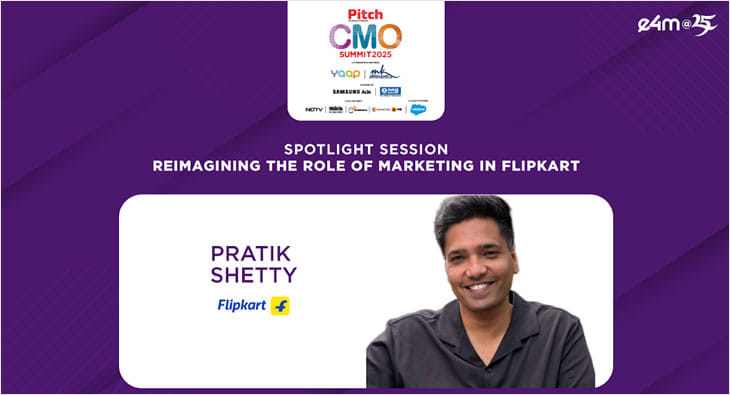

At the Pitch CMO Summit 2025, Pratik Shetty, Vice President, Growth & Marketing at Flipkart, offered an unfiltered look at how India’s homegrown e-commerce giant has redefined its marketing playbook over the past few years.
His spotlight session was less a corporate presentation and more a candid storytelling exercise on how Flipkart moved from fatigue with its iconic “kids as adults” campaigns to building a refreshed, quirky, and culture-driven marketing strategy.
Shetty anchored his talk on four themes: defining a clear North Star, rethinking media, understanding the role of culture in disruption, and creating an ecosystem for continuous creative output.
In the post-2019 phase, Flipkart’s marketing leaned heavily on performance ads aimed at immediate sales. Brand-building took a back seat, Shetty admitted, prompting an internal reset. “Our North Star,” he said, “is to drive consideration for brand Flipkart.”
That meant defining two core consumer cohorts that would drive the next wave of growth and focusing communication on them. It also meant establishing a consistent brand persona, humorous, quirky, even “stupid,” as Shetty put it, but in a way that connects. Campaigns like Big Bachat Days, meme-inspired sale events, and playful product ads became a hallmark.
Shetty illustrated how intentionally “silly” ideas can build memorability. A meme-led sale in May, a fridge delivery ad with a melting ice sculpture, and a Flipkart Minutes campaign offering vegetables at ₹9, all exemplified the balance between functional messaging and offbeat creative.
“We realised stupid works for Flipkart,” he said, “because people like watching it, and they like the brand more for it.”
Flipkart abandoned the siloed approach of separate TV and digital plans. With 150 million Indians now without cable, Shetty’s team built a tool to map attention metrics across devices, leading to integrated “large screen” and “small screen” plans. This shift not only improved effectiveness but cut costs by 15% for the same reach.
Impact, he argued, isn’t about media placement alone, it’s about making ideas travel beyond their original format. Examples included QR-code front pages in The Times of India that drew over four million scans, outdoor hoardings that reframed Flipkart as more than a mobile phone retailer, and print ads that revealed messages when water was poured on them.
A major internal change was moving from a single-agency model producing a handful of big campaigns to a multi-agency, high-frequency setup. Flipkart now delivers around 40 campaigns a year at only about 20% higher total spend. This agile production model fuels quick-turnaround activations tied to cultural moments, from Rakhi “invoice” campaigns to cheeky responses to competitors’ events.
Shetty closed by stressing that disruptive marketing isn’t a one-off, it’s a culture that needs to be built over years. Flipkart’s journey from Big Saving Days to its GOAT Sale (Greatest of All Time) illustrates how persistence and experimentation can transform brand presence.
“It takes time to build culture,” Shetty said. “In 2023 we were pushing the system; in 2024 we learned from successes; in 2025, we’re bigger than ever.”
The session, clocking just over 20 minutes, left the audience with a clear takeaway: in the crowded, fast-moving Indian e-commerce market, it’s not just about selling, it’s about staying culturally relevant, consistently disruptive, and unmistakably Flipkart.
Read more news about Marketing News, Advertising News, PR and Corporate Communication News, Digital News, People Movement News
For more updates, be socially connected with us onInstagram, LinkedIn, Twitter, Facebook, YouTube & Google News