The future of Indian events is infinite: Lalit Gattani, Showcraft Productions
Lalit Gattani, CEO of Showcraft Productions Pvt. Ltd., took center stage at the e4m Red Carpet Experiential Marketing Summit 2024 to share his insight
 by
by
Published: Dec 27, 2024 3:05 PM | 4 min read
 Follow Us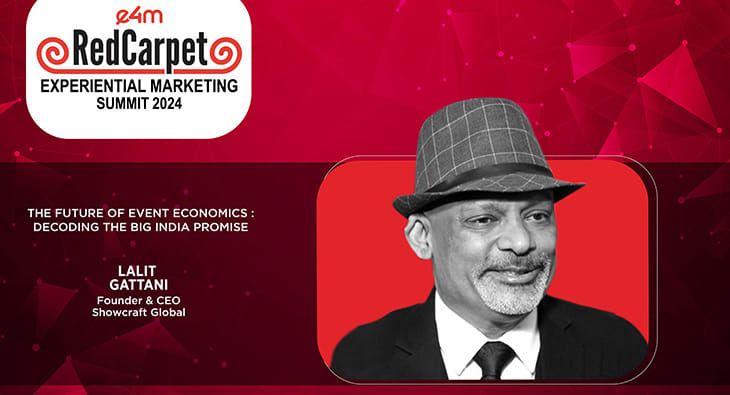

As the events industry experiences unprecedented growth and transformation, Lalit Gattani, CEO of Showcraft Productions Pvt. Ltd., took center stage at the e4m Red Carpet Experiential Marketing Summit 2024 to share his insights. Drawing from over 25 years in the field, Gattani celebrated the sector’s achievements while presenting an ambitious blueprint for its future.
“The future of Indian events is infinite,” declared Gattani. “We have infinite talent, infinite opportunity, and infinite avenues. India isn’t just a market; it’s a phenomenon waiting to unfold.” Reflecting on the evolution of the industry, he traced its growth from humble beginnings, such as cricket matches on Doordarshan, to today’s dynamic landscape of metaverse product launches and drone-choreographed weddings.
Gattani highlighted India’s unique position as a leader in cost efficiency. “We provide high-quality event services at a fraction of the cost compared to Western countries,” he stated. This strength, combined with India’s skilled workforce and advanced technological capabilities, places the country on the cusp of becoming a global powerhouse in event execution. “Our expertise in augmented reality, virtual reality, and artificial intelligence is paving the way for groundbreaking solutions in event management.”
While acknowledging the critical role of technology, Gattani emphasized its role as a tool rather than a replacement for human ingenuity. “AI is an enabler. It can design elements of an event, but we still need boots on the ground—people to execute. Creativity drives the medium, not the other way around,” he said. He shared how AI-enabled tools have empowered his team to visualize and plan large-scale events more effectively, but he underscored the irreplaceable value of human creativity and execution.
The government’s role in fueling the sector’s growth was another key focus. Gattani called the Indian government the country’s largest event manager, citing an annual spend of over ₹100,000 crores on events. “From celebrating sporting achievements like Neeraj Chopra’s victories to inaugurating infrastructure projects like Atal Setu, every milestone is marked with an event,” he said. He lauded initiatives like the G20 Presidency, which showcased India’s capabilities on a global stage, and pointed to upcoming projects such as WAVES, a government-backed conference dedicated to content creation.
Despite the sector’s progress, Gattani identified infrastructure as a critical challenge, particularly for private events. “While we excel in executing government events, private event infrastructure needs improvement,” he explained. He also called for better planning and preparation, criticizing the last-minute execution often expected of event managers. “We deliver because we’re prepared for surgical strikes, but this is not a sustainable model. Abroad, events are planned months in advance. We need to adopt a similar approach to ensure quality and consistency.”
Gattani’s vision for the future includes expanding India’s event footprint globally. “We are already delivering world-class experiences in India. The next step is taking these capabilities abroad,” he said. He highlighted the potential of wedding tourism, which is attracting not just NRIs but also international clients. “We’re seeing foreigners come to India for their weddings, with Ayodhya emerging as a potential hotspot. The possibilities are endless.”
Another significant opportunity lies in smart cities, which Gattani described as tailored venues for innovative event experiences. “With over 100 smart cities in development, these hubs will offer state-of-the-art venues and infrastructure, creating new avenues for the industry,” he said. Festivals like the Kumbh Mela and Jaipur Literature Festival were also cited as examples of how events can drive local economies. “The Jaipur Literature Festival brings over ₹50 crores into the local economy, showcasing the immense economic impact of events.”
Sports events, he noted, are another key driver of growth. “With initiatives like Khelo India, the government is investing heavily in infrastructure and ceremonies, creating a bright future for event professionals. Sporting events aren’t just about competition—they’re about creating experiences.”
Concluding his address, Gattani left the audience with an inspiring vision. “The event industry is set to rock the world. With rising corporate spending, a burgeoning middle class, and unmatched creativity, we are poised to lead the global stage,” he said. His final call to action was simple yet powerful: “Everyone here should believe we can do it.”
Gattani’s keynote was more than a celebration of the industry’s achievements; it was a call to action. By merging creativity, technology, and strategic vision, the Indian events sector is not just evolving—it’s on the brink of global leadership.
Read more news about Marketing News, Advertising News, PR and Corporate Communication News, Digital News, People Movement News
For more updates, be socially connected with us onInstagram, LinkedIn, Twitter, Facebook, YouTube & Google News