The Badaam Effect: Why 5 soaked almonds beat a 5-star review
In India, love is never said. It is soaked overnight. Soaked almonds are a uniquely Indian stroke of love and care, writes Dr. Sandeep Goyal
 by
by
Published: Sep 21, 2026 9:31 AM | 7 min read
 Follow Us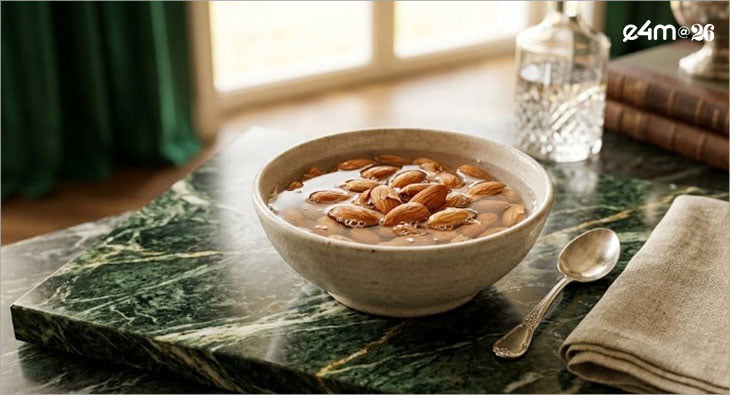

- The article discusses the cultural significance of the "Badaam Effect" in India, where small, thoughtful gestures symbolize love and care, such as a mother soaking five almonds for her child.
- It highlights how these acts of love are often more meaningful than expensive gifts, fostering loyalty and trust in personal relationships and businesses alike.
- However, the article also addresses potential pitfalls of the Badaam Effect, including the tendency to quantify love, feelings of guilt associated with sacrifices, and the risk of performing gestures without genuine presence or intention.
- The author advocates for maintaining the essence of the Badaam Effect by ensuring that acts of love are sincere and considerate, rather than merely performative or obligatory.
If you grew up in a middle-class Indian home, you did not grow up on almonds.
You grew up on 5 almonds.
Not 6. Not a handful. Exactly 5. Counted by your mother the night before, soaked in a small steel katori, kept on top of the fridge where you could not forget, and peeled the next morning with the precision of a neurosurgeon.
No one asked if you liked almonds. You hated them. The skin was bitter, the inside was bland. But you ate them because that peeled, slightly wet almond was not nutrition. It was an emissary of motherly love, family love.
That is the Badaam Effect.
In India, love must leave evidence.
We don't say "I love you" easily. It feels filmy. It feels Western. What we do instead is we do a small, visible, slightly inconvenient thing that proves we thought of you when you were not around.
Mother soaking badaam is the original prototype. Father filling petrol at night so you don't have to in the morning. Wife cutting the apple into small pieces even though you are 42 and have teeth. Grandmother keeping the last piece of mango for you in the fridge under a bowl so no one else takes it.
It is never big. It is never expensive. It is always a little bit of trouble taken just for you.
And it works more than any expensive gift.
I call it the Badaam Effect:
Small, Visible Sacrifice = Big, Invisible Trust.
Businesses figured it out before psychologists did.
Why does the kirana guy still put one extra toffee in your kid's hand? He loses 50 paise, gains your loyalty for a year. That's Badaam.
Why does Tanishq's store guy clean your old gold chain for free even if you don't buy anything today? 5 minutes of labour, lifetime memory. That's Badaam.
Why does Zerodha send a physical, signed P&L report once a year when it could be just a PDF? Because someone sat and signed it. That's Badaam.
In the age of AI where everything can be perfect, flawless, instant – Badaam is imperfect, manual, slightly late. And that is why we believe it. Love it.
BADAAM IS EVERYWHERE, IF YOU LOOK
- The Tiffin Badaam: Your wife or mother doesn't just pack sabzi. She packs your favourite sabzi on the day of your presentation. She remembers. The dabba comes back empty not because you were hungry, but because you were seen.
- The Charger Badaam: That friend who always carries a spare iPhone charger to the party. He is not a techie. He is a Badaam person. He took trouble before you had a problem.
- The Railway Badaam: Your father waiting at the station 20 minutes before the train arrives. Train is late. Platform is hot. He could have tracked live status. But standing there is the point. The sweat is the proof.
- The Office Badaam: The boss who remembers you don't drink tea with sugar and tells the peon before you enter. You will not leave that job easily. No salary hike can beat that sugarless tea.
- The Shaadi Badaam: In Odia weddings, the bride's mother still packs that small "Bahuna" – dried sweets, pithas, a new saree – for the daughter who is leaving. It is not needed. The daughter has Zomato. But the bahuna says – in your new kitchen, don't forget my old kitchen.
All Badaam. All over India. Different almond, same love.
BUT HERE IS THE SOCIETAL FAILING – BADAAM CAN BECOME POISON
Like all good Indian things, we may have taken Badaam too far. And made it toxic.
Failing 1: Badaam as Measurement.
When Badaam becomes the only proof of love, we start counting almonds.
"She soaked 5 almonds for her son, only 3 for my son." "He brought gift for his mother, not mine." “My mother-in-law cut apple for everyone but me.”
We tend sometimes to turn sacrifice into a scoreboard. WhatsApp forwards of "A true wife does these 7 things at 5 am" are just Badaam audits. And audits kill joy.
Love that needs daily evidence becomes labour.
Failing 2: Badaam as Guilt.
Indian mothers are queens of guilt-Badaam.
"I woke up at 4 am and made paratha, and you are saying you will eat in the canteen?" Now you cannot say no. The almond has become a handcuff.
Many Indian kids don't eat the almond because they like it. They eat it so mother doesn't feel bad. We eat guilt, not protein.
Same in offices. "I stayed late for you on Saturday" – Badaam given, guilt expected on Monday. That's not Badaam. That's blackmail with dry fruits.
Failing 3: Badaam as Performance, Not Presence.
This is the big one for brands and families.
We have learned to perform Badaam without being there.
A company sends you a birthday email with your name spelled wrong. That's fake Badaam. No one soaked anything.
A husband orders flowers on Ferns N Petals on his wife's birthday while on a call. Flower delivered, love not delivered. The almond is there, but it is not peeled. It is still raw.
Children know. Customers know. They can tell when the almond was soaked by hand and when it was bought from a cloud kitchen of emotions.
We have apps that send "Good Morning, Mom" messages automatically. The mother knows. No one wakes up at 6:12 am to send a good morning with a flower emoji every day with same spelling. She knows it's scheduled. And scheduled Badaam is worse than no Badaam.
Failing 4: The Mother-In-Law Badaam Paradox.
Who deserves the Badaam? The one who is blood.
In many Indian homes, Badaam flows only one way – to sons, not daughters. To husband's parents, not wife's parents.
We soak almonds for the son to get sharp brain, but give the daughter diet cola to stay slim for marriage. Same house, two almonds.
That is why the Badaam Effect, if not checked, becomes patriarchy with protein.
SO WHAT SHOULD WE DO? BRANDS AND HUMANS?
Don't stop the Badaam. Just make it honest.
For brands:
Don't do 10 fake Badaams. Do 1 real one. One. Like Paperboat did – they printed one real childhood memory on pack, not 10 marketing lines. Like Amul – their topical is still hand-drawn, not AI. You can see the human hand shaking a little. That shake is the Badaam.
Best test: If tech alone can do it, it is not Badaam.
For humans:
Ask before you soak. "Do you want badaam, or should I make you an omelette?" Real love gives choice. Guilt love gives almonds.
And sometimes, the biggest Badaam is not doing anything. Letting your son sleep 10 minutes more instead of waking him for almonds. That 10 minutes is also a soaked almond. A bigger one.
My mother is no more. But my wife still soaks almonds. I am 63. I have cholesterol. I have a nutritionist who says don't eat almonds in morning. But I eat 2 now. Not 5. I peel them myself sometimes. And I keep the katori back on the fridge.
Because some bills you don't pay with money.
You pay with memory.
And somewhere, in some kitchen at 11 pm tonight, a mother is counting – 1,2,3,4,5 – and putting the katori on the fridge.
The economy may change. Consent economy, exhaustion economy, experience economy – all will come and go.
But the Badaam Economy is forever.
It is India's original love language. Peeled, wet, and a little bitter. Just like love itself.
The Badaam Effect is part of ‘We Are Like That Only’ Bharat Lab Report. The Report will be exclusively released in exchage4media.com tomorrow.
Dr. Sandeep Goyal is a doctorate in management from FMS Delhi. He was conferred a DLitt by the University of Lucknow.
Read more news about Marketing News, Advertising News, PR and Corporate Communication News, Digital News, People Movement News
For more updates, be socially connected with us onInstagram, LinkedIn, Twitter, Facebook, YouTube & Google News