Need to balance performance marketing with brand marketing: Pidilite’s Kapil Narnaware
At the e4m Performance Marketing event, Kapil Narnaware, Chief of E-Commerce Business, Business Head, Pidilite, spoke on e-commerce strategies, the common challenges and more
 by
by
Published: Mar 8, 2025 9:11 AM | 6 min read
 Follow Us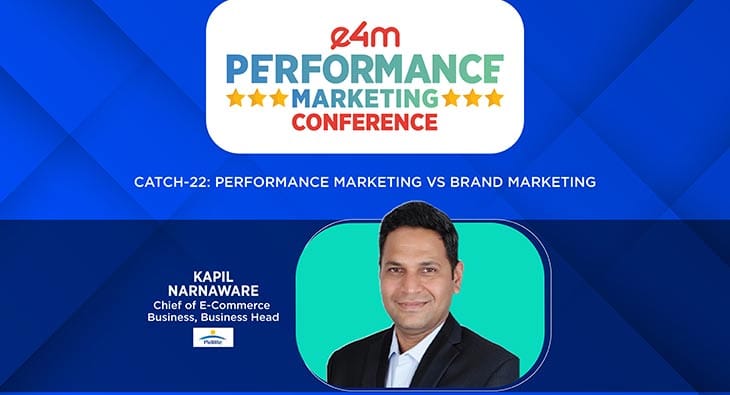

Performance marketing has rapidly evolved over the past five to six years, but relying solely on it is not a sustainable strategy for e-commerce brands, said Kapil Narnaware, Chief of E-Commerce Business, Business Head, Pidilite, at the e4m Performance Marketing event in Mumbai.
Highlighting the common challenges faced by the e-commerce sector, he stressed the need to balance performance marketing with brand marketing to drive long-term profitability and consumer loyalty.
Kapil challenged the traditional notion of performance marketing as the ultimate growth driver, stating that many businesses fail to achieve profitability despite heavy investments in paid campaigns. "People often ask, ‘Why isn’t the e-commerce business as profitable as general trade and modern trade?’ The concern is valid. Many assume we are just ‘buying sales’ by continuously investing in marketing without establishing profitability," he said.
Kapil emphasised that while performance marketing delivers quick results, it often fails to foster consumer loyalty. "Performance marketing is all about a result-oriented approach—driving impressions, clicks, and sales. It gives marketers a clear ROI, making it easy to measure success. However, the downside is that the moment you reduce spending, sales begin to drop. It’s not sustainable in the long run," he explained.
Discussing the limitations of performance marketing, Kapil pointed out that it becomes increasingly expensive due to rising competition. "When competitors enter the market, advertising costs surge. To maintain performance, businesses have to keep increasing their investment. The challenge is that once spending is optimized or reduced, sales decline, making it a short-term strategy rather than a long-term growth plan," he said.
According to Kapil, brand marketing is the key to overcoming this challenge. He highlighted how it helps in creating a strong brand identity and fostering customer loyalty, ensuring continued growth even when marketing budgets are adjusted. "Brand marketing is about building an emotional connection with consumers. It’s a long-term investment that pays off by positioning your brand in the customer’s mind. However, the challenge with brand marketing is that while it builds loyalty, it is difficult to measure immediate sales impact," he noted.
Kapil underlined the importance of integrating both performance and brand marketing strategies to drive sustainable e-commerce growth. "The real challenge is to make performance marketing and brand marketing work together. While performance marketing helps in gaining quick traction, brand marketing ensures consumers remember and prefer your brand. The right balance between the two can lead to both immediate sales and long-term success," he stated.
Kapil shared insights from Pidilite’s strategy and how the company has successfully combined both approaches. "At Pidilite, we have found that blending performance marketing with brand-building initiatives creates a sustainable growth model. It is crucial to strike the right balance to ensure that while we see immediate returns, we are also nurturing long-term brand value and customer retention," he said.
The Dilemma of Limited Budgets
For marketers working within tight budgets, the question always remains: where should the money be invested to drive business growth? Performance marketers often promise immediate sales by leveraging digital ad spend, but their tenure in organizations is usually short-lived, lasting only two to three years. This is because, in the long run, businesses struggle with sustaining organic growth and reducing their dependence on inorganic sales. The key challenge is to find the right balance between performance marketing and brand marketing.
Understanding the Symbiosis Between Performance and Brand Marketing
Performance marketing can only succeed when brand marketing has laid the groundwork. Likewise, strong performance marketing efforts can enhance brand recognition.
"Performance marketing delivers immediate results, but without brand marketing, growth becomes unsustainable. A strong brand foundation ensures that consumers don’t just buy a product once but come back for it repeatedly, reducing long-term acquisition costs," says Kapil.
When a brand is already well-known, performance marketing ensures that it remains discoverable and continues to convert customers efficiently. Conversely, for emerging brands, performance marketing efforts need to be backed by solid branding initiatives to establish credibility and long-term engagement.
The Three Cohorts of Brands
To optimize marketing investments, brands can be categorized into three cohorts: core brands, focus brands, and high-potential brands.
Core Brands: These are well-established brands with high awareness and market leadership. Here, performance marketing should take precedence to enhance discoverability, while brand marketing should focus on keeping the brand relevant through strategic storytelling.
Focus Brands: These brands are growing quickly but face intense competition and low awareness. A balanced approach is necessary—investment in awareness campaigns should be complemented by sustained performance marketing to drive conversion.
High-Potential Brands: These brands have a unique proposition but lack consumer familiarity. Here, brand marketing must take priority to build awareness, followed by performance marketing to convert interest into sales.
"High-potential brands often struggle because they aren’t top-of-mind for consumers. Investing in brand awareness today ensures that tomorrow, performance marketing efforts yield better conversion rates with lower ad spend," Kapil explains.
The Case Study of WD-40: Finding the Right Mix
WD-40, a well-known problem-solving product with over 2,000 applications, faced a marketing challenge despite steady growth. Initially, investments were heavily skewed towards performance marketing, leading to positive sales growth. However, attempts to optimize performance marketing spend resulted in declining sales.
Realizing that this model was unsustainable, the company experimented with a mix of brand and performance marketing. By collaborating with Blinkit, social media influencers, and outdoor advertising, the brand reinforced its relevance while maintaining a steady performance marketing spend. The results were striking—sales continued to grow even when performance marketing budgets were optimized, proving the effectiveness of a balanced marketing approach.
"Short-term gains may look great on a balance sheet, but true success lies in long-term brand equity. A well-balanced marketing approach ensures that brands don’t just grow—they sustain their growth for years to come," Kapil said concluding his address.
The key learning from this experiment is that brand and performance marketing must work in tandem to achieve sustainable business growth. Investing in brand awareness builds long-term customer affinity, reducing the dependency on paid acquisitions. Meanwhile, performance marketing ensures immediate visibility and conversions. Striking the right balance, tailored to the specific needs of each brand category, leads to a profitable and scalable marketing strategy.
Read more news about Marketing News, Advertising News, PR and Corporate Communication News, Digital News, People Movement News
For more updates, be socially connected with us onInstagram, LinkedIn, Twitter, Facebook, YouTube & Google News