Festivals must create memories, not just line-ups: Aman Kumar
Aman Kumar, Co-founder of Whitefox, The Grub Fest and AVA Experience, discusses the festival’s revenue model, changing expectations of Indian audiences and more
 by
by
Published: Sep 22, 2026 12:29 PM | 9 min read
 Follow Us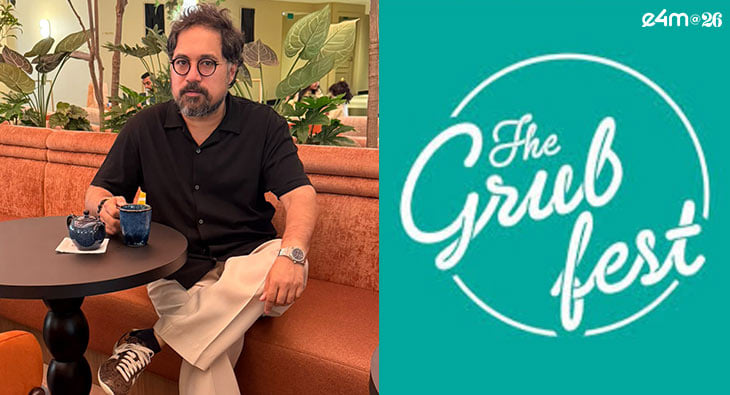

- The Grub Fest has transformed from a food-centric event into a comprehensive lifestyle festival over the past 12 years, integrating food, music, entertainment, and community engagement, and is now targeting Tier II markets for growth.
- Audience expectations have shifted from primarily seeking food experiences to desiring a holistic experience that includes music, social interactions, and various attractions, prompting the festival to continually innovate and diversify its offerings.
- The festival's revenue model relies on ticket sales, beverage sales, sponsorships, and space selling, with a focus on creating meaningful brand integrations and fostering community loyalty to enhance profitability and scalability.
- Future plans include launching the Grub Supper Club for a more curated family-oriented experience while expanding the large-format festival into Tier II cities, responding to the evolving preferences of both older and younger audiences.
Over the past 12 years, The Grub Fest has evolved from a food-led festival into a broader lifestyle experience combining food, music, entertainment and community engagement. As India’s live-entertainment economy expands, the homegrown intellectual property is now looking at curated formats and Tier II markets for its next phase of growth.
In an interview, Aman Kumar, Co-founder of Whitefox, The Grub Fest and AVA Experience, discusses the festival’s revenue model, the changing expectations of Indian audiences, the growing commercial potential of homegrown festivals and the need to build stronger experiences around Indian artists.
Excerpts:
What makes The Grub Fest distinct as an IP?
The Grub Fest is one of the oldest homegrown food and music IPs in the country, with a legacy spanning more than 12 years.
What makes it unique is its combination of food, music and entertainment. Over the years, it has built a strong social community and become an experience where people can spend an entire day enjoying the right mix of food, music and carnival-style entertainment.
It is not simply an event that people attend for a few hours. It is an IP where experiences are created and memories are made. That emotional connection with the audience has become an important part of the festival’s identity.
How have audience expectations evolved since the festival began?
When we started, people came primarily to explore food. Over time, we have seen that the overall experience has become much more important. Today, audiences want a complete package.
It is now about music, social communities and creating an ecosystem where people can spend half a day with their friends. We are responding to this by constantly introducing new experiences and creating more opportunities for engagement.
Alongside music and food, we have added carnival attractions, interactive experiences, brand integrations, cosmetic and salon pop-ups, community seating areas and a beer garden where visitors can sit and relax with their friends. There is now much more for people to explore.
Our approach to music has also been distinctive. We usually bring in younger artists whom audiences may not have seen perform before. If you look at our previous line-ups, we have generally featured artists who had not performed at the festival earlier. It gives audiences an opportunity to discover music as well as food and community activities.
The festival has to keep evolving because consumer preferences change every year. Our original visitors are also growing older. Someone who came to The Grub Fest 10 years ago as a 20-year-old may now be married and have children. At the same time, a new generation of younger visitors is coming in.
We therefore have to balance the expectations of both groups. The Grub Fest is a popular property that attracts people with different preferences, so the experience must cater to multiple genres and audience segments.
What does it take to create a festival experience that people remember and revisit?
The most important thing is to begin with a strong central idea. Everything must emerge from that idea.
You cannot simply bring together food, music, entertainment and brand integrations and assume that the combination will automatically create a successful festival. It does not work that way.
Once the central idea has been established, every element must fit into it properly. The music, food, activities and brand experiences must work in sync. That is how a memorable festival is created.
At the end of the day, people are evaluating what they are taking back from the experience. They should feel that they have discovered something, participated in something or formed a memory. They should not feel that they have merely visited another event.
Whether it is music, food or another experiential activity, everything should contribute to the festival’s larger idea. That is what gives the experience coherence and encourages consumers to return.
What are The Grub Fest’s principal revenue streams?
Our key revenue streams are ticket sales, beverage sales, sponsorships and space selling. That is also broadly the order of their contribution to the festival’s overall revenue.
However, revenue cannot be viewed separately from the consumer experience. Ticket sales depend on the strength of the line-up and the overall festival proposition, while beverage sales and space selling are influenced by audience turnout and the amount of time visitors spend at the venue.
Sponsorship revenue is also becoming increasingly connected to the quality of brand integration. Brands are no longer satisfied with simply placing their names at an event. They want meaningful participation and direct engagement with consumers.
How can the IP be scaled profitably?
The strongest way to scale an IP is by building loyalty and community. Once you create a genuine sense of belonging among the audience, scalability and profitability follow naturally.
Our objective is for every visitor to feel that they are part of The Grub Fest community rather than someone who has simply purchased a ticket to attend an event.
When people identify with an IP, they return, recommend it to others and remain engaged with it between editions. That loyalty gives the festival a stronger foundation for entering new markets, introducing new formats and building long-term commercial partnerships.
Community-building, therefore, is not merely a marketing exercise. It is central to the business model and the festival’s ability to grow sustainably.
What drives The Grub Fest’s long-term valuation?
The biggest drivers of The Grub Fest’s long-term valuation are its social community, brand loyalty and legacy.
The IP has historically demonstrated strong consumer demand and built a robust brand that resonates with its audience. The combination of brand equity, community and repeat engagement gives it significant long-term value.
A festival IP becomes valuable when it is not entirely dependent on a single artist, edition or trend. Its value lies in the trust and recognition it has developed over time and in its ability to bring audiences back consistently.
The Grub Fest’s 12-year legacy gives it that foundation. The community understands what the property represents, while the brand continues to evolve in response to changing consumer expectations.
How large is the growth opportunity for India’s festival industry?
There is tremendous room for growth. India is geographically vast and has a huge population, but I believe the biggest opportunity for festivals lies in Tier II and Tier III cities, which are still largely untapped.
Disposable income is increasing, India has a young population and consumers are becoming more willing to spend on experiences. This makes Tier II and Tier III markets a significant opportunity for homegrown festivals.
As far as international festivals are concerned, India has already demonstrated that the franchise model can work. We now have festivals such as Lollapalooza, Rolling Loud and Zamna in the country, and several other international properties are exploring the Indian market.
Despite this momentum, we are still at a nascent stage of the growth curve. There is considerable room for homegrown festivals, but they must be customised for Indian consumers.
A format that works internationally cannot simply be replicated here without understanding local tastes, spending patterns, cultural preferences and the way Indian audiences consume entertainment. The opportunity is large, but localisation will be essential.
How is the Indian live-entertainment ecosystem evolving?
Indian artists are evolving significantly. Earlier, many of them primarily performed at local or homegrown festivals. We are now seeing far more standalone concerts and large-format shows built around Indian performers.
International artists tend to be highly developed in terms of the technology and experiences surrounding their performances. More companies in India are now working on these areas, but a gap still exists. We often rely on international companies to create large-format experiences even for Indian artists.
Artists such as A.R. Rahman, Diljit Dosanjh, A.P. Dhillon and Karan Aujla have shown the strength of the demand for Indian music. We have the population and a strong cultural inclination towards Indian artists, which creates an enormous economic opportunity.
The gig economy is growing, people are willing to spend on experiences and Indian artists are becoming increasingly popular. They can sell as many tickets as international artists. Diljit, for instance, has sold out stadiums, and we have all seen the scale of that demand.
India already has the talent. What we need now is greater recognition of that talent and stronger experiences designed specifically for local artists. Indian performers are also in an exploratory phase and are examining how they can create more immersive experiences around their music.
I recently had the opportunity to see a new live experience created by Shashwat Sachdev. It was something audiences had not seen before—a large four-set concert featuring a 52-piece orchestra, a 30-member choir, eight singers, drummers and Manganiar musicians from Rajasthan, with Shashwat bringing everything together from the console. It was a beautiful musical journey.
Indian live entertainment is becoming very significant, and we will see many more collaborations in the future. Indian artists are also increasingly collaborating with international performers and bringing them together on the same stage.
What is the real opportunity for brands at festivals today?
The opportunity for brands is very different from what it was earlier. In the past, brands would put their names on an event and say they were sponsoring it. Today, meaningful integration is far more important.
Marketers want to understand how their brands can become part of a concert or festival rather than simply having their names displayed at the venue. They are looking at how a brand can fit into the way consumers experience and respond to a show.
Brands are increasingly aware of this shift. They are constantly asking for ideas that allow them to engage with consumers seamlessly instead of merely placing their logos on a platform.
When the integration is relevant and natural, it can help a brand build a deeper relationship with the audience. The experience becomes more valuable for the consumer as well as the marketer. That is where festivals can deliver much more than conventional visibility.
What is next for The Grub Fest in terms of formats and cities?
We are launching Grub Supper Club, a niche and curated format designed for the modern audience.
Our earliest visitors are now around 12 years older. Many of them have families and are looking for a more comfortable, premium and curated experience instead of a large and crowded festival environment.
Grub Supper Club is being designed specifically for this audience, with a strong focus on families, curated food and music, and a wide range of family-oriented activities. The objective is to create the perfect day-out experience for families.
For the large-format festival, our focus will be on expanding into Tier II cities while continuing to operate consistently in the major metros where The Grub Fest has already established a strong presence and legacy.
Read more news about Marketing News, Advertising News, PR and Corporate Communication News, Digital News, People Movement News
For more updates, be socially connected with us onInstagram, LinkedIn, Twitter, Facebook, YouTube & Google News