Build trust into data infrastructure, not individual campaigns: Gowthaman Ragothaman
At the Pitch BFSI Summit, Saptharushi's Founder & CEO outlined how privacy-first data collab, federated AI, consumer-controlled consent could reshape personalisation in the financial services sector
 by
by
Published: Sep 23, 2026 4:12 PM | 6 min read
 Follow Us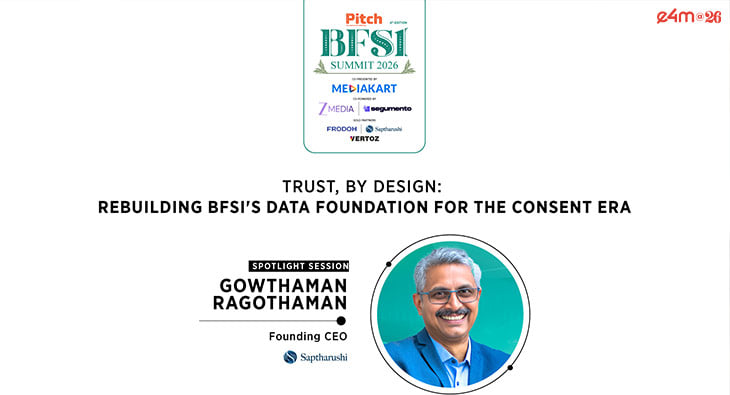

- Gowthaman Ragothaman, CEO of Saptharushi, emphasized the need for embedding trust in the infrastructure of customer data management during his session at the Pitch BFSI Summit 2026 in Mumbai, highlighting the importance of moving beyond campaign-based trust strategies.
- Ragothaman introduced Saptharushi's "Seven Convictions" white paper, outlining technological principles aimed at fostering privacy-first data collaboration and personalisation, including the use of distributed ledger technology and federated learning.
- He proposed a shift in data-sharing practices, advocating for a model where queries are sent to enterprises rather than transferring customer data, thereby maintaining control over sensitive information while enabling collaboration with external partners.
- The session also focused on the necessity of maintaining auditable records of customer consent and data processing activities, with Saptharushi's ATOM architecture designed to facilitate this while allowing enterprises to retain oversight of their data usage.
As India's BFSI sector navigates the increasingly complex intersection of personalisation, privacy and regulatory compliance, trust can no longer be addressed on a campaign-by-campaign basis. Instead, it must be embedded into the infrastructure through which customer data is accessed, processed and activated.
This was the central message delivered by Gowthaman Ragothaman, Founder and CEO of Saptharushi, during his spotlight session, 'Trust by Design', at the Pitch BFSI Summit 2026, held in Mumbai on September 23.
The session also marked the launch of Saptharushi's Seven Convictions white paper, which outlines seven technological principles that the company believes will shape the future of privacy-first data collaboration and personalisation.
Opening his address, Ragothaman observed that while trust had been repeatedly discussed throughout the summit, the industry needed to move beyond conversations about balancing privacy and personalisation towards addressing the underlying architecture of data exchange.
"I think more than the message, what's important is the plumbing itself, from where the data is moving, how data is being used," he said.
He argued that financial institutions possess some of the richest first-party customer information, including verified demographic details, KYC records and documented purchase intent. Yet, despite this advantage, they continue to depend on external partners to deliver personalised customer experiences.
The challenge, he explained, lies in enabling collaboration without compromising control over sensitive customer information.
Moving queries instead of moving data
A key theme of Ragothaman's address was the need to fundamentally rethink how organisations collaborate with external technology providers, marketing agencies and AI developers.
Conventionally, businesses transfer customer information to third parties to develop recommendation engines, execute campaigns or create personalised content. However, increasing regulatory scrutiny and the evolving nature of customer consent make such arrangements more complex.
Referring to India's Digital Personal Data Protection framework, Ragothaman highlighted the growing importance of purpose-specific consent, customers' ability to withdraw permissions and organisations' responsibility to demonstrate how consent has been exercised.
"The customers are given the choice to revoke it whenever they want. It is not a snapshot of one time I give a consent and keep it with me," he said.
Consequently, organisations must ensure that customer permissions remain current across their data-processing and collaboration activities.
Ragothaman proposed reversing the traditional data-sharing model.
"So we believe it has to be flipped. Do not send in the data. Let the queries come to you," he said.
Under this approach, enterprises retain customer information within their own infrastructure while authorised partners submit queries to generate insights or activate audiences.
The objective is to enable collaboration without requiring organisations to repeatedly transfer underlying customer datasets.
Building accountability into the architecture
Ragothaman also emphasised the importance of maintaining auditable records of customer consent and subsequent data-processing activities.
He identified Records of Processing Activities, or ROPA, as an increasingly important component of enterprise data governance.
"Not only consent and the queries are executed, you need to also maintain record of how it's being done as well," he said.
To address these requirements, Saptharushi has developed ATOM, an enterprise data collaboration architecture designed to enable identity resolution, consumer permission management and audience activation through federated querying.
The architecture incorporates an enterprise-controlled repository that records incoming queries and associated permissions, allowing organisations to retain oversight of how their information is accessed and used.
According to Ragothaman, the platform has been operational for approximately 18 months and has executed close to 72.5 billion federated queries across four to five enterprises.
He said Saptharushi currently offers access to more than seven data collaboration partners and is working towards bringing together audience signals from 22 publishers.
"Nobody's data moves, everybody's data remains in their own servers, only queries travel," he said.
The broader objective, he added, is to establish trust at the infrastructure level rather than addressing privacy concerns individually for every customer interaction or marketing campaign.
Seven convictions for the future of privacy-first personalisation
Building on this approach, Ragothaman introduced the seven technological convictions underpinning Saptharushi's product architecture and the white paper unveiled at the summit.
The first conviction centres on distributed ledger technology, which the company uses to maintain auditable records of data-processing activities.
"Every act of processing will leave a record, the record needs to be maintained," Ragothaman said, explaining that Saptharushi uses its patented distributed ledger technology to support this requirement.
The second conviction focuses on differential privacy, which seeks to minimise the possibility of tracing query results back to individual customers. Ragothaman explained that the company's system introduces statistical noise into queries to reduce repeated identification and tracking.
The third conviction is federated learning, which enables multiple organisations to contribute to AI model development without centralising their underlying datasets.
Ragothaman argued that as collaborative AI becomes more widespread, questions surrounding model ownership, accountability and the contributions of individual participants will become increasingly significant.
The fourth conviction addresses context management in agentic AI.
"Every agency will become agentic. There's no choice. And every platform will claim to have agents," he said.
As AI agents operating across different platforms begin communicating with one another, he believes context will become essential to ensuring interoperability between differing data structures and taxonomies.
The fifth conviction anticipates a shift towards consumer-controlled digital wallets containing personal credentials, identity information and consent preferences.
"Eventually the power will shift to the consumer," Ragothaman said, describing a future in which individuals determine what information they share and when.
The sixth conviction positions consumer attention as a measurable and potentially rewardable asset.
Saptharushi is developing an attention-rewarding mechanism through which consumers could receive tokens based on their engagement, allowing them to access additional content, advertising experiences or other rewards.
"Attention is the way going forward, particularly when you see the way consent is going to be exercised," he said.
The seventh conviction focuses on distributed computing, reflecting the growing computational demands associated with AI and large-scale data processing.
"Scale must not require centralization," Ragothaman said, arguing that distributed processing will become increasingly important as AI workloads expand.
Concluding his address, Ragothaman reiterated that these seven convictions form the foundation of Saptharushi's product architecture.
For BFSI organisations, his message was that the next phase of personalisation will require more than better customer targeting or responsible messaging. It will depend on building data infrastructure that enables collaboration while preserving enterprise control, consumer choice and accountability.
The future of trust, he suggested, lies not simply in what brands communicate to consumers, but in how their data systems are designed to operate.
Read more news about Marketing News, Advertising News, PR and Corporate Communication News, Digital News, People Movement News
For more updates, be socially connected with us onInstagram, LinkedIn, Twitter, Facebook, YouTube & Google News