'Anything that enhances convenience & shortens decision-making time will shape retail'
From hyper-personalization to sustainability and AI-driven retail, industry leaders discussed how brands are leveraging technology, consumer insights, and ethical practices at the e4m RetailEX 2025
 by
by
Published: Mar 13, 2025 4:59 PM | 9 min read
 Follow Us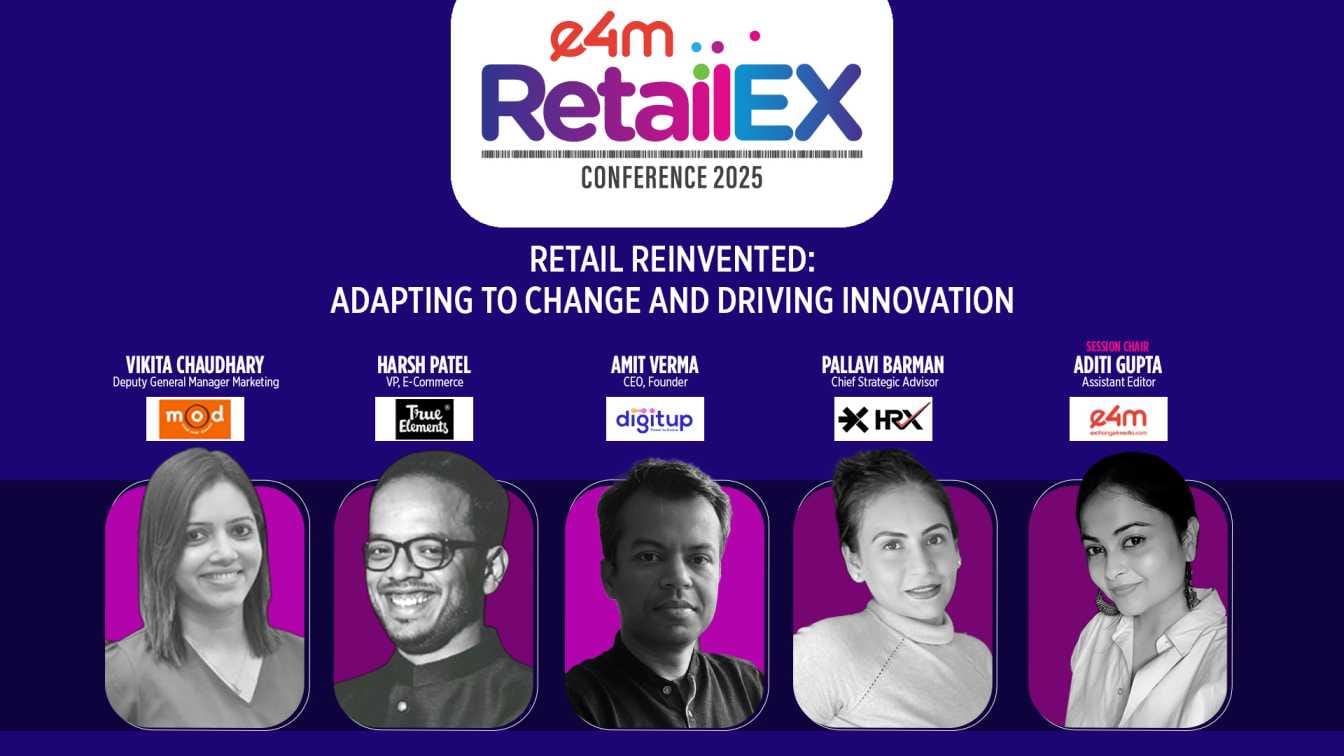

At the e4m RetailEX Conference & Awards 2025, a panel of industry leaders, including Vikita Chaudhary, Deputy General Manager Marketing, Mad Over Donuts; Harsh Patel, VP, e-Commerce, True Elements; Amit Verma, CEO & Founder, Digitup; and Pallavi Barman, Chief Strategic Advisor, HRX, explored how evolving consumer expectations and technological advancements are reshaping the retail landscape. Aditi Gupta, Assistant Editor at Exchange4media, chaired the session.
The discussion began with Chaudhary highlighting the role of trends in shaping product innovations at Mad Over Donuts. "Social media gives us all the clues about what product to launch. We recently introduced the ‘Dubai Viral Chocolate’ because it was trending, and customers were asking for it," she shared. She emphasised the importance of continuous innovation, stating, "We believe in surprise and delight. From campaigns to packaging innovations, we want customers to come to MOD for more than just donuts."
She also cited a recent Women's Day campaign where discounts were offered based on customers' ages. "We had a 101-year-old granny visit our Colaba store to claim her discount. These experiences create a sense of delight, and that's what we aim for," she added.
Patel discussed how True Elements adapts to evolving consumer needs by analyzing trends from consumer engagement. "We look at trends emerging from word clouds, comments, and reviews," he explained. One such insight came from frequent buyers of seeds. "When we asked why they purchased seeds separately instead of a pre-mixed pack, they revealed that their nutritionists recommended it for PCOS management. That insight led us to explore new product possibilities," he noted.
He highlighted the brand's experimental approach, stating, "Over the last year, we've conducted 80 to 100 experiments on new product launches. It's all about understanding category needs, testing, and learning. This approach will continue to guide us in 2025 and 2026."
Verma addressed the shift in retail from offline-first to digital-first. "Earlier, new brands would launch offline first. Now, they start digitally and then think of expanding offline," he observed. He stressed the need for synchronisation between offline and online experiences. "Customer journeys span across social media, digital platforms, and offline stores. The challenge is integrating these seamlessly and creating a unified brand experience."
He also noted how brands are learning from both online and offline experiences. "Some brands take insights from offline sales and apply them digitally, while others do the reverse. AI is playing a significant role in enhancing these experiences," he added.
Taking a strategic perspective and discussing how brands manage evolving consumer expectations at scale, Barman said, "In B-schools, they teach you to exceed customer expectations, but in reality, there’s no such thing as exceeding—it's about optimising within constraints," she said. She explained that as a brand grows, diversity in consumer demands makes customisation more challenging.
She outlined two key factors in consumer satisfaction. "First is the highest level of customisation we can provide. This doesn’t mean hyper-personalisation like putting a customer’s name on a jersey, but targeted marketing and relevant messaging," she said. "The second is reliability. No customer wants a difficult return process or delayed refunds. Fast response times and smooth service build trust."
She emphasised the importance of consistency. "Trends evolve, but we can’t change product cycles every two weeks. Instead, we focus on reliability and strategic communication to enhance customer experience and trust," she concluded.
The discussion shifted to digital transformation and customer experience. Patel shared how True Elements approaches the entire customer journey using a funnel approach. "What we are looking for the journeys that the consumers are going through are and how we can touch upon them on a regular basis," he said.
He highlighted that this comprehensive strategy has yielded significant results, explaining, "That has led to a retention of about 40%, 45% between different channels. The aim is to keep increasing that percentage as we move ahead."
Chaudhary emphasized the importance of technology at every customer touchpoint. "We are trying to see at every customer touch point how technology can enhance the customer experience," she noted. She illustrated this with an example from their stores: "If my CSA over there comes to know that a customer has eaten ‘double trouble’ five times, the CSA can tell what he would like to have with the ‘double trouble’."
She also discussed innovative approaches to customer engagement and data collection, including the use of AR for gamification. "We have also used AR, augmented realities on our boxes, which was first of its kind for any QSR industry, where people could scan the box and play a game and make their own donuts," she explained. "That helped us garner customer data, which we were not getting from the delivery partners."
Verma brought a different perspective to the conversation, focusing on data privacy concerns. He stressed the need for technological advancement that reduces dependency on tools that compromise user privacy, suggesting, "Some level of technology upgrade has to happen where you can run your shop, your business, without having dependency on such tools."
He predicted that AI could be the solution to this challenge. "AI, I think, is going to be that solution piece. But, it is yet to develop," he observed. "I think it's the brands who should take that first leap, who should say, ‘I will be the industry leader and will not use data privacy, but I will do some research and get around that.’"
Concluding the discussion on the topic, Barman shared insights from HRX's journey as a digital-first brand for the past decade. "Anything and everything that it takes to lift the brand, to establish the brand, to sell the brand, to grow the brand was always done digitally," she said.
She highlighted how they've leveraged technology beyond consumer-facing aspects, particularly in manufacturing and design, through machine learning. "We started using machine learning, a beautiful way of mapping trends, minimizing your gestation period for a collection to go live. It also helps you understand the characteristics of your customers and the data analytics insights they give you into their buying behaviour and needs," she explained.
Barman also discussed the transformation of their communication strategy. "The way we have transformed ourselves now in communication is by moving towards organic content creating the UGI because we realize that whole user-generated internet is working in our favour because ‘salesy’ things don't sell anymore," she stated. She emphasized the shift toward making content more organic and working with real people as opposed to paid creators and paid influencers.
The panellists then moved on to discuss how their brands are leveraging data for personalisation. Patel spoke on the subject first by emphasizing a pragmatic approach to personalization. "True Elements as a brand is present in your next-door Kirana store, and these stores do not engage in any kind of personalization. They stock products based on what most consumers in their area typically buy. My approach to personalization is to analyze consumer use cases and align our product offerings accordingly," he explained.
Patel cited an example where a category manager from a QuickCom channel informed them that organic staples were seeing an uptick in demand across three specific geographies, particularly during certain events in the calendar year. "Instead of predicting what an individual consumer might want based on demographics, we simply plug in the right product where demand exists," he said.
A similar insight-driven approach led to the introduction of Muesli in India. "Originally, consumers were buying oats, fruits, nuts, and milk separately to make their breakfast. We streamlined this process by launching Muesli, making it easier for consumers. That’s how our products evolve," Patel noted.
On the topic of sustainability and ethical retail practices, Chaudhary stressed the importance of compliance and ethical sourcing. "All our products are FSSAI licensed. We ensure that customer data is collected only with consent, especially since we have both an e-commerce and a retail presence," she stated. She further highlighted their commitment to ethical ingredient sourcing: "We do not use artificial food colours or additives, and our packaging meets the highest industry standards. The trust our brand has built over the past 16 years is something we strive to uphold."
For Pallavi Barman, sustainability is a long-term goal requiring incremental changes. "Sustainability is a vast field, and while we cannot claim to be revolutionizing the industry overnight, we are taking small but significant steps," she said.
Barman discussed the focus of HRXon sustainable fabrics, which currently need to be sourced from China—a challenge given global macroeconomic factors. "Transitioning to sustainable materials is not easy, but we have started with packaging changes and energy conservation at the retail level. Simple steps like optimizing store navigation contribute to a larger sustainability goal," she explained.
She acknowledged the financial challenge of sustainability, referencing major fashion brands: "Even global giants like Zara and H&M dedicate only 2-3% of their collections to sustainability. We aim to move in that direction without burdening customers with premium pricing. It’s a long-term journey, but we are committed to reducing landfill contributions and ensuring consumer well-being."
When asked about key trends shaping the future of retail, Verma acknowledged the unpredictability of the industry. "Predicting the future of retail is difficult. Look at how 10-minute deliveries were initially questioned, yet today, they have completely transformed grocery shopping habits," he remarked.
Verma emphasized the role of data and customer experience in driving innovation. "At the core of these shifts is data. Retail success is about how quickly consumers can make a purchase decision. They don’t want to browse through endless product options—they want efficiency. Anything that enhances convenience and shortens decision-making time will shape the future," he asserted.
"AI will play a crucial role in this evolution, enabling personalized recommendations and seamless shopping experiences. Brands that effectively integrate AI will lead the way in retail innovation."
Read more news about Marketing News, Advertising News, PR and Corporate Communication News, Digital News, People Movement News
For more updates, be socially connected with us onInstagram, LinkedIn, Twitter, Facebook, YouTube & Google News