BFSI brands tighten grip on influencer messaging amid SEBI crackdown
Brands are now teaming up with travel bloggers, home chefs, and digital creators rooted in real-life experiences to deliver their message through authentic storytelling
 by
by
Published: Jun 23, 2025 8:44 AM | 7 min read
 Follow Us

With the Securities and Exchange Board of India (SEBI) tightening its grip on finfluencer-led promotions, brands in the BFSI (Banking, Financial Services, and Insurance) sector are undergoing a narrative reset. Earlier, finance-first influencer content—often packed with jargon and investment advice—dominated YouTube, allowing finfluencers to earn significantly through content monetisation, subscriptions, memberships, and course kit sales.
Now, brands are now teaming up with travel bloggers, home chefs, and digital creators rooted in real-life experiences to deliver their message through authentic storytelling. Leading voices from HDFC Bank, Bajaj Capital Insurance Broking Ltd, and Visa spoke to e4m about how they’re navigating the new regulatory expectations while maintaining brand integrity.
Ashish Morone, EVP & Head – Brand & Retail Marketing, HDFC Bank, said their strategy never leaned heavily on finfluencers to begin with.
“Yes, we do work with influencers, though not extensively in the financial space. Most of the influencers we've collaborated with are in categories like food or travel. The idea is to engage them for end-use communication—say, encouraging people to use our credit cards or take loans,” he told e4m reporter.
“We haven’t explored the finfluencer space much. And even when we do, we’re conscious of the responsibilities involved. Honestly, we are the experts. As one of the top banks in the country, we have the knowledge and authority when it comes to financial fundamentals. So, we don’t feel the need to rely on others to communicate those basics,” Morone added.
It’s a stance that seems justified, given the regulatory space. In FY24 alone, SEBI issued nearly 45 advisories against unregistered entities promoting financial products. Meanwhile, data from the Advertising Standards Council of India (ASCI) revealed that in 2023, finance and crypto influencers accounted for 30% of all misleading influencer content flagged for violations. Alarmingly, ASCI also found that 80% of finance-related influencer posts lacked proper disclaimers—underscoring the risks associated with working in this space without stringent oversight.
(Source: SEBI, ASCI)
‘No room for ambiguity’: Shifting from finance-first to ambition-led narratives
Rahat Khan, Co-Founder of influencer marketing firm Fame Keeda, explained the creative logic driving the transition. “The smartest BFSI players know people don’t wake up excited to ‘explore a new term insurance plan.’ But they do care about funding a solo trip, buying their first home, or quitting that 9–5 to go freelance. So yes, there’s a definite shift—not to escape compliance, but to reframe financial products as enablers of ambition,” she said.
“Finance is becoming the subplot in lifestyle vlogs, mutual funds are being positioned as passive income for creators, and tools like digital banking are finding relevance in real-life goals. This isn’t a cop-out—it’s better storytelling,” Rahat added.
According to her, the finfluencer content wave is naturally tapering off. “As for direct advisory content, yes, there’s a decline—and that’s not a red flag. That’s the market maturing. Nobody wants 23-year-olds dishing out stock picks on Instagram anymore. The narrative has moved from ‘what to invest in’ to ‘how I use XYZ app to plan better.’ It’s now tool-first, action-led, and risk-aware. Call it the de-influencing of bad finance takes—and honestly, it’s the healthiest thing to happen to this space in a while,” she said.
“The onus lies on both us and the regulators to ensure there are clear, transparent guidelines in place,” Morone said. Referring to recent industry initiatives like influencer conclaves, he added that efforts are already underway to create a consensus around ethical influencer practices, particularly to curb the misuse of reach and trust.
Morone pointed out the sensitive nature of BFSI communications, stating that the bank maintains strict oversight to ensure influencers are well-versed with product specifics. “We ensure they fully understand the product and communicate it accurately. They can always come to us for clarity before putting anything out,” he said, adding that the bank distances itself from any influencers who misrepresent facts or flout norms.
Brands still cautiously experimenting with finance-first creators
While some BFSI brands are pulling away from finfluencers, others are experimenting in measured ways. Venkatesh Naidu, CEO - Bajaj Capital Insurance Broking Ltd, shared that the company is “seriously evaluating influencer-led strategies for broader categories—be it insurance, mutual fund investments, or financial planning.” Their recent co-branded Tiger Credit Card with IndusInd Bank is one example, where influencers are being tested to boost distribution and awareness. “The early results have been quite encouraging,” he said.
View this post on Instagram
Visa’s approach has been to keep things experience-first. Ramakrishnan Gopalan, Chief Product Officer, India and South Asia, Visa, said: “Our focus is on communicating what the product actually offers and the value it delivers. We often do this by grounding our stories in real consumer experiences. We believe that keeping it simple, relatable, and experience-driven is far more effective—and, importantly, compliant.”
Agencies and creators adapt to regulation
Kruthika Ravindran, Director, Key Accounts, TheSmallBigIdea, agreed that SEBI’s guidelines have forced all stakeholders to rethink their approach. “SEBI’s scrutiny has changed the game, but it’s not just on finfluencers—it’s on us as brands and agencies too. Our role is to guide them responsibly, shift focus to authentic, lifestyle-led content, and ensure compliance while still inspiring action. Education and ethics must lead the way,” she said.
Rahat Khan echoed a similar sentiment on the importance of being strategic. “Zero ambiguity on compliance: if it even looks like advice, make sure it’s backed by a SEBI-registered expert. No shortcuts. Influencer vetting has to be AI-led—audience credibility, past content, sentiment analysis. Gut feel isn’t good enough anymore. And most importantly: don’t kill creativity in the name of caution. Some of the most high-performing content today comes from turning disclaimers into storytelling, not tucking them into 2pt font,” she said.
The no-influencer route: AMFI plays it safe
However, not every player is sold on influencer marketing. Venkat Chalasani, CEO of the Association of Mutual Funds in India (AMFI), said, “We don’t directly engage with influencers. We have our own channels through which we prefer to communicate. Trust and transparency are absolutely critical for us, and we believe we can convey our messages more effectively through direct communication rather than relying on influencers.”
He also said SEBI’s increased scrutiny is a welcome move. “It ensures clarity, accuracy, and accountability—something we take very seriously as an institution.” AMFI continues to rely on a hybrid approach using TV, digital platforms, and extensive on-ground outreach in schools, colleges, and communities.
Venkatesh echoed the need for caution and transparency—especially in the insurance segment. He highlighted how the rise in SIP investments and influx of retail investors had also invited unrealistic financial narratives, often fuelled by influencer hype.
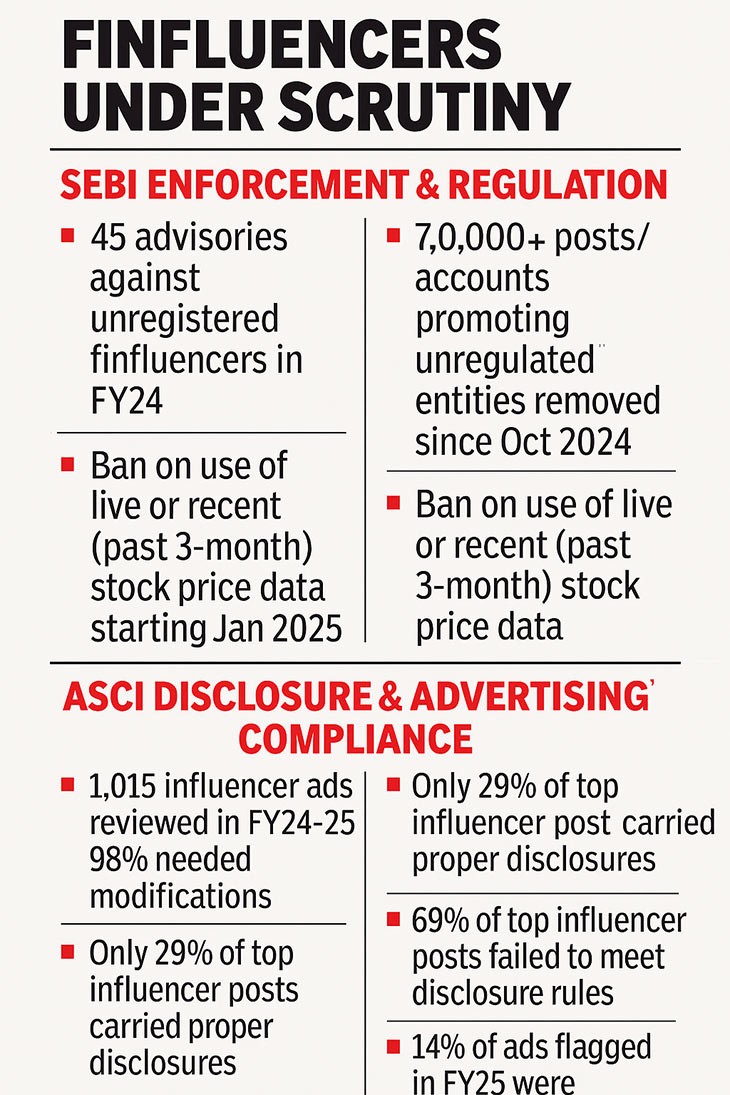
(Source: SEBI, ASCI)
Drawing a distinction between stock market-related content and insurance communication, Naidu stressed that IRDAI guidelines are stringent and unambiguous. “We’re extremely cautious about the messaging—especially around guarantees, benefits, and coverage,” he explained. “We don’t just talk about what you get, we also make it clear what you don’t get. This balance is crucial.”
Naidu, who is also active on LinkedIn, said his personal content strategy aligns with this balanced approach—discussing both premium and economical offerings with equal clarity. “That’s the approach we follow even when working with influencers—to ensure responsible, compliant, and balanced communication,” he said.
Ramakrishnan, said the brand is deliberate about staying away from superlatives and instead focusing on what the product truly delivers.
“We steer clear of exaggerated claims—no ‘fastest,’ ‘tallest,’ or ‘best in class’,” Gopalan said. “Our messaging is honest, grounded, and transparent.”
Brands are drawing clear lines of engagement to ensure influencer marketing remains credible, accurate, and compliant.
Read more news about Influence Zone, Marketing, PR and Corporate Communication, Internet Advertising, People Movement
For more updates, be socially connected with us onInstagram, LinkedIn, Twitter, Facebook, YouTube & Google News