How GTA 6 is rewriting the rules of entertainment: Rediffusion Consumer Lab report
Rediffusion Consumer Lab's report explores how GTA 6 has evolved beyond gaming into a cultural phenomenon, drawing brands, consumers into its orbit and reshaping entertainment and marketing
 by
Published: Nov 21, 2026 7:31 AM | 8 min read
 Follow Us
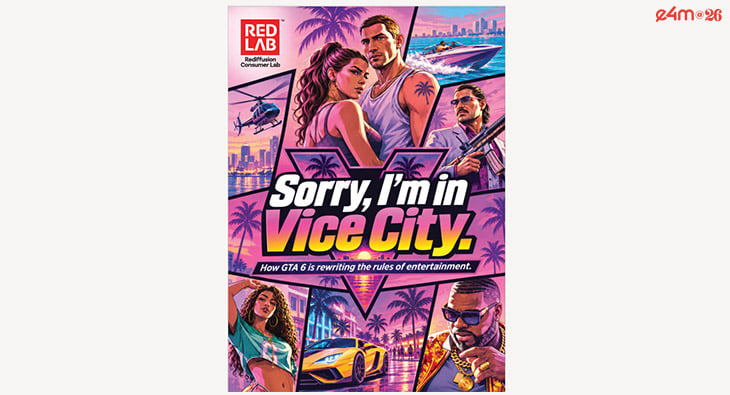

- On November 19, 2026, the release of Grand Theft Auto VI prompted several companies to grant employees time off to play the game, marking a significant cultural shift in workplace policies regarding entertainment.
- Companies like Logitech, boAt, and Infl uish offered paid leave or optional holidays, while some employees humorously referred to their time off as "GTA Flu," with 11% of surveyed U.S. workers planning to adjust their schedules for the game's launch.
- The game's cultural impact extends beyond gaming, influencing brands to create promotions and products, such as Popeyes' limited-time "Spice City" sandwich, as they seek to engage with consumers around this shared experience.
- The phenomenon illustrates a broader trend where entertainment, particularly gaming, increasingly intersects with work and lifestyle, challenging brands to find meaningful ways to connect with cultural moments rather than relying solely on traditional advertising methods.
The game that got people out of office
Notice To All Employees
Your Vice City Vacation Has Been Approved
On November 19, 2026, something unusual happened. Some companies didn't just prepare for employees to be absent. They gave them permission to be.
The reason? Grand Theft Auto VI.
After 13 years since the release of GTA V, the world's most anticipated video game finally arrived. And the excitement was spilling out of gaming communities and into an altogether different territory: the workplace.
Logitech introduced a paid benefit called Logi Game Day, giving its approximately 7,000 employees a day off to play video games. In India, boAt offered employees an optional holiday. Digital agency Infl uish offered its 50 employees paid leave, while interior design firm Inde by ChairsCarté announced a company-wide holiday covering employees, interns and freelancers.
And it didn't stop there. Japanese game developer Pocketpair reportedly offered five days off, jokingly describing it as an urgent business trip to Vice City.
Think about that for a moment.
Companies routinely give employees time off for festivals, national holidays and personal milestones. But a video game? That's a different proposition.
It signals that the cultural importance of entertainment is no longer confined to what people consume after work. It is increasingly influencing how they organise work itself.
The phenomenon even has a name: GTA Flu. Employees are booking leave, requesting schedule changes and, in some cases, joking about calling in sick to spend time in Vice City.
A survey reported by SHRM found that 11% of 1,040 US workers planned to take time off or change their schedules for GTA VI. Among Gen Z workers, that figure rose to 22%.
The important distinction: this isn't proof that the global economy has stopped functioning. Some of the more dramatic productivity-loss estimates circulating online have been questioned by economists and journalists. But the cultural signal is real.
When entertainment becomes an appointment
For years, entertainment has competed for our spare time. A film released on Friday. A series dropped on a streaming platform. A sporting event occupied the weekend.
But gaming is different.
A game isn't something you simply watch. It's something you enter, participate in and increasingly build a relationship with. You don't just follow the story of its characters; you become part of their world.
And GTA has mastered this relationship.
The franchise has built an enormous following through its combination of open-world exploration, storytelling, irreverent humour, music, social commentary and freedom of experience. Its fictional cities feel like living, breathing versions of the real world.
GTA V, released in 2013, continued to attract audiences for more than a decade, with its online universe extending the experience well beyond its original launch.
This is where the story gets interesting.
People are waiting to return to a world they have spent years imagining, discussing and sharing with others.
It is the difference between waiting for a product and waiting for an experience.
And when enough people anticipate the same experience, at the same time, it starts behaving like a cultural appointment.
Think about the World Cup. Super Bowl. A major Taylor Swift/Coldplay concert.
These aren't merely entertainment products. They are collective moments that bring people together around a shared cultural reference.
GTA VI is beginning to demonstrate a similar ability, albeit through a very different medium.
Everyone wants a piece of Vice City
When a cultural moment becomes this big, brands inevitably want in.
And GTA VI is presenting a particularly interesting opportunity: it is creating a commercial conversation that extends far beyond the gaming category.
Logitech has turned the launch into an employee engagement story. boAt has used it to communicate its cultural proximity to young consumers. Food and retail brands are finding ways to participate in the launch-day excitement.
In the US, Popeyes introduced a limited-period Spice City sandwich, playing on the game's fictional Vice City. Retailers and other businesses have also used the launch to create promotions aimed at people spending more time at home.
The opportunity is not difficult to understand.
When millions of people are talking about the same thing, brands have an opportunity to enter a conversation that consumers are already interested in having.
But there is a bigger lesson here.
Traditionally, brands created cultural moments through advertising, sponsorships and large-scale campaigns. Today, some of the most powerful opportunities emerge when brands identify a moment that already has cultural momentum and find a credible way to participate.
The brands that understand the conversation can become part of it. The ones that don't risk looking like they're simply borrowing its popularity.
The irony of GTA: A world that mocks brands, built into a branding goldmine
There is something particularly ironic about brands rushing to associate themselves with GTA.
For nearly three decades, Grand Theft Auto has built its identity around satirising the very world brands operate in.
Its fictional universe is full of parody brands, exaggerated advertising, ridiculous corporate behaviour and sharp commentary on consumer culture.
Cluckin' Bell mocks fast food. Sprunk and eCola parody the cola wars. Lifeinvader takes aim at social media culture.
The game doesn't need real-world brands to make its universe believable. In fact, its fictional alternatives are part of what makes that universe so distinctive.
And therein lies the contradiction.
While marketers spend millions trying to place their brands in popular entertainment, GTA has built an immensely valuable entertainment property by creating a world that makes fun of commercial culture.
It reminds us that cultural relevance cannot always be bought through placement.
Sometimes, the most desirable cultural spaces are the ones that don't need brands to exist.
For marketers, the lesson is important: being part of culture is not the same as appearing inside it.
The real business at stake is attention
Perhaps the biggest impact of GTA VI is how much of people's attention it is capable of commanding.
We live in an entertainment environment where attention is fragmented across streaming platforms, social media, short-form video, gaming and live entertainment.
Every platform is fighting for the same limited resource: people's time.
GTA VI represents a formidable competitor in that battle.
PwC has highlighted how the game's release could influence everything from streaming consumption and music discovery to food delivery, fashion collaborations and tourism. Its in-game radio, for instance, has the potential to introduce music to audiences in a way that feels organic to the experience rather than interruptive.
This opens up an interesting shift in how we should look at entertainment.
A game is no longer competing only with other games. It is competing with Netflix for viewing time, Spotify for listening time, Instagram for social engagement and even restaurants and retailers for consumer spending.
And unlike most entertainment formats, gaming can hold attention for extended periods because the consumer is actively participating.
This is a particularly important consideration for brands.
If consumers are spending more time in a particular entertainment universe, the brands that understand its ecosystem have an opportunity to connect with them through adjacent experiences, products, communities and cultural conversations.
But the opportunity also comes with a warning.
Not every brand needs to jump on every cultural moment. Being relevant requires more than attaching a trending reference to a product.
The real question is whether the brand has anything meaningful to add to the conversation.
The Red Lab takeout
Perhaps the most interesting thing about GTA VI is what the world is doing around it.
Employees are planning their leave around it. Companies are turning gaming into an employee benefit. Brands are creating products and promotions around its launch. Media platforms are anticipating shifts in consumption. And millions of people are preparing to spend an extraordinary amount of time inside a fictional world.
What was once considered a niche entertainment interest has become a mainstream cultural force.
And this is part of a larger shift in how we consume culture.
The boundaries between entertainment, lifestyle, work and commerce are becoming increasingly blurred. What people watch, play and follow is no longer restricted to their leisure time. It influences their conversations, decisions, spending and even their professional lives.
For brands, this changes the equation.
Cultural relevance cannot be built only through advertising. It comes from understanding what people genuinely care about, recognising the moments they collectively gravitate towards and finding meaningful ways to participate. GTA VI is an extraordinary example of this.
Because when a video game can get people to rearrange their work calendars, inspire companies to declare holidays and bring brands from completely different categories into its orbit, it has achieved something beyond entertainment.
It has become a cultural event.
And perhaps the biggest lesson for brands is this:
Before trying to get people's attention, brands need to understand what already has it.
References
- Rockstar Games – Official GTA VI release announcement.
- NDTV – Indian companies giving employees a day off.
- Moneycontrol – boAt, Logitech, Infl uish and Inde by ChairsCarté.
- SHRM – GTA VI and employee leave trends.
- The Guardian – Is the GTA Flu really happening?
- PwC – GTA VI and the battle for consumer attention.
- Adweek – Brands capturing the GTA VI buzz.
- Modern Retail – Retailers riding the GTA VI wave.
Report created by: Siddhanth Idnani and Rajesh Makwana.
Read more news about Industry Briefing, Internet Advertising, Marketing, PR & Corporate Communication, Television Media
For more updates, be socially connected with us onInstagram, LinkedIn, Twitter, Facebook YouTube & Google News