The new rules of Reputation: What communicators must know in 2025
Industry leaders weigh in on what’s changing in reputation management realm and what communication professionals need to focus on to stay ahead
 by
by
Published: Nov 14, 2025 5:45 PM | 8 min read
 Follow Us

Reputation is one of the most powerful assets a brand can own and for communicators, it is the backbone of every campaign, message, and interaction to how stakeholders perceive a brand’s intent, behaviour, and credibility.
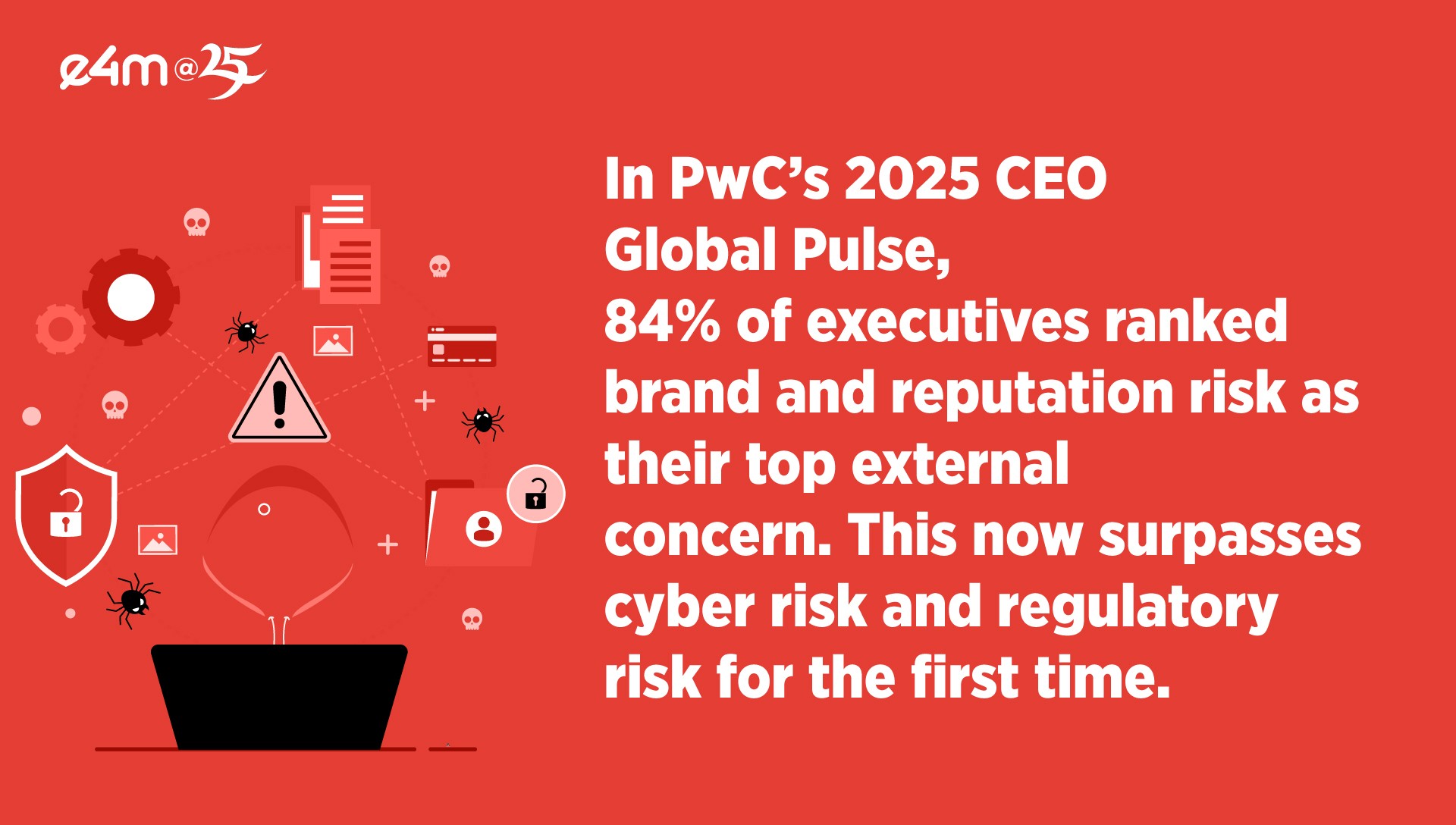
With the changing landscape of the industry, the strategies of reputation management are being rewritten. While its core principles of trust, credibility, authenticity remain the same, everything around them has changed. Information spreads in seconds, audiences analyse intent as much as message, and the platforms shaping public perception are shifting from traditional search to AI-driven ecosystems. However, only 17% of companies actively manage their reputation, unveiling a significant gap between reputational risk and organisational readiness.
Moreover, this shift has raised the stakes for communicators, making reputation management a real-time responsibility, not an annual exercise. Their role is shifting from storytelling or media management to understand geopolitics, advise on business risks, predict stakeholder reactions, leverage technology, and help organisations navigate constant scrutiny while maintaining the core principles of trust.
To understand what today’s communicators must prepare for in the reputation management world, we spoke to industry leaders and reputation managers who navigate these challenges first hand, seeking their views on what’s changing, what’s emerging, and how professionals can stay ahead in an increasingly complex landscape.
New reputation rules that communicators should prepare for!
-
Connect Geopolitics, Commerce and Technology
In today’s emerging landscape, reputation is shaped not just by what a company says, but by how well it navigates the interplay of global politics, business imperatives, and new-age technology.
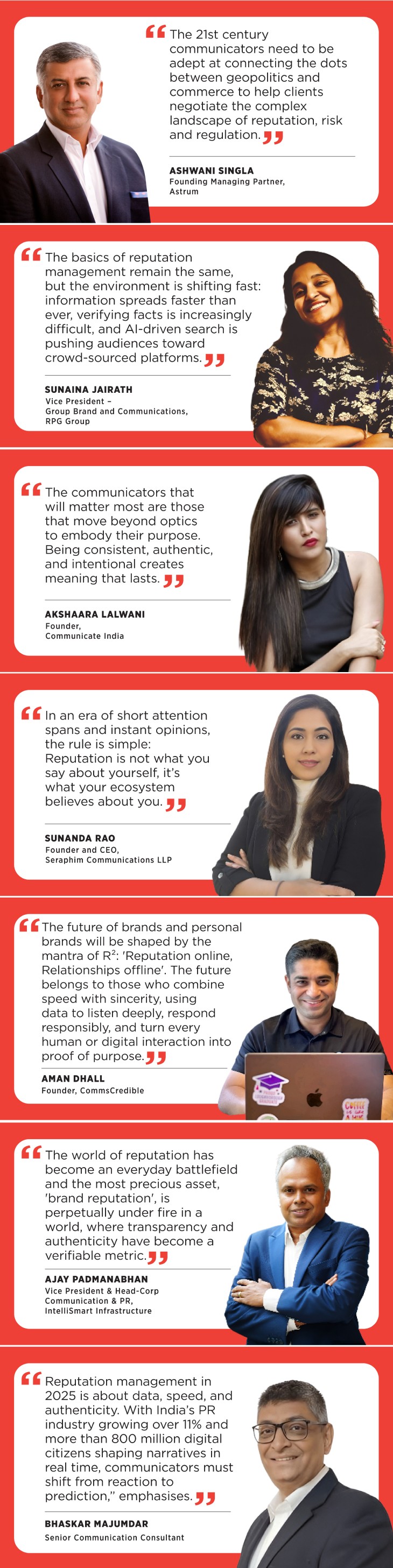
“The 21st century communicators need to be adept at connecting the dots between geopolitics and commerce to help clients negotiate the complex landscape of reputation, risk and regulation; and do that smarter, faster and better they should be able to leverage advancements in technology to their advantage. Last but not the least, insights and intelligence will continue to be the X factor in success,” asserts Ashwani Singla, Founding Managing Partner, Astrum
So, to catch up the pace of evolution, communicators today must act as strategic interpreters of the world, understand how geopolitical trends influence stakeholder expectations and brand behaviour to manage reputational risks and build long-term trust among all stakeholders.
-
Focus on Data, Speed & Timeline
“Reputation management in 2025 is no longer about brand visibility & damage control alone — it’s about data, speed, and authenticity. With India’s PR industry growing over 11% and more than 800 million digital citizens shaping narratives in real time, communicators must shift from reaction to prediction,” emphasises Bhaskar Majumdar, senior communication Consultant.
Mentioning what communicators should focus on, he explains, “The future belongs to those who blend AI intelligence with human insight, influencer credibility with governance, and vernacular storytelling with measurable impact. Reputation today isn’t built in headlines; it’s earned in every conversation, every click, and every choice that reflects purpose, transparency, and trust.”
-
Trust as Reputation’s New Currency
In 2025, trust has overtaken visibility as the core driver of reputation. Employees, customers, regulators, and online communities all act as real-time validators, assessing whether a brand’s promises align with its conduct, making communicators' every interaction a trust checkpoint.
“Over the years, I have seen the way people perceive brands change completely. Audiences have become sharper, more aware, and far less forgiving. They question intent, notice tone, and can sense when something does not feel authentic. In a world where algorithms shape perception almost instantly, trust has quietly become the ultimate currency of reputation. Visibility alone is no longer enough. Credibility, consistency, and authenticity are what turn attention into lasting belief,” supports Akshaara Lalwani, Founder, Communicate India.
What communicators should focus on in 2025 and beyond while managing reputation, she highlights, “Communicators should focus on the human elements that truly build trust. It grows in everyday choices, in how a brand treats its people, how it responds when things go wrong, and how it lives its values even when it is inconvenient. People no longer expect perfection. They expect honesty, empathy, and accountability. Those who embed these qualities into their work will shape reputations that endure. The communicators that will matter most are those that move beyond optics to embody their purpose. Being consistent, authentic, and intentional creates meaning that lasts.”
-
Leverage AI and Human Intelligence together
As artificial intelligence takes center stage in how organisations monitor sentiment, analyse risks, and predict emerging issues, communicators should start navigating a new dual reality.
Explaining this transformation, Sunanda Rao, Founder and CEO, Seraphim Communications LLP elaborates, “Communication isn’t just a postscript, it has become the heartbeat of any business strategy. The idea of reputation as a separate, reactive exercise no longer holds. Today, companies are evaluated by the integrity of their actions and how consistently they communicate them. AI has transformed the way we listen, analyse, and respond, offering sharper insights into sentiment and stakeholder expectations. But technology alone cannot build credibility; that still depends on human judgment, empathy, and consistency. The most successful organisations will be those that merge data intelligence with a clear, values-driven narrative. In an era of short attention spans and instant opinions, the rule is simple: Reputation is not what you say about yourself, it’s what your ecosystem believes about you.”
-
Learn R²: Reputation Online, Relationships Offline rule
The next emerging transformation in reputation management is that now it is built on the foundation of two interconnected worlds. What audiences see online shapes perception instantly, but what they experience offline cements it.
Aman Dhall, Founder, CommsCredible explains this as a concept of “R² principle—Reputation Online, Relationships Offline.” “In 2025, reputation is no longer built by visibility alone. It's defined by verifiability, by how authentic, consistent, and accountable a brand’s actions are across both digital and physical worlds. At CommsCredible, we believe the future of brands and personal brands will be shaped by the mantra of R²: 'Reputation online, Relationships offline'. Communicators must now think like trust architects, not just storytellers. The future belongs to those who combine speed with sincerity, using data to listen deeply, respond responsibly, and turn every human or digital interaction into proof of purpose,” Dhall states.
-
Navigating the New Information Ecosystem
The information ecosystem shaping reputation in 2025 is faster, more decentralised, and far less predictable than ever before. Information spreads in minutes, but its authenticity is harder to verify. Moreover, a recent survey shows that 92% of consumers trust earned media more than any other advertising form, emphasizing the significance of strategic communication and reputation management for organizational success.
To navigate this scenario, Sunaina Jairath, Vice President – Group Brand and Communications, RPG Group guides communicators and highlights three key trends. “The basics of reputation management will not change however the operating environment is evolving rapidly due to these key trends:
- Speed at which information spreads is constantly increasing
- Ability to assess veracity of information is becoming more difficult
- To add sources of information gathering are changing. As primary search moves to AI platforms, the source of information is moving to Wikipedia / reddit etc – platforms which prioritize crowd sourced information.
Understanding these changes are important as communicators plan for reputation management – how information is sourced? Is it authentic? Can you set or correct the narrative?”
-
Reputation as a 24/7 Battlefield
Reputation is under constant surveillance. A single post, comment, or leaked detail can trigger a chain reaction in minutes, forcing brands into a perpetual state of readiness. This makes brand reputation a continuous battle fought across digital and physical touchpoints, every hour of every day.
Underlining the growing importance of reputation, Ajay Padmanabhan, Vice President & Head-Corp Communication & PR, IntelliSmart Infrastructure explains, “The world of reputation has become an everyday battlefield and the most precious asset, 'brand reputation', is perpetually under fire in a world, where transparency and authenticity have become a verifiable metric. Today's brands operate in a state of high alert where the traditional sources of risk have been eclipsed by an unpredictable, hyper-connected network of vested interests, unvetted influencers and weaponized social media. The crisis that we have seen unfolding in the recent past has led to the focus to shift from reactive damage control to proactive, all-encompassing strategic influence, backed by a robust preparedness plan.”
Highlighting how communicators should protect brand identity in reputation battlefield, he underscores, “Preparedness and the velocity of response time are not merely best practices; they are the sole differentiators between a swift recovery and existential brand damage. The 'golden hour' of crisis management has shrunk to the 'golden minutes,' where the initial, authentic response dictates the entire narrative's trajectory.”
Read more news about PR and Corporate Communication News, Internet Advertising, Marketing News, Digital Media News, People Movement News
For more updates, be socially connected with us onInstagram, LinkedIn, Twitter, Facebook YouTube & Google News
