Mumbai floating OOH bids close today, top industry players steer clear
The industry isn't against taking advertising to water, but says the tender has sunk under restrictive eligibility clauses, steep licence fees and a sea of regulatory uncertainties
 by
Published: Nov 27, 2026 9:11 AM | 7 min read
 Follow Us
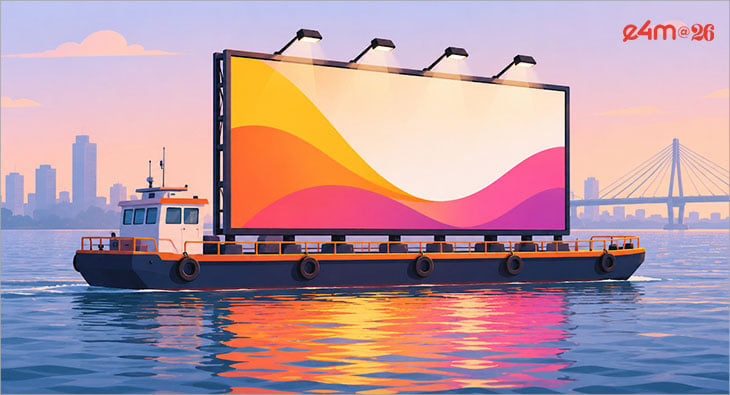

- The Maharashtra Maritime Board's tender for 15 floating outdoor advertising structures in the Mumbai Metropolitan Region has faced significant resistance from the OOH industry, with major companies like Laqshya Media and Times OOH opting not to participate due to restrictive eligibility criteria and high costs.
- Key concerns include the requirement for bidders to have prior experience in water-based advertising, which is unprecedented in India, as well as high licence fees and additional GST liabilities that complicate financial viability.
- Industry executives have expressed skepticism about the commercial potential of the new advertising format, citing a lack of audience data and regulatory clarity, which has led to uncertainty regarding its marketability to brands.
- Environmental and public sentiment issues further complicate the introduction of floating advertising, with concerns about potential backlash and the need for a solid regulatory framework before proceeding with bidding.
As bidding for Maharashtra Maritime Board's proposed floating outdoor advertising inventory enters its final day, several players have confirmed to e4m that they have not participated in the process
The tender, which covers 15 illuminated floating advertising structures across 10 locations in the Mumbai Metropolitan Region (MMR), has attracted scrutiny from the OOH industry since its announcement.
Industry executives cited a combination of restrictive eligibility conditions, high licence fees, regulatory uncertainty, environmental concerns and questions over the commercial viability of the proposed medium.
One of the Sources confirmed to e4m, Laqshya Media, Times OOH and Mumbai-based Alakh Advertising & Publicity are among the companies that did not participate in the bidding.
Read earlier story on Mumbai's floating OOH test
The resistance is not against the idea of introducing floating advertising as a new OOH format. Rather, media owners say the conditions under which the inventory is being offered, the absence of a clear regulatory framework and the lack of audience data have made it difficult to commit to a medium that has yet to establish its commercial credentials.
Neeta Gulati, Director, Alakh Advertising & Publicity, said the tender's eligibility requirements do not accommodate the larger OOH industry, while securing the necessary permissions could prove difficult. "It doesn’t fit the required criteria for the larger OOH industry. Getting the necessary permissions from the authorities will be difficult too. Besides, it would only add to pollution. The eligibility criteria are such that most of us simply cannot qualify," she said.
Eligibility criteria emerge as a major stumbling block
One of the biggest concerns among OOH players is the requirement for bidders to have prior experience in handling advertising media on or in water bodies. Industry executives argued that floating OOH is an entirely new advertising format in India, making the experience requirement difficult for conventional OOH operators to meet.
An executive of an OOH media company said, "The Maharashtra Corporation has stated that only companies with prior experience in OOH advertising on water bodies are eligible to participate in the bidding. But in India, nobody has undertaken OOH advertising on water bodies. This one clause goes against the way the OOH industry operates in India right now. We don't have such clauses in the existing framework."
Another executive questioned how companies could be expected to demonstrate experience in a medium that has not previously been established in the country. "The RFP stated that only companies with experience in handling media on or in water would be eligible to participate. But this is an entirely new medium in India. Who would have that experience? How can you make prior experience in water-based media an eligibility criterion when this format has never existed in the country?"
The executive added that some industry players had raised objections to the condition, questioning how they could acquire experience in a format they had never had the opportunity to operate. The eligibility requirements have also triggered concerns about the transparency of the bidding process. An industry executive alleged that the conditions could potentially favour a particular media player, although the executive acknowledged that there was no evidence to establish such a possibility.
Licence fees and GST make the economics difficult
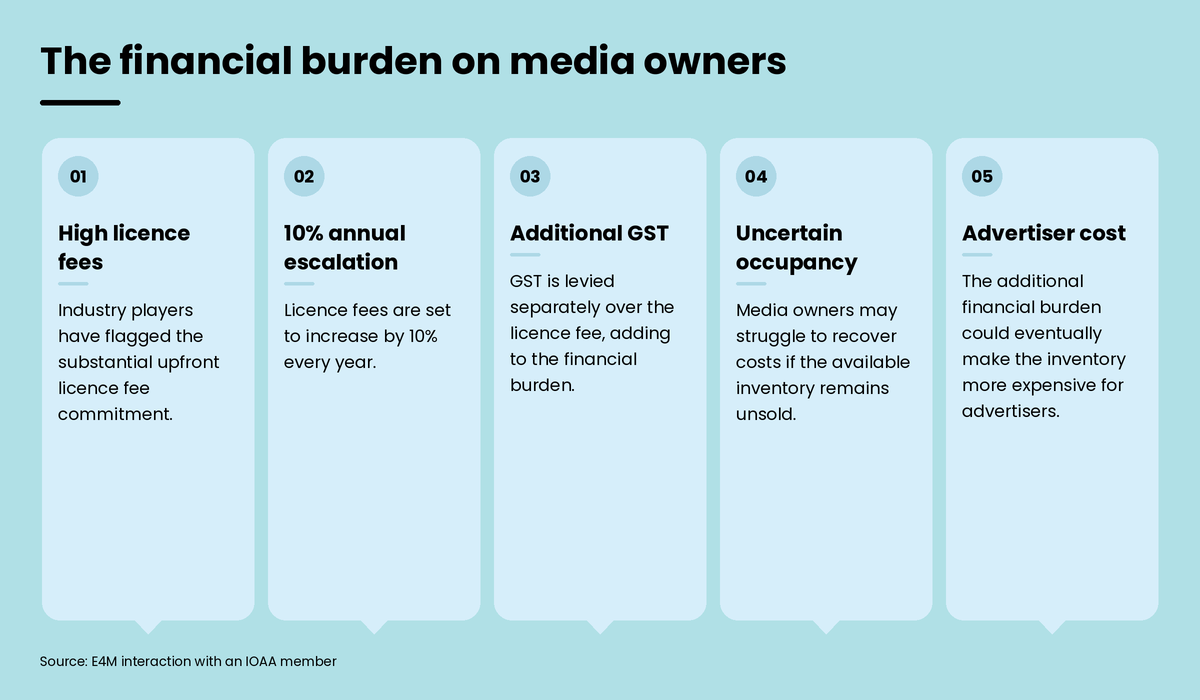
Beyond eligibility, the financial structure of the tender has emerged as another deterrent for media owners. An IOAA member said the high licence fees, coupled with an annual escalation of 10% and the additional GST liability, make the proposition financially challenging. "There is a massive licence fee. The licence fee will be increased by 10% every year, which is making it difficult for media owners. Apart from this, you are also paying GST. Our contention is that you should either charge a licence fee or GST. When you charge a licence fee and then levy GST on it as well, it increases the burden on the end advertiser," one prominent player shared.
The member said the association had also sought a legal opinion on the possibility of challenging the arrangement. "We have also sought an opinion on filing a case. A couple of cases have been filed earlier as well, but nothing has come out of them. That is where the problem arises. It effectively amounts to double taxation, with the licence fee and GST being charged separately."
The member added that the financial commitment becomes particularly difficult to justify when media owners cannot be certain of selling the entire inventory. "Both put together create a very heavy financial burden, considering the kind of payouts media owners have to make, particularly when the media inventory may not be fully occupied."
A new medium without a proven commercial proposition
While the authorities are looking to introduce a new advertising format, industry executives said the absence of an established market makes it difficult for media owners to assess its potential returns.
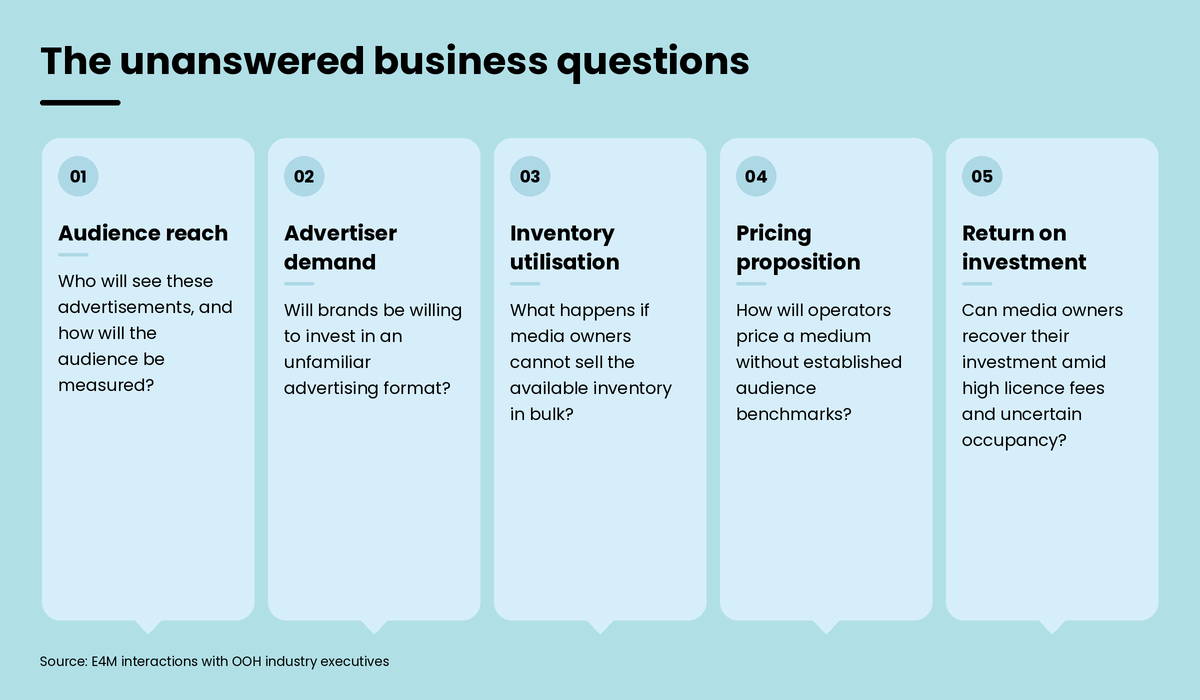
An OOH executive said the industry was unfamiliar with the format and did not have enough information to determine how it could be packaged and sold to advertisers. "The problem is that this is a completely new medium that has never been available in India. So, people are unfamiliar with it, and when something new comes along, they are often reluctant to participate because they do not understand the demand."
The executive said media owners were also uncertain about the audience the medium could deliver and whether brands would be willing to pay for the inventory.
"Second, they do not know how to sell it or structure the proposition to make it commercially viable for media owners and attractive to brands. There is also uncertainty around the potential returns and the audience it can deliver. This is not a medium suited to everyday brands, particularly given the costs involved. What happens if we are unable to sell the inventory in bulk, as we would with conventional OOH sites?"
Regulatory uncertainty and public sentiment add to the resistance
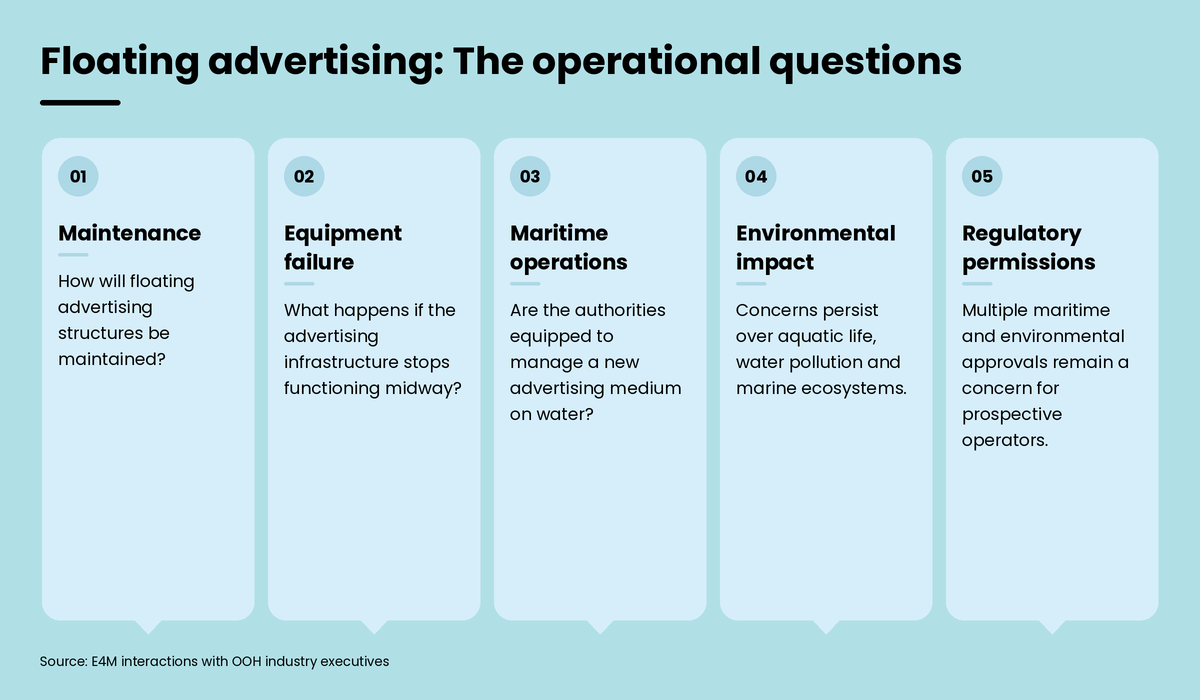
The proposed floating inventory has also remained under scrutiny because of environmental and regulatory concerns, particularly those involving maritime operations and aquatic ecosystems.
An IOAA member said advertisers were yet to develop confidence in the medium because of the regulatory questions surrounding it. "Advertisers are also not very sure about this specific media inventory because there are multiple issues involved, especially regulations concerning the sea, aquatic life and maritime matters. There are no clear regulations. Hence, there is skepticism around it as well."
Public sentiment around the project has added another layer of uncertainty. Industry players said brands could be reluctant to associate with an advertising format that has already attracted criticism over its potential environmental impact.
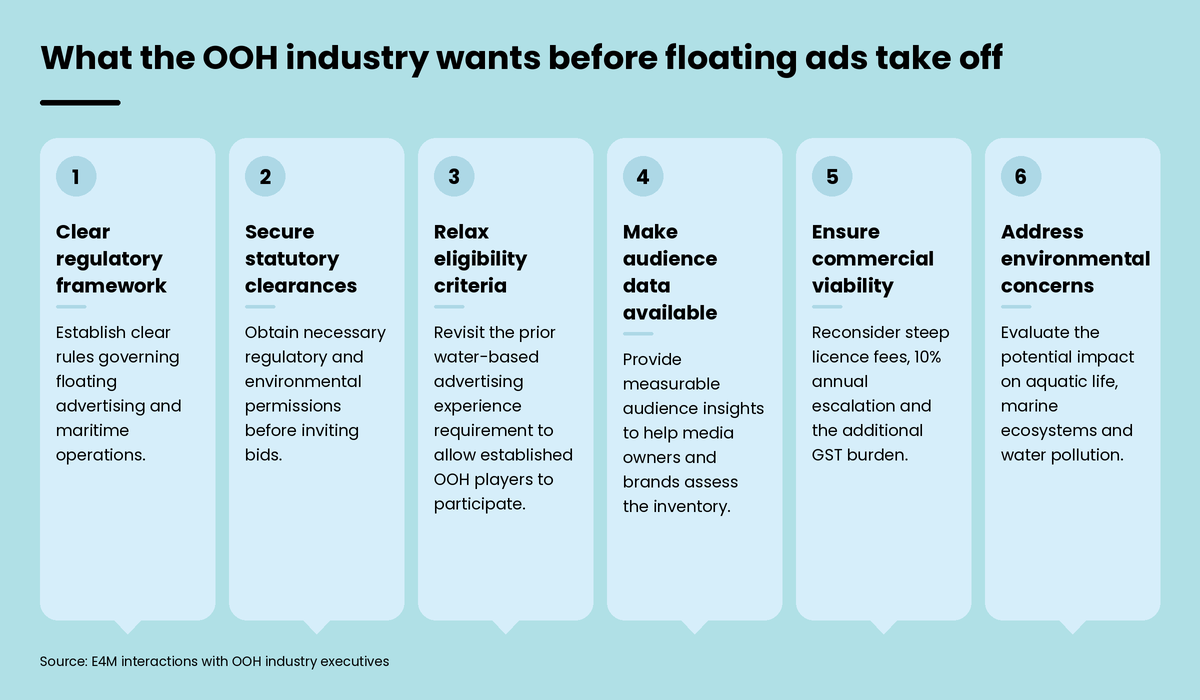
An OOH executive said the authorities should have first established the regulatory framework, secured the necessary clearances and made audience data available before inviting bids. "It is good that the authorities are exploring this medium. However, they should have established the regulatory framework, made audience data available and secured the necessary clearances before inviting bids. The bidding process should have come after these steps, not before them. It makes little sense to invite bids first and seek clearances later."
The executive added that brands would also have to weigh the reputational implications of participating in a project that has attracted public opposition. "If I were a brand, I would also think twice before associating myself with a medium that could potentially attract public backlash or put the brand in a negative light. Every brand has its own reputation to protect, and nobody wants to invite unnecessary controversy."
The deadline may be today, but the real test begins after it. Floating hoardings are an intriguing proposition, and nobody in the industry is disputing that. The pushback is against the way the opportunity is being rolled out. Asking companies to demonstrate experience in a medium that has never existed in India, while imposing licence fees that climb 10% every year, GST on top, and leaving audience data and clearances uncertain, is a tall order. The absence of established OOH players from the bidding may be less a rejection of the format than a reflection of how much groundwork remains to be done. If the sea is the next frontier for OOH, the question is whether the rules, permissions and commercial framework will be ready before the industry is expected to take the plunge.
Read more news about Out of Home, Internet Advertising, Marketing, Digital Media, TV Media
For more updates, be socially connected with us onInstagram, LinkedIn, Twitter, Facebook, YouTube & Google News