'India is uniquely positioned where TV and digital are growing simultaneously'
In a panel discussion hosted by MPA at WAVES Summit 2025, top execs from Jiostar, Amazon and National Geographic discussed the future of sports & entertainment content across markets
 by
by
Published: May 5, 2025 8:59 AM | 5 min read
 Follow Us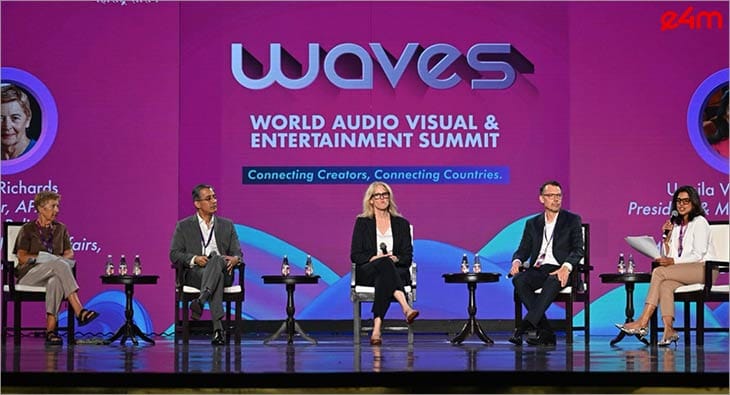

India is uniquely positioned, and it's one of the few countries where both TV and digital are growing simultaneously, said Kevin Vaz, CEO-Entertainment, JioStar, at WAVES Summit, which concluded recently.
During a panel discussion at the summit moderated by Urmila Venugopalan, President and MD of Motion Picture Association, Vaz spoke about the coexistence of traditional TV and digital platforms in India’s evolving media landscape, and said, “We see ourselves as a content company, agnostic to screen size. At the core, we’re storytellers focused on delivering great content, regardless of how or where it’s consumed.”
“India is uniquely positioned, and it's one of the few countries where both TV and digital are growing simultaneously. With a population of 1.4 billion, the opportunity is enormous. TV penetration is currently at 60%, and smartphone penetration stands at about 70%, so there’s still significant room for growth in both.
“Our job is to create compelling content and let consumers decide how, when, and where they want to consume it. We've seen strong resonance across both platforms—whether it’s sports or entertainment. Shows like Bigg Boss and Laughter Chef receive robust viewership on both TV and digital. So, it’s not about choosing one over the other. For us, it’s an ‘and’ market—both will continue to grow together,” Vaz said.
On being asked about JioStar now commanding an unmatched footprint across regional and sub-regional markets in India, how is it deepening that engagement and what are JioStar’s plans to expand that engagement, Vaz said, every hundred miles, language, culture, and habits change and to truly connect with consumers in India, deep understanding is essential.
“At JioStar, we put the consumer first. Our passion lies in understanding not just what people want today, but also anticipating future preferences.
“One of our biggest strengths is our pan-India presence. Being located across regions allows us to tap into diverse local creators. Like the South film industry's success, which draws from talent beyond Bollywood, we focus on creators who deeply understand their audiences. It’s not just about language—it’s about creating content rooted in local culture and context,” he said.
On how Amazon is tailoring its ambitious content strategy for India’s diverse linguistic and cultural landscape, Kelly Day, VP International, Amazon Prime Video, said, “At Prime Video, we operate as one of the few truly global streaming services, with a presence in over 200 countries. India is not only one of our largest markets but also one of the biggest growth drivers for the business worldwide.”
She said that Prime Video recognises that Indian audiences deeply value local content, local talent, and local storytelling.
“India has a rich film and television industry, which gives us an incredible opportunity to tap into its creative potential. When planning our content investments, we take a country-by-country approach. What appeals to audiences in India is not necessarily the same as what works in Brazil, the UK, or other international markets. That’s why we view our service as a local offering first—focused on what customers in each country want and need.
“We've been operating in India for nine years now and have significantly expanded our studios team and production capabilities here. We've also dramatically scaled our investment in original movies and series. In fact, just last year, we announced 70 new titles to be released from late last year through 2026—a substantial commitment. We currently program content in 10 different Indian languages and produce original content in Hindi, Tamil, and Telugu,” she said.
Echoing a similar sentiment, Debra Richards, Director, APAC Content & Studio Production Affairs at Netflix, emphasised that local content is incredibly important and “if something works locally, it has a better chance of succeeding globally.”
On how India benefits from Disney’s global sports media expertise and how learnings from the Indian market inform strategies in the U.S. and beyond, Justin Warbrooke, EVP and Head of Corporate Development, The Walt Disney Company, praised the collaborative partnership with Sanjog Gupta, CEO-Sports, JioStar.
“We have a really great collaborative partnership between Sanjog, who heads our sports business here in India for JioStar, and our ESPN team in the U.S. We’re very fortunate to have what is probably the leading sports portfolio both in the United States and here in India.
“In some ways, Sanjog and the team have actually gone further, faster, in what they’ve done with the sports portfolio here. The sports and entertainment portfolios are offered to the consumer seamlessly across both television and digital platforms. We've really seen the power of bringing that combined portfolio together and what it can do for both subscriber acquisition and retention,” he said.
He further said that there has been a lot of innovation in the consumer offering—different video formats, alternate feeds, and so on.
“In the U.S., we’re taking a slightly different approach by bundling our ESPN service with our entertainment offerings. We’ve seen a lot of success with that, although so far it’s been limited to our secondary sports portfolio, ESPN Plus.
“Later this year, in August, we’ll be launching our primary sports portfolio, which we’ve internally code-named ESPN Flagship. So, there’s a really great dialogue between the teams, and a lot of learning has gone into this,” he said.
Read more news about Television Media, Digital Media, Advertising India, Marketing News, PR and Corporate Communication News
For more updates, be socially connected with us onInstagram, LinkedIn, Twitter, Facebook YouTube & Google News