Royal Stag’s AI-led ‘Code of Large’ turned cricket fans into creators: Pierre de Greef
Pernod Ricard India’s CDMO shared rare AI measurement data from the T20 World Cup campaign, including 300 million views and a 15% LLM search uplift
 by
by
Published: Sep 30, 2026 3:09 PM | 3 min read
 Follow Us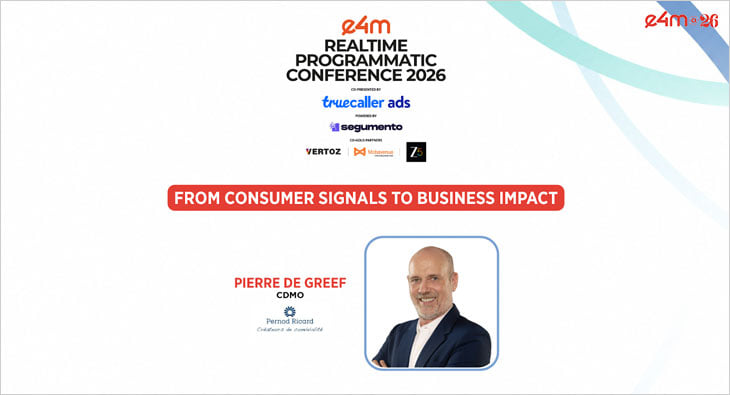

- Pierre de Greef, CDMO of Pernod Ricard India, presented a session on AI's role in enhancing brand campaigns at the e4m Real Time Programmatic Advertising Conference 2026, emphasizing the dual interests of brands and agencies in leveraging AI.
- The campaign for Royal Stag, centered around the T20 World Cup, featured brand ambassador Rohit Sharma and aimed to connect emotionally with fans through personalized AI messages and a microsite experience.
- The campaign achieved significant reach, engaging 88 million cricket fans and generating 300 million views, with a notable increase in share of voice and positive sentiment metrics.
- Business outcomes included a 4% increase in conversion rates and a 15% uplift in search related to large language models, with the campaign setting a new internal benchmark of 125,000 personalized codes generated.
Opening his spotlight session, "From Consumer Signals to Business Impact," at the e4m Real Time Programmatic Advertising Conference 2026, Pierre de Greef, CDMO, Pernod Ricard India, began with a wry read of the room. "Brands, you're here because you want to use AI to reduce your agency fee. Agencies, you want to be here to increase your creativity, to increase your agency fee. And students, you are smart enough to be here to take our jobs very soon."
De Greef then presented what he called the first full-fledged look at a campaign built on AI to deepen emotional connect. Royal Stag, the official sponsor of the national cricket team, anchored the effort in the T20 World Cup, where India defended its title at home. Brand ambassador Rohit Sharma was central to the idea of helping every fan discover their own "Royal Stag Code of Large," a code of success built on being selfless, driven, fearless and inspiring. Mental performance coach Paddy Upton featured in the film.
The consumer journey ran through a microsite. Fans registered, took a selfie and instantly received a call from Sharma carrying a personalised AI message. They then defined their personal code of success, and within 30 seconds received a shareable, selfie-based visual with that definition.
Distribution, de Greef said, was equally AI-driven. Alongside TV, OTT and sponsorship, the brand ran moment marketing, capturing live stadium moments and turning them into topical messages pushed through programmatic. Influencers were reframed as content creators. A geo-targeted plan linked ATL to BTL through the "last three feet" experience, while digital PR was built to improve visibility on large language models. "Google is not really still the reference for us," he said. "If you want to be present on LLM, you have to implement a very strong digital PR presence."
He said the numbers were shared deliberately. "A lot of people do some trials, but we never really go deep on the measurement of AI on programmatic."
The campaign reached 88 million cricket fans and generated 300 million views, with 40% coming from user-generated content. Share of voice rose from 75% to 90% against the competition's 10%. Positive sentiment stood at 96%, and the engagement rate was 6% against a 1.5% benchmark. Programmatic data showed X driving more conversation than expected, prompting a budget reallocation. Earned media was valued at 16 crore, with a further 22 crore from ICC support, which began promoting the campaign after the scale of fan participation became clear.
The business impact followed. The brand saw a 4% gain in conversion at the last occasion, the three-second window when a shopper decides in store. Search uplift on LLMs was 15%, which de Greef called proof of "pull marketing" that is "free" because "people come to you. You don't go to them."
The campaign generated 1,25,000 codes, now the internal benchmark. "We will not execute any next AI program without beating this number," he said, adding that a place on the consumer's phone matters more than a house key. "AI is a tool. AI is not a hand game."
Read more news about Marketing News, Advertising News, PR and Corporate Communication News, Digital News, People Movement News
For more updates, be socially connected with us onInstagram, LinkedIn, Twitter, Facebook, YouTube & Google News
