Marketing has moved on from being product-led to being purpose-led: Indranil Gupta
At the e4m Do Good Conference and Awards, Indranil Gupta, Founder Director of BrandNEW Associates, explained why purpose-driven branding is no longer optional in today’s consumer landscape
 by
by
Published: May 14, 2025 5:05 PM | 3 min read
 Follow Us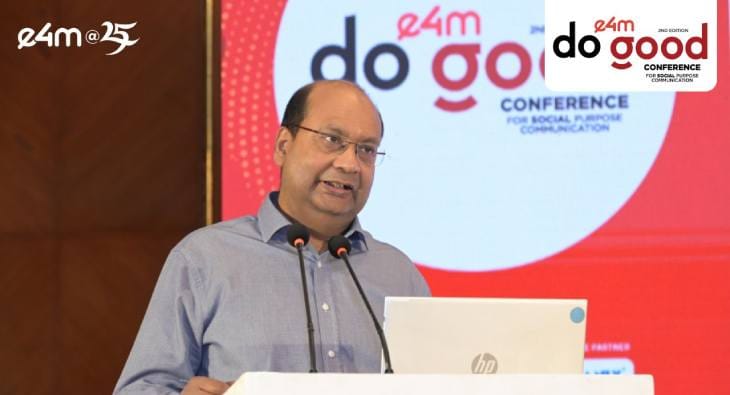

At the e4m Do Good Conference and Awards, Indranil Gupta, Founder Director of BrandNEW Associates, delivered a compelling session on why purpose-driven branding is no longer optional in today’s consumer landscape. With data, storytelling, and real-world case studies, he urged marketers to embed purpose at the heart of business strategy.
“Consumers today aren’t just shopping—they’re voting with their wallets for the kind of world they want to live in,” said Gupta, citing that 72% of global consumers expect brands to reflect their values, and 64% are willing to switch or boycott brands based on their stance on social issues.
Marketing, he stressed, has shifted from being product-led to purpose-led. A staggering 83% of millennials and 76% of Gen Z expect brands to take a stand. These digital-native generations are quick to call out inauthenticity, making purpose a non-negotiable. Climate justice is driving demand for sustainable packaging and net-zero commitments; diversity and inclusion efforts are expected to be genuine, not tokenistic. Brand narratives today are shaped by gender equity, social justice, and sustainability.
The question, Gupta said, is no longer if your brand should stand for something, but what it stands for and how consistently it shows up in every decision. Purpose is the reason a business exists beyond making money. For instance, Tata Tea’s “Jaago Re” campaign sparked civic conversations on voting and gender. Nike’s mission isn’t just to sell shoes—it’s to “bring inspiration and innovation to every athlete in the world,” defining athletes as anyone with a body.
Gupta emphasised that the purpose is not CSR. “CSR is the side salad. Purpose is the main course,” he said. CSR often sits outside core operations—donations, volunteering—while purpose drives value creation across products, policies, and practices. It’s also not political activism or a one-off marketing campaign, but a long-term commitment to meaningful impact.
He cited Dove’s transformation as a standout example. Its shift from a soap brand to a movement promoting real beauty and self-esteem helped double global sales—from $2.5 billion to $4 billion. Campaigns like Real Beauty Sketches and the Self-Esteem Project resonated deeply with women who felt unseen by mainstream beauty narratives.
From his own work, Gupta highlighted Heimat, a premium clothing brand born from Delhi’s slum clusters. Through the MasterG initiative, women from underserved communities are trained in pattern making. “Every Himat garment carries a story of identity and empowerment,” he said.
He also showcased the Balipara Foundation in Assam, which uses “Natureomics”—a model combining nature and economics—to restore ecosystems and uplift rural communities. “They’re not just an environmental NGO—they’re a movement for ecological equity,” he noted.
Gupta wrapped up with a four-phase framework for embedding purpose—Discover, Define, Deliver, Demonstrate—and urged brands to take consistent, measurable action. “Purpose is not a trend,” he concluded. “It is a long-term differentiator. Be the brand people are proud to believe in.”
Read more news about Marketing News, Advertising News, PR and Corporate Communication News, Digital News, People Movement News
For more updates, be socially connected with us onInstagram, LinkedIn, Twitter, Facebook, YouTube & Google News