How strategy trumps scale in omnichannel marketing
Experts at the e4m India Brand Conclave 2025 emphasised brand identity, storytelling, and strategic platform selection for effective omnichannel marketing
 by
by
Published: Jan 31, 2025 12:13 PM | 8 min read
 Follow Us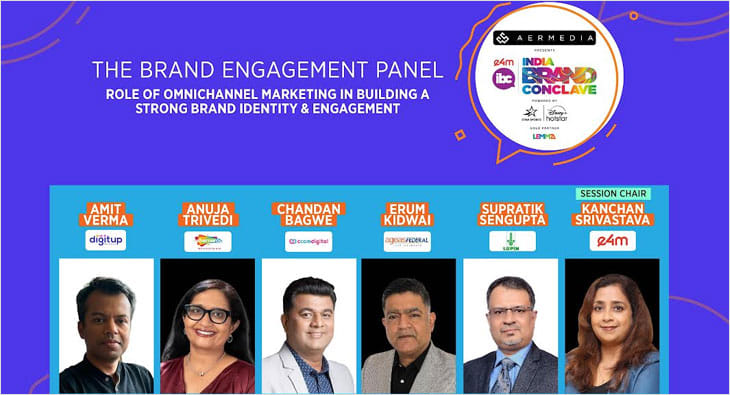

The e4m India Brand Conclave 2025 hosted a panel discussion which had marketers discuss the significance of omnichannel marketing in shaping brand identity and engagement.
The panel, featuring Amit Verma, CEO & Founder of Digitup; Anuja Trivedi, Chief Marketing Officer of Shemaroo Entertainment; Chandan Bagwe, Managing Director of CCom Digital; Erum Kidwai, SVP & Head of Marketing at Ageas Federal Life; and Supratik Sengupta, Head of Marketing (OTC) at Lupin Limited, explored how brands can maintain consistency across multiple touchpoints while adapting to evolving consumer expectations.
Kanchan Srivastava, Senior Editor & Group Editorial Evangelist at exchange4media, moderated the session.
Sengupta opened the discussion by addressing the challenge of creating a unified brand identity across customer touchpoints. “If you talk about unified identity, and by identity you mean the look and feel of the brand, the mnemonics, and everything, FMCG has decoded and managed that almost 15 years back through brand guidelines, brand guardrails, brand books—where you know which Pantone to use, which font to use, which weightage to give them, and how to take that forward across media,” he said.
He pointed out that while uniformity is no longer a significant challenge in the FMCG and CPG sectors, other industries are still evolving. “Consumer durables and others have picked that up, but what I would like to bring in is another dimension. It’s not about how unified you are; it’s also about how long you remain unique,” he stated. Sengupta highlighted examples from the Indian market, noting, “Almost every automobile brand has changed their logos in the last five years—Mahindra changed three times, JLR changed, and many marketers questioned these moves.”
He stressed that brand consistency is not just about visual elements but about maintaining a distinct brand character. “Today, everybody is visible. The key is whether you are engaging with it. Classical marketing dictates that you should not tweak a brand or logo, but look at Google. They change their logo almost every week with contextual formatting. In FMCG, that’s a strict no-no, but they get away with it because they have embedded this as part of their brand’s unique character.”
Sengupta emphasized that the real challenge of omnichannel marketing is not just maintaining visual uniformity but ensuring that the brand’s essence remains unmistakable across all channels. “You might get away with tweaking the logo colour or making small adjustments, but as long as you stay true to your brand’s core characteristics, you can successfully navigate the omnichannel landscape.”
Following this, Kidwai discussed the role of consumer insights in crafting a unified brand identity. “The importance of surveys can be seen from the fact that this discussion itself started with a survey,” he noted. He reflected on how brand research has evolved over time. “Twenty-five years ago, when I started my career, conducting surveys was a cumbersome process. You had to engage big agencies like Nielsen or BlackRock, which was extremely expensive. Plus, biases in the surveys were always a concern.”
He highlighted the advantages of modern digital tools. “Today, I keep telling my team and management—when you have the opportunity to do quick social media surveys, why aren’t we integrating them into our strategy? Focus group discussions, real-time validation of our course of action—these should be an essential part of brand planning,” he asserted.
Kidwai stressed that every brand decision involves costs, making data-driven insights critical. “I have an aversion to marketers who rely purely on gut feel. While I’m not saying we should conduct surveys for everything, they need to be a part of our strategic process. When thinking about omnichannel presence, whether it’s physical, digital, or a mix of both, these insights help brands understand what their customers truly expect.”
He pointed out the accessibility and cost-effectiveness of digital surveys today. “In today’s digital age, biases are minimal, and you can reach a far wider audience. You can segment and create cohorts to gather deeper insights. So, when marketers shy away from using them, I find it baffling. If you are investing significantly in building an omnichannel presence, why hesitate to spend just a small fraction of that on ensuring your approach is backed by data?” he concluded.
In an era of digital fragmentation, integrating brand identity across multiple channels is no longer optional—it’s essential. Setting the foundation for an effective omni-channel presence, Bagwe emphasized the critical role of brand identity. “The most important part of this journey is the brand identity. Once you have this, you can define how it translates across different channels and platforms,” he stated.
Bagwe broke down brand identity into three key components: brand pillars, brand guidelines, and brand positioning. “Brand pillars are the essence of a company—its values, vision, mission, and ethos. But along with these, you need to define USPs (Unique Selling Propositions) and UBPs (Unique Benefit Propositions),” he explained. While USPs highlight product excellence, UBPs answer the core consumer question: What’s in it for me?
Brand guidelines, he added, provide consistency in elements like logos, colours, and communication style. “Supratik was saying that logos and colours are important. Yes, they are. They define how a brand is perceived across platforms.”
Positioning, according to Bagwe, is about clarity in segmentation. “Who is your target audience? Behavioural segmentation, demographic segmentation, geographic segmentation—all these define how you craft your brand message,” he noted.
Illustrating with an example, he pointed to Forest Essentials, a brand that maintains consistency across its website, social media, retail outlets, packaging, and customer interactions. “Their gold-rich colour palette, their storytelling around Ayurveda, and their information across all touchpoints create a seamless brand experience,” he said.
For content-driven brands, storytelling plays a central role in positioning. Speaking from her experience at Shemaroo, Trivedi highlighted the importance of distilling a brand’s essence into a single compelling narrative. “At Shemaroo, every story is a brand,” she asserted.
Trivedi outlined a three-step approach to crafting effective marketing campaigns. The first being grabbing attention – “In a cluttered environment, how does my promo in the first three seconds stand out? Is it a sound, a visual, a celebrity?” The second, she added, was creating relevance – “For example, if a story is about a widowed mother finding love again, we might ask: How would you feel if you were told your child is not your child? That’s how we make the story resonate with more people.” Trivedi’s third approach is to leave a hook – “Since time is the most valuable commodity, we must give the audience a reason to return.”
She emphasized the importance of adapting the core message across channels. “The same one-liner will be portrayed differently on a promo, a static post, or social media. But it all ties back to a central idea,” she said.
While omnichannel marketing is often deemed necessary, Verma brought a pragmatic perspective. “The funny part is, how many companies can actually afford to do it?” he remarked. “Everyone dreams of being on the roadside, in newspapers, on social media, with influencers—but with the kind of money it takes, only a handful can do it.”
Instead of chasing an exhaustive omni-channel strategy, Verma advocated for a targeted approach. “Look at brands like Lijjat Papad or Minimalist—did they invest in full-scale omnichannel marketing? No. But they still built strong brands,” he pointed out. The key, he argued, is strategy over scale. “Understand what will work for your brand, what channels are effective, and where your audience truly engages.”
He also highlighted the challenge of measuring ROI in omni-channel campaigns. “Companies burn enormous amounts of money and still don’t know where their traction comes from. They struggle to answer: Is my branding right? Am I communicating effectively?”
Using Shark Tank India as an example, Verma noted how brands strategically leverage the platform. “Some startups give up 0.5% equity just for marketing exposure. They’ve chosen their channel wisely,” he said.
With digital transformation accelerating, Verma stressed the critical role of website and app optimization. “Your URL is your first impression. It holds your brand logo, your content—everything. If you don’t get this right, no amount of omnichannel marketing will save you,” he warned.
Citing Shark Tank again, he pointed out how investors often call out weak branding. “The moment they see inconsistencies in logos or positioning, they advise brands to fix it first.”
Verma predicted a shift in B2B branding as AI and digital ecosystems evolve. “Right now, many B2B companies ignore digital presence, thinking they don’t get clients online. But that’s changing. Soon, they’ll have to rethink their websites as strategic assets,” he concluded.
Read more news about Marketing News, Advertising News, PR and Corporate Communication News, Digital News, People Movement News
For more updates, be socially connected with us onInstagram, LinkedIn, Twitter, Facebook, YouTube & Google News
