CTV is more than just an extension of digital advertising: Teads’ Diogo Andrade
At e4m Media Confluence Summit 2026, Diogo Andrade, VP, Agency Partnerships, APAC, Teads, highlighted the opportunities opening up with rising smart TV ownership, changing viewing habits & more
 by
Published: Nov 25, 2026 12:29 PM | 5 min read
 Follow Us

- India's connected TV (CTV) market is experiencing significant growth due to increased smart TV ownership and a shift from traditional cable subscriptions to streaming content, with approximately 65 million connected smart TVs currently in the country.
- Diogo Andrade from Teads emphasized the need to view CTV as a distinct television opportunity rather than just an extension of digital advertising, highlighting the importance of understanding audience behavior and the shared viewing experience.
- The session discussed the potential of home-screen advertising on smart TVs, which offers brands repeated visibility as viewers navigate between streaming applications, and the significance of co-viewing for enhancing ad recall and engagement.
- Andrade concluded with key takeaways for advertisers, including the scale of the CTV opportunity in India, the benefits of home-screen advertising, and the necessity for stronger connections between CTV, mobile, and web campaigns to improve overall advertising effectiveness.
India's connected TV (CTV) market is entering a significant growth phase, driven by rising smart TV ownership, increasing consumption of streaming content and changing audience behaviour. As more households move away from traditional cable subscriptions towards digital-first television viewing, CTV is emerging as an important opportunity for brands to expand their reach and strengthen audience engagement.
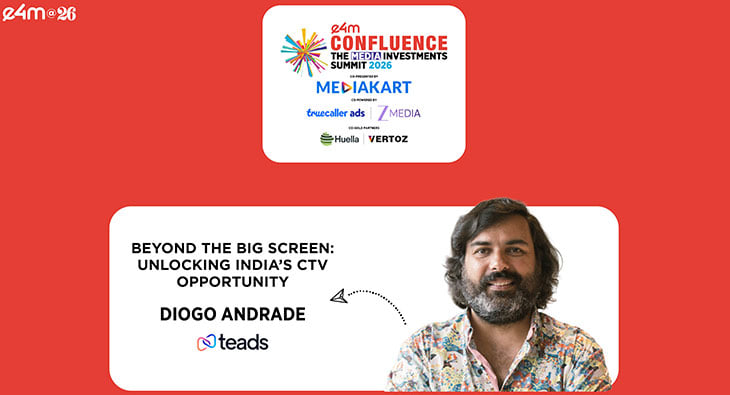
Exploring this evolving landscape, Diogo Andrade, VP, Agency Partnerships, APAC, Teads, delivered a session titled 'Beyond the Big Screen: Unlocking India's CTV Opportunity' at the e4m Media Confluence Summit 2026,
Opening the session, Andrade emphasised the need to look at connected TV as a television opportunity rather than merely an extension of digital advertising. "I often see connected TV as a discussion about digital marketing. But obviously connected TV should be seen and understood as a comparison to linear TV," he said, highlighting the importance of understanding the medium's distinct viewing behaviour.
He pointed to the growing penetration of smart TVs in Indian households, noting that affordability and changing consumer preferences are accelerating adoption. According to GWI data cited during the session, India currently has approximately 65 million connected smart TVs.
"The numbers in India are pretty sizable at this point in time," Andrade said, adding that the opportunity needs to be viewed in the context of household viewing patterns. With an average of 2.5 people per household, CTV continues to offer a shared viewing experience rather than the one-impression-to-one-user model typically associated with digital advertising.
He also highlighted that audiences watching television are already accustomed to advertising. "The majority of people that watch TV are actually in the predisposition to consume ads," he observed, pointing to the familiarity viewers have developed with the advertising-supported television experience.
A significant part of Andrade's discussion focused on the shift from linear television to streaming. He noted that smart TV owners, particularly younger and affluent audiences, are increasingly consuming content through streaming platforms rather than traditional cable subscriptions.
Sharing an insight from a recent conversation with Samsung, he said, "For any TVs that have been bought this year, because they can see who actually signed up and has a cable subscription on their TV, they say this percentage is actually 70 to 80%."
He argued that this shift makes CTV increasingly important for brands looking to reach audiences who are gradually moving away from conventional television schedules. "People are streaming, and people are not signing up for cable," he said, adding that younger audiences are spending considerably more time watching streaming content on smart TVs than linear television.
Andrade also drew attention to the importance of co-viewing, an aspect he believes advertisers should not overlook while evaluating CTV campaigns. He explained that shared viewing experiences can lead to greater interaction with advertisements, stronger recall and conversations between viewers.
"When you're co-viewing, you interact more with the ads. You remember those ads better. You actually talk about the ad with the person you're watching TV," he said.
He further cautioned against looking at advertising effectiveness only through the lens of measurable campaign outcomes. "Our industry has gotten into this rabbit hole of having to measure everything we do," Andrade remarked, explaining that the impact of shared viewing may not always find a place in conventional campaign reports.
Moving beyond in-stream advertising, Andrade highlighted the relatively untapped potential of smart TV home screens. He described the home screen as an emerging advertising opportunity, offering brands visibility at the moment viewers switch on their television.
"The home screen is a really interesting opportunity for brands to think about," he said, explaining that viewers repeatedly return to this interface while navigating between streaming applications.
Citing LG data, Andrade noted that users visit their television home screens an average of five times a day. The time spent browsing through different apps and deciding what to watch creates repeated opportunities for brands to capture attention. He also pointed out that advertising across different television manufacturers, including LG, Samsung and Hisense, can help brands access incremental household reach.
"Typically, if you're running advertising on LG, on Samsung, on Hisense, you're tapping into different households. So you're actually aggregating that reach, and not really duplicating that reach," he explained.
The session further explored the relationship between connected TV and mobile devices. Andrade observed that second-screen behaviour is increasingly common, with viewers simultaneously watching television while using their smartphones to browse social media, communicate with friends or engage with other content.
He stressed that brands need to understand how these two screens can work together. "How do you take a CTV ad and understand what a user is doing on a mobile to really connect the dots and get a user to perform an action?" he asked, underlining the opportunity to move audiences from exposure on television to engagement on mobile.
Drawing a distinction between the two viewing experiences, he explained that co-viewing on CTV is particularly valuable for brand recall, while mobile offers opportunities for deeper engagement and action. "It's really important to understand this dynamic of branding as a co-viewing experience and the CTV to mobile as a really great opportunity to build engagement and go down the funnel," he said.
Drawing on multiple brand-lift studies conducted across the region, Andrade also highlighted the importance of connecting CTV investments with mobile and web campaigns to strengthen advertising effectiveness across the funnel.
Concluding the session, he identified three important takeaways for advertisers: the scale of India's CTV opportunity, the potential of home-screen advertising to address fragmentation across streaming platforms, and the need for advertising partners to build stronger connections between devices.
"If you look at the number of TV sets and the average household, you're looking at 160 million Indians. That is the opportunity to reach," he said.
He further emphasised that home-screen advertising could help brands navigate the fragmented streaming ecosystem, while better integration between devices would be critical to driving campaign impact. He concluded by stating that brands should understand how different devices are used and challenge partners to connect TV, mobile, and web activity to strengthen campaign impact.
Read more news about Marketing News, Advertising News, PR and Corporate Communication News, Digital News, People Movement News
For more updates, be socially connected with us onInstagram, LinkedIn, Twitter, Facebook, YouTube & Google News