Brands must not go short-term in a performance era: ISA’s Sunil Kataria
Performance platforms made every rupee traceable. ISA chairman Sunil Kataria on why that must not turn marketing short-term, and what AI changes next
 by
Published: Nov 28, 2026 11:36 AM | 14 min read
 Follow Us

Every rupee of advertising money in India is now being asked to account for itself. According to the Pitch Madison Advertising Report (PMAR) 2026, produced by Pitch in partnership with Madison World, India’s adex reached ₹1,55,105 crore in 2025 on an expanded definition, up 12%. Digital, at ₹93,156 crore, now makes up 60% of that pie and grew 22% in the year, while traditional media slipped 1% to ₹61,949 crore.
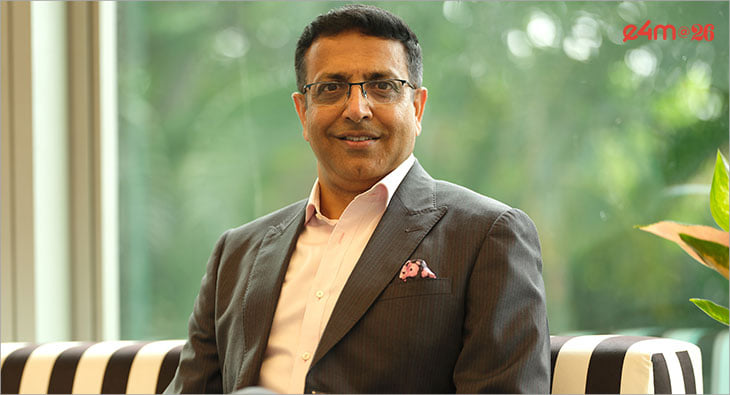
Few people are better placed to read that shift than Sunil Kataria, Chairman of the Indian Society of Advertisers (ISA), the peak body that has represented India’s advertisers for over seven decades. Kataria, who is also CEO and Managing Director of Godrej Agrovet, has held senior roles at Marico, Raymond Lifestyle and Godrej Consumer Products, where he was CEO for India and SAARC.
In a conversation with e4m, his throughline was consistent: the tools have changed and the temptation to chase only what can be counted has grown, but the fundamentals of building a brand have not moved.
Accountability is old, the scoreboard is new
The idea that performance marketing has suddenly forced marketers to justify their spend is, in Kataria’s telling, a misreading of history. What has changed is where the ROI question can be answered. “Even before quick commerce, e-commerce and performance marketing happened, marketing was always responsible for driving business outputs,” he said. “Marketing effectiveness and marketing ROI were always the biggest question any CEO would ask the CMO and the marketing team.”
The real shift is visibility at the bottom of the funnel. Brands once spent upper-funnel money on equity and demand while conversion happened across millions of stores that the media plan could barely see. Performance platforms have put that conversion, and its cost, on a dashboard. “The demand generation piece stays. But now there is performance marketing, where there is a very clear capture of demand conversion, and it happens easily, with all the data and input-output ratios visible on the platforms,” he said. “Along with demand generation, there is a span which is moving towards capturing demand conversion, and that conversion is more easily visible. I think that’s the shift.”
Visibility, however, carries a bias. Whatever can be measured to the decimal tends to win budgets, while brand equity does not show up on a dashboard by the hour. “Demand conversion alone is not going to build healthy brands,” he cautioned. “Marketing has to be careful that it does not become short-term. That’s the watch-out for all marketers. Please keep doing the demand generation, demand building and brand equity building work in parallel. So don’t be short-term about it.”
It is the consumer who has fragmented, not the media
Media fragmentation is the industry’s favourite complaint. With digital projected at 64% of a ₹1,74,605 crore adex in 2026, according to PMAR, planners have more vehicles than ever to choose from. Kataria’s first move was to question the vocabulary. “What we have to understand is that it’s the consumer media consumption pattern which has become fragmented, not the media,” he said. “Consumers are consuming media very differently, in a much more complex and fragmented way. That does not mean our advertising strategy should fundamentally become fragmented alone.”
His checklist for planners starts with the person rather than the platform. “Finally, we are chasing consumers. So brands should chase consumer journeys and not just micro channels,” Kataria said. “And the good part is, with some of the technology available, while it’s not 100% there, consumer journeys are more traceable than they were 10 years back.”
Second is deduplicated reach, the long-standing blind spot of Indian media planning. BARC India (the Broadcast Audience Research Council) and Nielsen launched BARC x Nielsen ONE Ads in March 2026 to stitch linear TV and digital data into a single view. Media and entertainment company JioStar later reported less than 10% duplication across TV and digital in campaigns measured during the ICC Men’s T20 World Cup 2026. “Cross-media measurement is a large work in progress in our country still,” Kataria said. “But deduplicated reaches across platforms are going to be very critical for media planners. I think they’re all aware of it. But it is clearly work to do.”
The third point is about what a reach number cannot tell a brand. “In this whole search for the right reach and the right efficiency, we must not forget the quality of consumer engagement which comes from various media platforms,” he said. “Within different platforms, the quality of engagement for your consumer audience does vary from platform to platform.”
Linear TV gets a sharper edge
PMAR 2026 puts linear TV adex at ₹32,855 crore in 2025, down 5%, with ad volumes falling about 10%. Yet once connected TV (CTV) is counted, the large screen grew about 4% to ₹38,855 crore, because CTV alone doubled to an estimated ₹6,000 crore. The report expects linear to stay flat in 2026 while CTV climbs to ₹8,000 crore. Video budgets, in other words, are being redistributed rather than leaving the television screen. Kataria believes that story is not told often enough. “There is definitely an evolution happening on linear TV which is not very well talked about in larger media forums,” he said. “Linear TV continues to have that mass reach. It has cultural relevance and it has the ability to build scale brands.”
What is new is what now sits on top of it. Linear is not turning into a micromarket medium on its own. CTV and streaming are adding the targeting layer that television never had. “CTV and streaming are added layers available along with linear TV on top of it,” he said. “These two layers give you the ability to do sharper targeting and the flexibility to do audience segmentation. That adds a fantastic creamy layer on top of the mass scale which exists.”
The commercial logic follows, since a plan can now buy mass and precision in the same flight.
“If used well, this allows advertisers to combine the mass scale reach with very specific audience strategies,” Kataria said. “The opportunity for us is to make television planning more integrated, with linear TV delivering scale and digital video and CTV helping address sharper, more specific audience cohorts.”
Trust before targeting
Personalisation is where the data argument turns uncomfortable. A 2026 survey of 300 CMOs by Boston Consulting Group (BCG) found that around 52% of Indian CMOs expect generative AI to significantly improve personalisation, the highest among the regions surveyed. At the same time, the regulatory floor is rising. India notified the Digital Personal Data Protection (DPDP) Rules in November 2025; the provisions on consent managers came into force this month, and the bulk of the obligations on data fiduciaries follow in May 2027.
“Consumer data is a very strong strategic asset, but even more than that, consumer trust is the most valuable asset,” Kataria said. “We can all go gaga about the way we can use first-party consumer data, but this cannot come at the cost of losing consumer trust.” He sees the promise of personalisation and the limits of privacy as one idea viewed from two sides. “Personalisation can build very strong and much sharper loyalty by engaging one-on-one,” he said. “But you cannot be intrusive, because then you will immediately put off the consumer. You cannot violate the trust; you cannot breach privacy.”
On the law, he treats the DPDP framework as a floor rather than a finish line. “DPDP is a fantastic compliance guardrail, but brands should not do this only because it is a guardrail,” Kataria said. “You have to do it to ensure that you are giving personalised communication which consumers value and do not treat as a breach.”
The penalty for getting this wrong, he argued, is less a regulatory notice than a consumer hitting the block button. “Otherwise, you keep bombarding me with anything, I will end up getting irritated as a customer and blocking you,” he said. “As I say, with great power comes great responsibility. It’s a great strategic asset, but consumer trust is a much bigger responsibility.”
Quick commerce is now a media avenue
Quick commerce advertising on platforms such as Blinkit, Zepto and Swiggy Instamart jumped 202% from ₹1,325 crore in 2024 to ₹4,000 crore in 2025, and PMAR projects ₹6,000 crore in 2026. So is this a redistribution of budgets away from traditional media? Kataria says yes, to a degree, but the bigger story lies elsewhere.
“Yes, there will be some redistribution which is happening and which will happen. But remember why this is happening,” he said. “Quick commerce is a structural, fundamental shift in the FMCG industry, and beyond FMCG too. But the bigger thing which it does, along with being a last-mile and fulfilment channel, is that it is a fantastic consumer discovery and consumer conversion platform.”
That discovery function is what separates a quick commerce app from a physical shelf, and what makes it worth advertising on. “Brick and mortar channels, while they were conversion channels, never gave you a great, controllable and trackable way of doing consumer discovery,” Kataria said. “Once it gives you consumer discovery options, product conversion tracking and very sharp consumer insights like repeat purchases, that makes it a very powerful media avenue as well. That’s what is attracting money, because it is combining fulfilment with consumer discovery.”
Then comes the familiar warning, now applied to the moment of purchase. “Brands should not evaluate retail media only on immediate sales,” he said. “The question you have to see is what it is doing to your incremental sales, what it is doing to your new customer acquisitions, and whether it is giving you lapsed consumers back. Those parameters are easily trackable, and that’s where the power of this lies.”
AI is still in its juvenile phase
On AI, the data shows an industry that is more confident than it is ready. BCG’s survey found that more than half of Indian CMOs expect AI use cases to add 5% to 9% to revenue, the highest among the markets surveyed, and only 13% of them see an AI skills shortage as a severe risk, against 22% globally. IBM’s 2025 CMO study, by the IBM Institute for Business Value, which polled 1,800 CMOs and chief sales officers across 33 geographies, was more cautious about the Indian bench. Just 23% of Indian CMOs had prepared their teams for the cultural and operational shifts that AI agents will bring, and only 26% believed they had the talent to meet their goals over the next two years.
“Any such fundamental disruption has its own curve of adoption. It has always happened,” Kataria said. “We are in that flux time, and we should not paint it with one larger brush, because this is a journey. I won’t say very early days, but if I have to call it, I would say this is still the juvenile phase of AI.”
In that phase, he observed, marketing is using AI more as a cost lever than as a growth lever. “Most of the work in marketing AI is still happening in the area of efficiency, where we are focusing on doing existing tasks faster at lower cost,” he said. “I think we are still stuck in that early phase of doing current marketing tasks using current marketing models, doing it faster, better, more efficiently and cheaper.”
His own roadmap has three phases: efficiency, effectiveness and transformation. The second is where he believes the C-suite must now step in, because the move beyond efficiency is a leadership problem before it is a tools problem. “How can you use it to improve your consumer insights? How can you use it to do better targeting and decision-making?” Kataria said. “If you can move from efficiency to effectiveness, that is a phase which is starting now. The last phase will be when some pieces of AI will actually say that the way we do marketing today, that model itself will undergo a change. That is the transformative phase.”
That opportunity, he argued, is a question of ambition rather than efficiency. “The biggest opportunity is not to do today’s marketing faster and cheaper,” he said. “It is to reimagine marketing completely as a growth trigger in itself, and to reimagine how we create tomorrow’s growth.”
On whether Indian companies are investing enough in the talent and organisational change this demands, Kataria did not put a number on it. He framed it as a question of leadership instead.
“Phase two and phase three changes are not going to happen without CEOs leading them themselves, without organisations going through some churn,” he said. “And by churn, I don’t mean people churn. I mean the churn of change itself, the adoption change.”
The ISA as catalyst
The ISA’s own brief is widening along with the industry’s. A body built to be the voice of advertisers is increasingly being asked to act as infrastructure for them as well. “We have always been the voice of the Indian advertiser, and that remains our foundational, existential reason,” Kataria said. “One of the faster changes in the ISA’s role, and we’re playing that pretty aggressively, though we can do much more, is how we become a catalyst to the future emerging ecosystem.”
First on that agenda is measurement. e4m reported in September that the ISA is preparing a cross-media measurement system, with video likely to be the first phase, shaped on the World Federation of Advertisers’ Halo framework. The UK’s Origin, the most mature implementation of Halo, now covers more than 60% of that market by spend, according to the WFA. Kataria describes the Indian journey as an early one. “We know it’s a longer journey and we have done some work on that already at a very preliminary level,” he said. “But we believe the ISA will have to work closely with our industry leaders to play a very critical role in bringing a cross-media measurement model to India.”
The second leg is access. Smaller businesses carry a growing share of the adex, with PMAR pegging MSME digital spends at ₹35,814 crore in 2025 and projecting ₹42,976 crore in 2026. Yet the capability to use the new ecosystem well is not evenly spread. “There are many small advertisers who do not get easy access to the changing ecosystem,” Kataria said. “It is very easy for the top 20, 30, 40 advertisers to put in resources and to understand performance marketing. Some smaller advertisers will never have access to that.”
Asked to sum up the mandate in a line, he did. “It is for us to make sure that we continue to be, and become even stronger, a catalyst to the future of the advertising ecosystem in this country,” Kataria said. “That, in one line, is the biggest role for the ISA.”
Across all these questions, the thread was the one he began with. Performance platforms have made every rupee easier to trace, CTV has put targeting on top of television’s scale, quick commerce has turned the shelf into a medium and AI is promising to rewrite the marketing organisation itself. What none of it changes, in Kataria’s reading, is the older arithmetic of trust and brand equity. The scoreboard has been redrawn, but the game is still about building something consumers will keep choosing.
Read more news about Marketing News, Advertising News, PR and Corporate Communication News, Digital News, People Movement News
For more updates, be socially connected with us onInstagram, LinkedIn, Twitter, Facebook, YouTube & Google News