Dior vs Prada: Hand-drawn Christmas films turn into AI authenticity row
While Prada's hand-drawn film won applause, Dior's Rihanna-led short got dissected frame by frame, making animation luxury's newest AI trust test
 by
Published: Nov 28, 2026 9:32 AM | 6 min read
 Follow Us
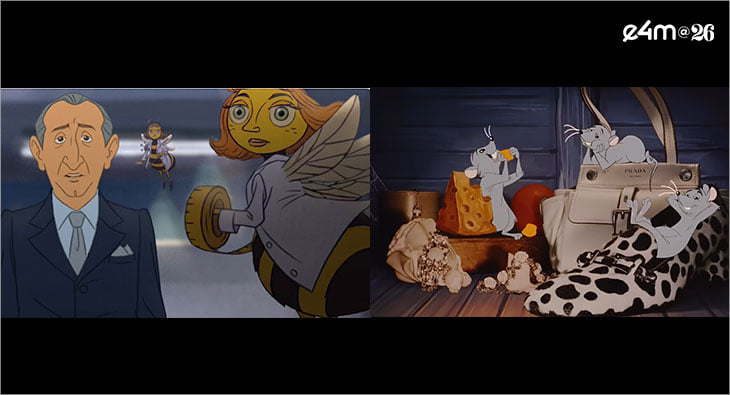

- Prada and Dior both released hand-drawn animated holiday films this season, with Prada's "Drawing Prada: Animated by Hand" receiving acclaim for its authenticity and behind-the-scenes transparency, while Dior's "Christian Dior's Night in Color" faced scrutiny over potential use of AI technology.
- Prada's film featured a cast including actors from "Stranger Things" and was praised for its traditional animation techniques, with the brand providing evidence of the hand-drawn process, which resonated positively with audiences.
- In contrast, Dior's film, set in 1949 Paris, was criticized for animation inconsistencies that led viewers to suspect the involvement of generative AI, despite the creators asserting that the film was primarily hand-drawn, with only a small portion using automated interpolation.
- The controversy highlights a broader industry concern regarding authenticity in luxury branding, as consumers increasingly demand transparency about the creative processes behind products marketed as handcrafted.
Luxury's Christmas ad season was meant to be a tale of two storybooks. Prada and Dior both reached for pencils instead of prompts this year, releasing hand-drawn animated holiday films within days of each other at a time when AI-generated creative is everywhere.
One got a standing ovation. The other got a magnifying glass, and soon a full-blown row over whether a campaign sold as handcrafted was quite as handcrafted as advertised.
Prada draws first and draws applause
Prada moved first with ‘Drawing Prada: Animated by Hand’, a holiday film that marries live action with traditional 2D animation. The cast has ‘Stranger Things’ actors Sadie Sink and Maya Hawke alongside Chen Haoyu, Luther Ford and Kelvin Harrison Jr. The drawing was led by John Pomeroy, a veteran animator whose credits include ‘Pocahontas’, ‘The Land Before Time’ and ‘Fantasia 2000’. British photographer Glen Luchford handled the imagery that stitches the actors into the illustrated world. Mice make off with Sink's shoes, a fox tags along with Hawke through a snowy forest and a snow lynx eyes Chen's handbag.
What worked for Prada wasn't just the storybook charm, but the paper trail. The brand released behind-the-scenes footage showing sketches, test drawings and animators at work, handing audiences the proof of process that a craft-led pitch demands. Pomeroy brought together traditional animators scattered across different studios and has spoken about passing the pencil-and-paper approach to the next generation. In agency parlance, Prada made the making-of part of the creative itself, and the internet rewarded it. Ferdinando Verderi, the campaign's creative director, has also resisted pitching the work as an anti-AI statement, describing it instead as a traditional technique reframed for a new world.
Dior's night in colour becomes a finger-counting exercise
Dior followed days later with ‘Christian Dior's Night in Color’, a six-minute short directed by acclaimed French animator Sylvain Chomet of ‘The Triplets of Belleville’ fame and produced by Aton Soumache. Set in 1949 Paris, it imagines Marlene Dietrich phoning Christian Dior in the middle of the night because she needs a colourful dress for her first colour film, with the atelier's seamstresses reimagined as bees. Robert Pattinson narrates, Rihanna voices Dior's lucky star and the ensemble includes Camille Cottin, Josh O'Connor, Louis Garrel and LaKeith Stanfield, all under the creative direction of Jonathan Anderson.
The goodwill did not last long. Viewers began circulating screenshots of warped lettering, inconsistent faces, choppy movement and a hand that seemed to carry five and a half fingers, all of which social media promptly filed under tell-tale AI errors. The sting lay in the optics. Here was a house whose reputation rests on atelier craft, promoting a film that it had positioned as hand-illustrated, and audiences wanted to know if generative tech had slipped in without disclosure. Dior had not publicly confirmed any such use when the controversy broke, which makes the allegations, strictly speaking, still allegations.
The defence and the interpolation question
Chomet and Soumache were quick to reject the generative AI charge. Soumache told Variety that the film took seven months and was drawn entirely by artists, and reports peg the team at 20 animators. The duo did concede that an automated interpolation system, which generates the in-between frames that smooth out motion, was used for a very small part of the process. Chomet has maintained that his creative process is unchanged and that only the technology around it has moved on.
That admission is the crux of the row. Interpolation is not generative AI as most people understand it, yet it is also not a pencil-drawn frame, and in a campaign whose whole pitch is the human hand, that nuance is a tough one to land with a sceptical audience. Doubters have questioned whether 20 animators could deliver six minutes in seven months, while defenders note that classic animation sometimes carries extra digits deliberately to suggest movement. Some online users have also claimed Dior hurried to ride Prada's coattails, a theory that remains unproven. Both camps are, in effect, staring at the same frames and seeing different things.
Why luxury cannot afford a wobbly frame
Part of the reason the Dior film drew such scrutiny is simple arithmetic. Much of the animation industry has moved from hand-drawn 2D to 3D because it is faster and cheaper, and smooth hand-drawn motion is notoriously slow to produce. A glossy short on a festive deadline therefore invites suspicion by default. Industry observers have also noted that consumers no longer take luxury's promises at face value, and that whether or not AI tools were used, brands selling craft are now expected to prove it.
Angelo Ruggeri, a journalist and tutor at Istituto Marangoni, the Milan-based fashion and design school, has argued that labelling either film anti-AI is too simplistic. He points out that Prada has itself said AI was used in post-production for its Spring/Summer 2026 campaign, though not for this one. His larger point is that the debate has moved beyond whether fashion loves or hates AI towards where the tools enter an image, which decisions stay with the artist and how openly the process is disclosed. Trade chatter has already framed the Dior fallout as a question of craftwashing, where handmade is claimed more loudly than it is proven.
A festive pattern bigger than two houses
The row also sits within a wider festive pattern. Levi's rolled out ‘Let's Get Fuzzy’, a one-minute stop-motion film made with London studio Blinkink that the brand says took around 2,000 hours. Hermès has long worked with illustrators and animators, while Chanel recently put out an animated film for its Gabrielle bag. Fashion's AI-led efforts, meanwhile, have not helped the machine's case, with Gucci in February and Valentino last December releasing AI-generated imagery that was widely panned as cheap and low effort.
Add the maths of hand-drawn animation, where a sequence can need 24 drawings a second or 12 for simpler action and where ‘Bambi’ took from 1936 to 1942 to reach screens, and the appeal of the human hand as a luxury signal becomes obvious. Expensive takes time, and time is the one thing AI promises to take out.
For Indian creative agencies juggling festive tentpoles and tight turnarounds, the lesson travels well. Audiences are not necessarily against AI as a production tool; they are against a story that does not add up. A craft-led pitch is a promise, and promises need receipts. Prada showed its sketches and walked away with applause. Dior is still explaining its in-betweens.
Read more news about Internet Advertising India, Marketing News, PR and Corporate Communication News, Digital Media News, Television Media News
For more updates, be socially connected with us onInstagram, LinkedIn, Twitter, Facebook YouTube & Google News